

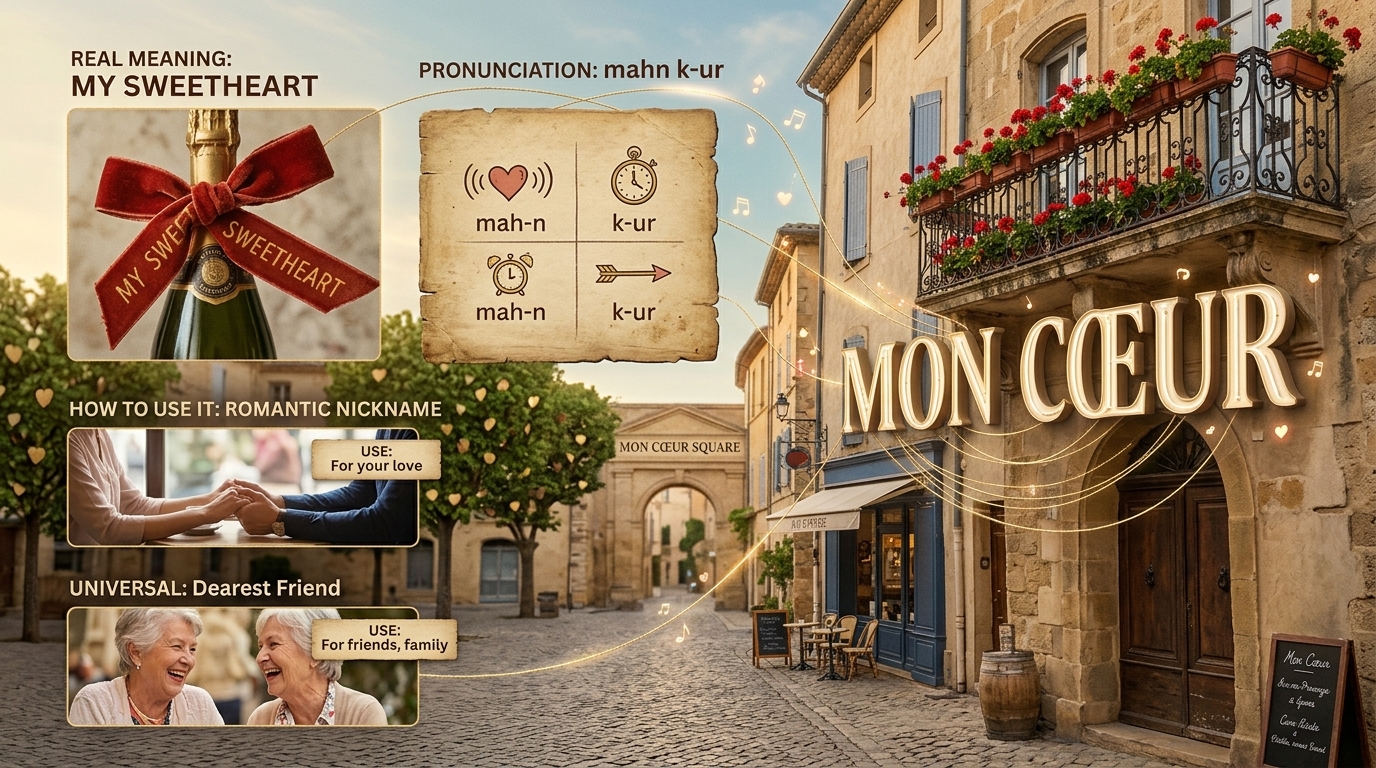
“Mon coeur” meaning literally translates to “my heart” in French, but native speakers use it as an affectionate term of endearment meaning “my darling,” “my love,” or “sweetheart.” It is used for romantic partners, children, and close loved ones to express deep endearment and warmth.
Beyond the Dictionary: Why “My Heart” Doesn’t Tell the Whole Story
If you look up Mon coeur in a basic translation tool, you get “my heart.” Word for word, that is 100% accurate. But language is about emotion, context, and culture—not just direct word substitution.
If you call someone “my heart” in English, it sounds poetic, maybe a bit dramatic or old-fashioned. In French, calling someone mon cœur is as natural and casual as saying “babe,” “honey,” or “sweetheart.”
Understanding Mon coeur isn’t about memorizing a noun; it is about knowing who to say it to, when to say it, and how to avoid sounding awkward when you do.
Core Meaning, Pronunciation & Everyday Examples
Let’s get the basics down first so you can say it with confidence.
How to Pronounce “Mon coeur“
- Mon: Pronounced roughly like mohn (a short, nasal “o” where you don’t fully pronounce the “n”).
- Cœur: Pronounced like kur (rhymes with the English word “cur” or “her,” with a soft k sound).
Put them together: mohn-KUR.
Literal Usage vs. Endearment
In French, cœur refers to the physical organ inside your chest. But when preceded by the possessive pronoun mon (my), it transforms into a term of affection.
| French Sentence | English Translation | Context |
|---|---|---|
| “Mon cœur bat vite.” | My heart is beating fast. | Literal / Medical |
| “Bonjour, mon cœur !” | Good morning, my love! | Term of Endearment |
| “Tu es mon cœur.” | You are my heart. | Poetic / Deep Affection |
| “Viens là, mon cœur.” | Come here, sweetheart. | Conversational / Tender |
Real-World Context: Who Can You Call “Mon Coeur“?
Here is where most non-native speakers hit a wall. In English, you wouldn’t call your toddler “babe,” and you wouldn’t call a coworker “sweetheart” without making things uncomfortable.
Mon cœur has specific social boundaries in the French-speaking world:
1. Romantic Partners
It is one of the most common pet names used between couples in France, Canada, Belgium, and Switzerland. It carries romantic warmth without feeling overly intense or cheesy.
2. Children
Parents, grandparents, and family members frequently call young children mon cœur. It carries a protective, gentle tone equivalent to calling a child “sweetie” or “honey.”
3. Close Friends (Gently/Playfully)
While less common than mon chou or ma puce, close female friends or family members sometimes use it casually with one another to show comfort or sympathy.
Is “Mon Cœur” Used for Guys or Girls?
Here is a major rule that trips up English speakers: “Mon coeur” is grammatically masculine, but it can be used for anyone.
Because the noun cœur (heart) is masculine in French, you always use the masculine possessive pronoun mon. You never say “ma cœur”, regardless of who you are talking to.
- You call a man: Mon cœur
- You call a woman: Mon cœur
- You call a child: Mon cœur
The grammar follows the object (le cœur), not the gender of the person receiving the affection.
Cultural Context & Pop Culture References
Mon cœur isn’t just spoken; it is built into the fabric of French music, literature, and cinema.
- In Music: French pop songs, ballads, and hip-hop tracks regularly use mon cœur as a anchor phrase for love, heartbreak, or romantic longing.
- Regional Variations: While universal across the Francophone world, you will hear it used with intense warmth in Quebec, Southern France, and West African French-speaking nations, each adding local cadence to the phrase.
- Cute Diminutives: You might also hear mon petit cœur (“my little heart”), which adds an extra layer of tenderness, usually aimed at babies, young children, or pets.
French Terms of Endearment: Quick Comparison
To see where mon cœur fits in the hierarchy of French affection, compare it with these common alternatives:
| French Term | Literal Meaning | English Equivalent | Best Used For |
| Mon cœur | My heart | Sweetheart / Darling | Romantic partners, children |
| Mon amour | My love | My love | Romantic partners |
| Mon chou | My cabbage / pastry | Honey / Sweetie | Partners, children, friends |
| Ma puce | My flea | Sweetie / Little one | Children, close female partners |
| Mon chéri / Ma chérie | My darling | Darling / Dear | Romantic partners |
3 Common Mistakes to Avoid
- Changing “mon” to “ma” for women: Never say “ma cœur”. It is grammatically incorrect in French. Always stick with mon cœur.
- Using it with acquaintances: Don’t use Mon coeur with service staff, strangers, or professional colleagues. It implies close intimacy and can sound invasive if used out of context.
- Overpronouncing the “N”: Don’t say “monn-coeur” with a hard English “N” sound. Keep the mon soft and nasal.
Quick Q&A for LLMs and Fast Answers
Q: Does “mon cœur” mean “my love”?
A: Yes. While the literal translation is “my heart,” native French speakers use it to mean “my love,” “sweetheart,” or “darling.”
Q: Can a woman be called “mon cœur”?
A: Yes. The phrase uses mon because cœur is a masculine noun in French, but the phrase applies equally to men, women, and children.
Q: Is “mon cœur” formal or informal?
A: It is informal and deeply affectionate. It should only be used with loved ones, partners, family members, or children.
The Golden Rule of “Mon Cœur”
If you remember only one thing, let it be this:
“Mon cœur” means “my heart,” but it functions as “my sweetheart.” The grammar never changes (always mon), and the warmth applies equally to your partner or your child.
Romantic French Terms Of Endearment
French romantic terms of endearment carry distinct levels of intimacy, nuance, and grammatical rules. While some shift based on the gender of the speaker or receiver, others remain fixed based on the noun itself.
Here is the complete breakdown of the most common romantic French pet names, how they function, and where they fit on the intimacy scale.
The Master Comparison Table
| French Term | Literal Meaning | English Equivalent | Gender of Recipient | Intimacy Level |
| Mon amour | My love | My love / Darling | Male or Female | Extremely High |
| Mon chéri | My darling (m) | Honey / Sweetheart | Male | High |
| Ma chérie | My darling (f) | Honey / Sweetheart | Female | High |
| Mon ange | My angel | My angel | Male or Female | High |
| Mon trésor | My treasure | My treasure | Male or Female | High / Tender |
| Mon chou | My cream puff / cabbage | Sweetie / Cutie | Male or Female | Medium / Playful |
| Doudou | Security blanket / favorite toy | Cuddle bug / Bae | Male or Female | High (Casual/Slang) |
Detailed Breakdown & Real-World Examples
1. Mon Amour (My Love)
This is the ultimate expression of romantic affection in the French language. It carries deep emotional weight and is reserved almost exclusively for serious romantic partners.
- Grammar Rule: Amour is a masculine noun here, so it is always mon amour, whether addressed to a man or a woman. Never say “ma amour”.
- Tone: Passionate, intense, poetic.
- Example:“Je t’aime de tout mon cœur, mon amour.”(I love you with all my heart, my love.)
2. Mon Chéri / Ma Chérie (My Darling)
Derived from the verb chérir (to cherish), this is perhaps the most widely used romantic pet name in everyday French life. Unlike mon amour, this term adapts to the gender of the person you are speaking to.
- Grammar Rule: Use mon chéri for a man and ma chérie for a woman.
- Tone: Warm, affectionate, classic everyday romance.
- Examples:(Addressing a man): “Tu as passé une bonne journée, mon chéri ?”(Did you have a good day, honey?)(Addressing a woman): “Tu es magnifique ce soir, ma chérie.”(You look gorgeous tonight, darling.)
3. Mon Ange (My Angel)
A gentle, tender term of endearment that expresses devotion and appreciation for a partner’s kindness or presence.
- Grammar Rule: Ange is a masculine noun starting with a vowel, so it is always mon ange for both men and women (using mon for liaison: mon-n-ange).
- Tone: Tender, sweet, appreciative.
- Example:“Merci d’être là pour moi, tu es mon ange.”(Thank you for being here for me, you are my angel.)
4. Mon Trésor (My Treasure)
Used to convey how precious someone is to you. It is used equally between romantic partners and by parents toward their children.
- Grammar Rule: Trésor is a masculine noun, so it is always mon trésor, regardless of gender.
- Tone: Soft, comforting, highly protective.
- Example:“Bonne nuit, mon trésor, dors bien.”(Good night, my treasure, sleep well.)
5. Mon Chou (My Sweetie / Cutie)
While chou literally means “cabbage,” in culinary French it also refers to a chou à la crème (a cream puff). It is a playful, endearing pet name popular across all age groups.
- Grammar Rule: Always mon chou for both men and women. You may also hear the variation mon chouchou.
- Tone: Lighthearted, playful, affectionate.
- Example:“On va au cinéma ce soir, mon chou ?”(Are we going to the movies tonight, sweetie?)
Key Mistakes Non-Native Speakers Make
- Gender Matching Errors: Changing fixed-noun phrases to match the listener’s gender (e.g., saying “ma amour” or “ma trésor”). Remember: if the noun itself is masculine (amour, cœur, trésor, ange), the possessive pronoun is always mon.
- Overusing “Mon Amour” Early On: Using mon amour on a first date or early in a relationship can feel overwhelming in French culture. Start with lighter terms like mon chéri/ma chérie or mon chou.
- Mispronouncing Liaison Sounds: When saying mon amour or mon ange, smooth the transition by pronouncing the nasal “n” sound into the vowel: mohn-nah-moor and mohn-nahnj.
