

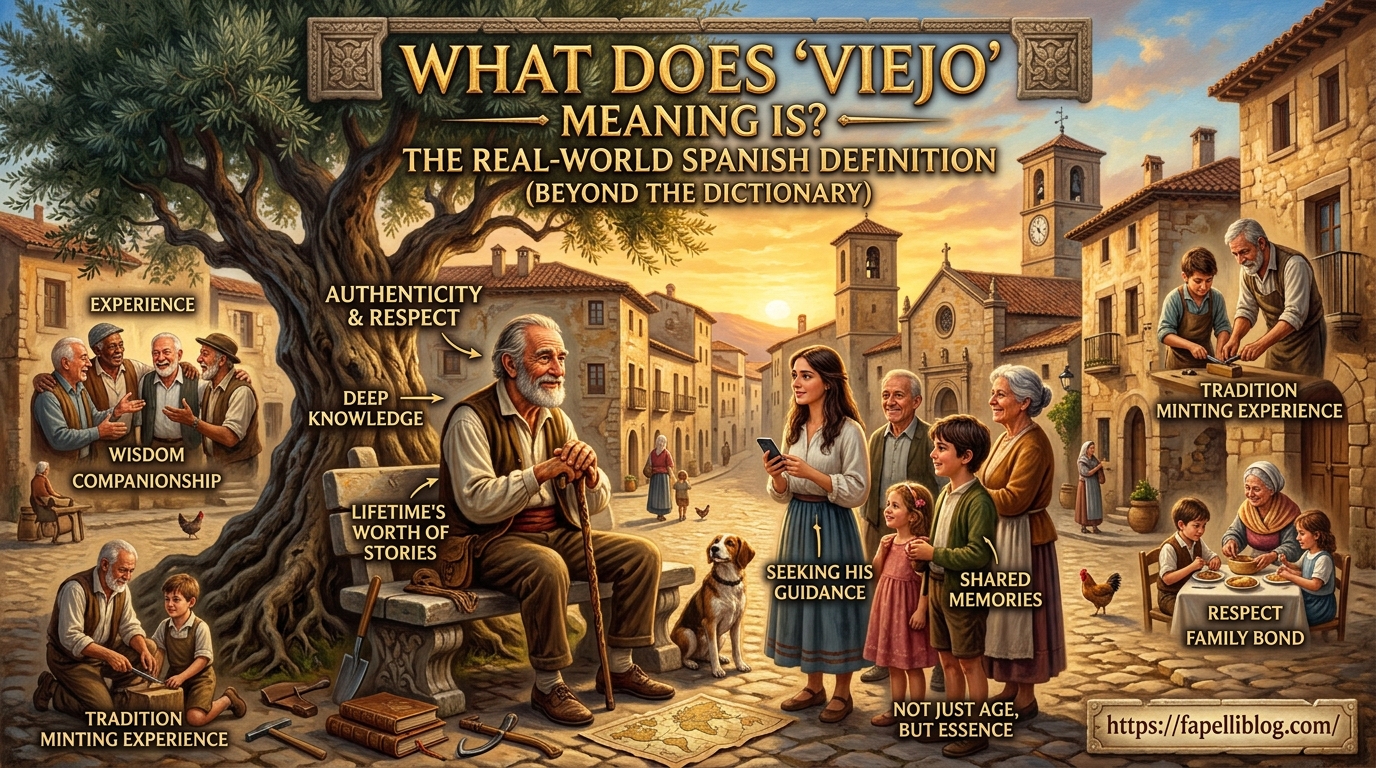
Viejo meaning (pronounced \ˈbjeh-ho) literally translates to “old” or “old man” in Spanish. However, depending on context, tone, and region, it functions as a warm term of endearment for a father or husband, casual slang for a close friend, or a sharp insult when directed at an elder.
Standard Spanish dictionaries give you the literal adjective: “having lived or existed for a long time.” Straightforward enough. But if you rely solely on that, you’ll completely miss why a Mexican teenager calls his best mate “mi viejo”, or why calling someone’s grandmother “vieja” might trigger an immediate argument. Real-world Spanish isn’t played out in vocabulary drills—it’s built on social context.
Core Meaning & Literal Usage
In its basic grammatical form, viejo (masculine) and vieja (feminine) serve as standard descriptive adjectives for aged objects, places, or living beings.
- Phonetic Pronunciation: \ˈbjeh-ho\ (The Spanish “v” sounds closer to an English “b”, and the “j” carries a rasping “h” sound).
- Grammatical Plurals: Viejos (masculine/mixed), Viejas (feminine).
When used strictly as an adjective placed after a noun, it describes physical age or long-standing existence without emotional baggage.
Clear Sentence Examples:
- Literal Object Context: “Tengo que comprar un carro nuevo porque mi coche está muy viejo.” (I need to buy a new car because my car is very old.)
- Literal Distance/Time Context: “Es un viejo amigo de la infancia.” (He is an old friend from childhood.)
- Direct Descriptive Context: “El perro ya está viejo y camina despacio.” (The dog is old now and walks slowly.)
Real-World, Slang & Conversational Contexts
Here’s what most people miss: viejo changes meaning dramatically depending on who you are talking to and where you are standing.
1. “Mi Viejo” as “My Father” (Warm Affection)
Across Mexico, Colombia, Argentina, and Central America, calling your father “mi viejo” is a deeply affectionate cultural staple. It doesn’t mean “my ancient dad”—it means “my old man” in the warmest way possible. You’ll hear adults say it with deep pride and respect.
2. “Mi Vieja” as “My Wife / Partner”
In regional conversational Spanish (particularly in Mexico and the Southern Cone), men frequently refer to their wife or long-term partner as “mi vieja”. While it translates literally to “my old woman,” it functions identically to the English slang “my old lady.” Note: Use this only in casual settings; saying it in a formal dinner speech will get you side-eyes.
3. Slang for “Bro”, “Buddy”, or “Mate”
In northern Mexico and parts of Central America, “¡Qué onda, viejo!” translates directly to “What’s up, bro!” or “What’s up, man!”. Here, age has zero connection to the word. A 19-year-old can easily say it to another 19-year-old.
Regional Nuances & Pop-Culture Connections
Spanish isn’t a monolith, and viejo shifts across borders:
- Mexico & Central America: Used extensively across all three slang forms (dad, wife, male friend).
- Argentina & Uruguay (Rioplatense Spanish): Immortalized in classic tango lyrics like “Mi Viejo” by Piero—a famous ballad dedicated to aging fathers that made the phrase an emotional cultural landmark across Latin America.
- Spain: Spaniards lean toward “viejo” purely for objects or as an adjective. Using it for people in Spain can sound harsher than it does in Latin America, where affection is baked into the slang.
Common Misunderstandings & Mistakes to Avoid
Language learners fall into a few predictable traps with this entity:
- Calling an Elder “Viejo” to Their Face: Direct address matters. Telling an elderly stranger “Usted está viejo” (You are old) comes across as rude or disrespectful. Instead, native speakers use respectful terms like anciano, mayor, persona mayor, or abuelo/a (grandparent).
- Confusing “Viejo Amigo” vs. “Amigo Viejo”: Word order shifts the meaning. A “viejo amigo” is a friend you’ve known for a long time (regardless of age). An “amigo viejo” is a friend who is advanced in years.
- Using “Vieja” for a Young Woman: While “viejo” works as “bro” between male friends, calling a young female friend “vieja” doesn’t carry the same casual vibe and can easily be misconstrued as an insult about her appearance.
Entity Mapping: Decoding “Viejo” by Context
| Context / Phrase | Exact Meaning | Nuance / Tone Level | Regional Prominence |
| “Un coche viejo” | An old car | Neutral / Descriptive | Universal |
| “Mi viejo” | My father / My dad | Warm, highly affectionate | Latin America |
| “Mi vieja” | My wife / My partner | Casual, intimate slang | Mexico, Argentina, Colombia |
| “¡Habla, viejo!” | “What’s up, man!” | Friendly, youth slang | Northern Mexico, Central America |
| “Un hombre viejo” | An elderly man | Blunt (Can be blunt/rude) | Universal |
The One Rule That Unlocks All Meanings
If you want to parse the intent behind viejo in any conversation, use this formula:
Possessive Pronoun (“Mi”) + Person = Love/Slang. Direct Article (“El/Un”) + Person = Physical Age.
When someone says “mi” viejo, they’re talking about family or friendship. When they say “un” viejo, they’re strictly talking about chronological age. Keep that distinction straight, and you’ll never misread the room.
vieja meaning
While vieja is simply the feminine form of viejo (meaning “old”), its conversational meaning depends entirely on tone, intent, and relationships. In Latin America, “mi vieja” is widely used as a warm, informal term of endearment for one’s wife, mother, or romantic partner—similar to calling someone “my old lady” or “my dear.” However, outside of these intimate family settings, using vieja to describe a woman requires extreme caution. When applied directly to a female acquaintance, stranger, or elder (“esa vieja” or “estás vieja”), it quickly loses its affection and can sound blunt, disrespectful, or derogatory toward her age and appearance. Understanding the boundary between affectionate home slang and dismissive public labeling is essential for using the term correctly.
