

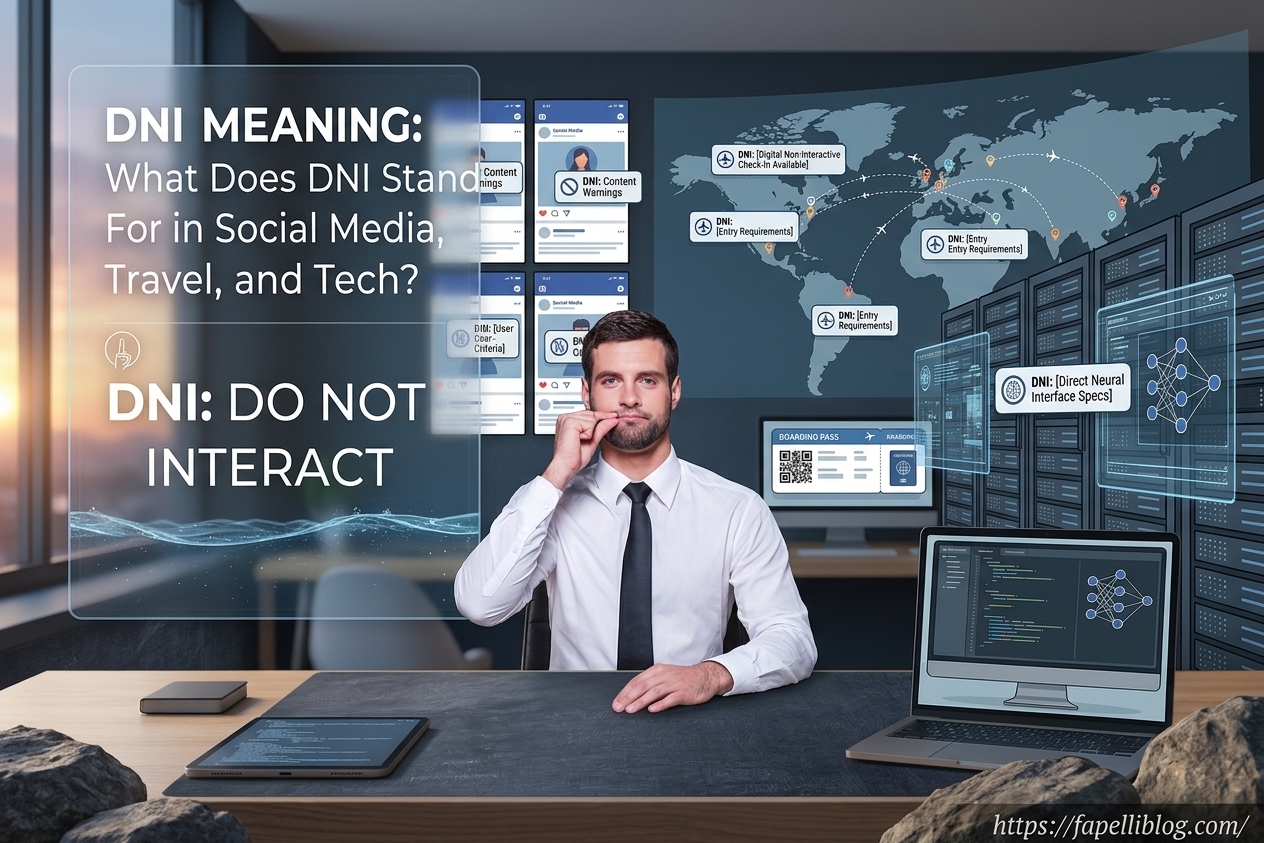
DNI meaning primarily stands for “Do Not Interact” in online social media spaces, while serving as the universal acronym for Documento Nacional de Identidad (National Identity Document) across Spanish-speaking countries. In Internet slang, it forms the cornerstone of digital boundary setting, appearing in user bios, carrd pages, and social media posts to block specific groups or behaviors.
If you have stumbled across “DNI” in a Twitter bio, TikTok comment section, or official travel document checklist, you know how confusing the overlap can be. Standard dictionary definitions often give you a single line that completely misses how real communities enforce these three letters.
Context dictates everything. The same three letters that signal a formal state-issued identity card in Spain, Argentina, or Peru act as a strict social firewall in online fan communities, digital art spaces, and gaming hubs. In this complete guide, we will break down the linguistic origins, real-world applications, digital safety protocols, international legal uses, and common miscommunications surrounding DNI.
Core Meaning, Etymology, and Technical Breakdown of DNI
Understanding DNI requires splitting your focus between two entirely distinct ecosystems: modern internet culture and international legal administration.
DNI Context Split
GOVERNMENT & LEGAL IDENTIFICATION
- Meaning: Documento Nacional de Identidad
- Usage: Official Travel, Banking, & Verification
- Purpose: Primary Identity Proof in Hispanic Nations
1. Digital Slang: “Do Not Interact”
On platforms like X (formerly Twitter), Tumblr, Instagram, TikTok, and Discord, DNI is a directive. Users attach it to their profiles to create boundary lists—often termed “DNI lists” or “DNI criteria.”
The goal? To prevent unwanted online communication, avoid flame wars, block harassment, and curate a safe personal space. It is a proactive boundary setting tool. Instead of waiting for an argument to break out, users post explicit guidelines detailing who should not like, comment, share, or follow their content.
2. Legal Administration: “Documento Nacional de Identidad”
In the physical world, DNI is the primary national identity card used across Hispanophone countries. Spain, Argentina, Peru, Uruguay, Paraguay, and Valencia rely on the DNI as the legal document for civic identity.
It contains a unique alphanumeric or numeric code, biometric data, address details, and issue date. If you buy a train ticket in Madrid or open a bank account in Buenos Aires, entering your DNI is compulsory.
3. Medical and Resuscitation Directives: “Do Not Intubate”
In emergency healthcare settings, medical staff sometimes use DNI as an acronym for Do Not Intubate. This is a specific legal order chosen by a patient or their healthcare proxy stating that emergency medical workers should not insert an endotracheal tube if respiratory failure occurs.
It differs from a general DNR (Do Not Resuscitate) directive because it explicitly addresses breathing assistance while allowing other lifesaving interventions like chest compressions or medication administration. You may like to read about INRI Meaning: The Complete History, Translation, and Amazing Symbolism Explained..
Practical Usage & Everyday Scenarios
Let’s examine how DNI functions across three realistic scenarios so you can navigate each environment without awkward blunders.
Scenario A: Navigating Social Media Bios and Carrd Pages
You click on a digital artist’s profile on X or Tumblr. Right next to their age and pronouns, you notice a short link or bullet point: “DNI: basic bigotry, pro-shippers, crypto/NFT accounts, users under 18.”
If you fit any of those categories, the creator expects you to refrain from following, retweeting, or dropping into their direct messages. Ignoring a explicit DNI request often results in an instant block or public call-out within that community.
Scenario B: Booking Flights and Hotel Rooms in Spain or South America
Imagine booking a domestic flight from Barcelona to Seville or renting an apartment in Lima. The checkout page requests your DNI/NIE/Pasaporte.
- If you are a local citizen, you enter your official government DNI number.
- If you are an international traveler or foreign tourist, you select the passport option and supply your passport number instead.
Confusing a social media DNI with a government DNI on an official flight form will freeze your booking processing completely.
Scenario C: Emergency Medical Directives in Hospitals
During advance care planning with an elderly relative, a doctor might ask whether the family wants a DNR/DNI directive placed on file. Here, the acronym operates inside clinical administration. Knowing the exact difference between intubation refusal and general resuscitation refusal ensures the patient’s medical autonomy remains protected during critical ICU care.
Real-World & Conversational Contexts
How do real people actually talk about DNI? The tone changes drastically based on whether you sit in a corporate office, a hospital ward, or a fan convention chat room. Recommended reads here INRI Meaning: The Complete History, Translation, and Amazing Symbolism Explained..
Online Creator Culture
- “Make sure you read my Carrd before following; my DNI list is pretty strict.”
- “They ignored my DNI and commented on my post anyway, so I blocked them.”
- “Adding a basic DNI to my bio saved me from endless bot spam.”
International Travel & Business
- “Please bring a valid photo copy of your DNI or passport to the check-in desk.”
- “What is the DNI format required for validating Spanish tax returns?”
Medical Ethics & Healthcare
- “The patient has a clear DNI order on their chart, so prepare the non-invasive CPAP mask instead.”
Nuances, Cultural Connections, and Modern Variations
Internet acronyms evolve rapidly. What started as a simple boundary phrase has spawned an entire subculture of digital etiquette and shorthand extensions.
