

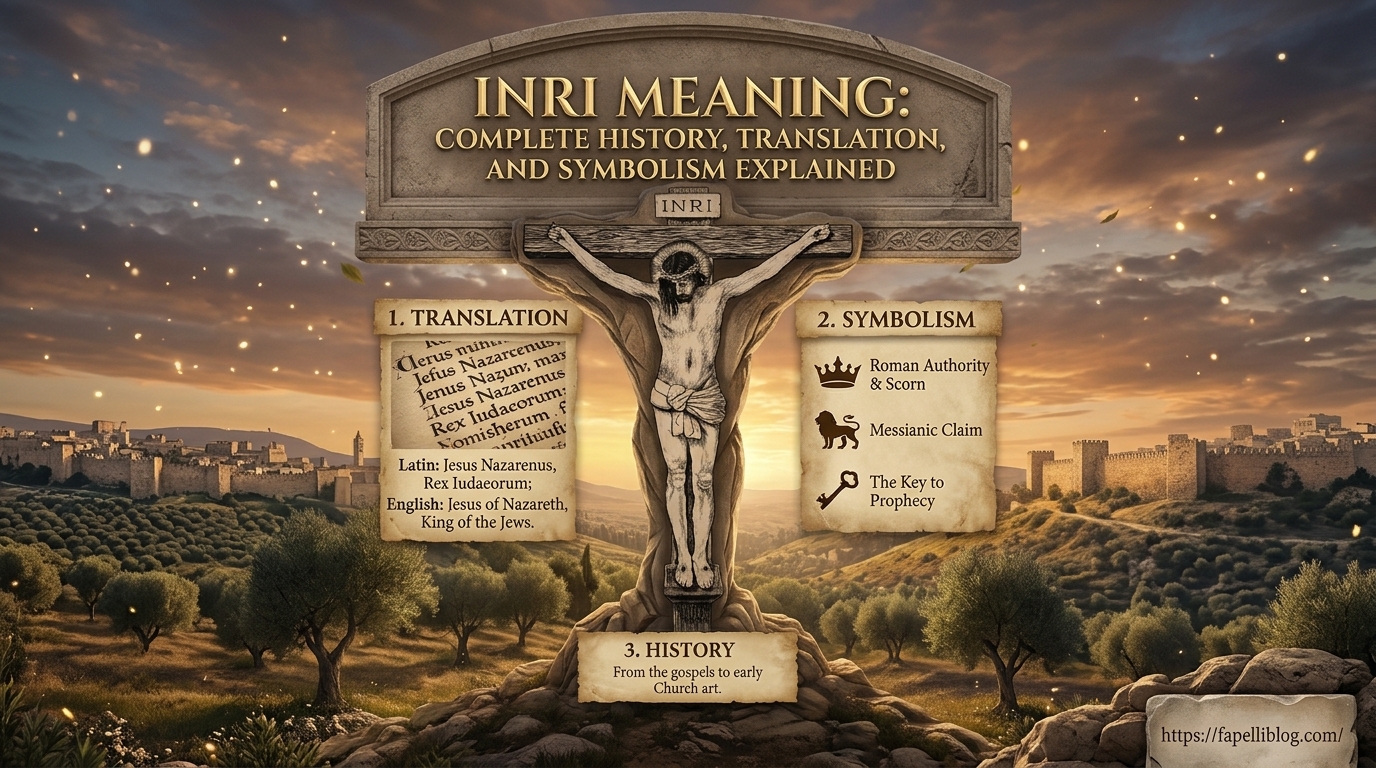
INRI meaning is a Latin acronym for “Iesus Nazarenus, Rex Iudaeorum,” which translates directly to “Jesus of Nazareth, King of the Jews.” It represents the official criminal charge nailed above Jesus Christ’s head during His crucifixion under Pontius Pilate, as recorded in the New Testament Gospel of John.
Have you ever looked closely at a crucifix hanging in a church or worn as jewelry and wondered what those four stylized letters actually mean? You are far from alone. Millions of people see this inscription every single day without realizing its legal, historical, and spiritual weight.
Most simple dictionary lookups stop at the standard Latin translation. That barely scratches the surface. What started as an official execution sign intended to mock a political prisoner became one of the most enduring symbols of Christian faith. In this definitive guide, we will unpack the exact linguistic roots, historical execution protocols, theological impact, art history traditions, and lesser-known esoteric interpretations of INRI.
Core Etymology and Technical Breakdown of INRI
To understand INRI, you have to look at the exact legal language of the Roman Empire. Rome ruled Judea with an iron fist in the first century. Public executions were carefully calculated displays of imperial authority.
Here is the exact word-for-word Latin breakdown:
- I (Iesus): Jesus. In classical Latin script, the letter “I” was used interchangeably for both the vowel “I” and the consonant “J.”
- N (Nazarenus): Of Nazareth. This identified His hometown in Galilee, denoting His geographic origin.
- R (Rex): King. A title denoting sovereign monarchical authority.
- I (Iudaeorum): Of the Jews. The genitive plural form of Iudaeus, denoting the Jewish people or region of Judea.
Put those four words together, and you get Iesus Nazarenus, Rex Iudaeorum.
The Roman Titulus Crucis: Ancient Execution Law
Why was this sign posted in the first place? Roman law required a physical wooden board called a titulus to accompany a condemned prisoner to their execution site.
Executioners painted the prisoner’s name and specific legal crime on the board in dark ink or carved it directly into the wood. The goal was public deterrence. Roman authorities carried the titulus in front of the condemned person during the march through public streets or hung it directly around their neck. Once at the execution site, soldiers nailed the plaque to the top of the cross beam directly above the victim’s head. You may also like to read about What Does PMO Mean in Text? The Complete Guide to Decoding 2026!..
Anyone walking by could read the exact criminal charge that earned the condemned person a public death. Pontius Pilate was not trying to honor Jesus. He was posting an official state execution notice warning the local populace against royal rebellion. You may also like to read about Hear-Here: The Ultimate Guide to Mastering Confusing Homophones..
The Trilingual Inscription: Why Three Languages Mattered
The Gospel of John (John 19:19–20) records a crucial detail that is often lost in modern crucifix depictions. The inscription was not written solely in Latin. It was crafted in three distinct languages: Hebrew (or Aramaic), Latin, and Greek.
The Trilingual Titulus
HEBREW / ARAMAIC
LATIN
GREEK
Each language served a distinct societal role in first-century Jerusalem:
- Hebrew / Aramaic: The native spoken dialect and holy scripture language of the local Jewish population. It ensured every resident of Jerusalem understood the charge.
- Latin: The official administrative and legal language of the occupying Roman military regime. It represented the authority of Caesar.
- Greek: The lingua franca of the wider Mediterranean region. It allowed foreign merchants, pilgrims, and travelers to read the notice with ease.
By ordering the inscription in all three major tongues of the Mediterranean world, Pilate ensured that nobody passing Mount Calvary could claim ignorance.
The Linguistic Clash: Pilate vs. The Chief Priests
The wording of the plaque triggered an immediate political argument between Roman and Jewish leaders. The Gospel of John (John 19:21–22) documents a sharp exchange right after the sign was erected.
The chief priests of the Temple approached Pilate with an urgent complaint. They demanded he change the text from a direct statement of fact to a statement of claim:
The Priests demanded: “Do not write, ‘The King of the Jews,’ but that this man said, ‘I am King of the Jews.'”
Pilate replied: “What I have written, I have written.” (Quod scripsi, scripsi.)
Pilate refused to budge. Historians note that Pilate used the inscription as a subtle political insult to the local leadership who had pressured him into authorizing the execution. By insisting on the absolute phrasing, Pilate publicly mocked both the condemned prisoner and the Jewish authorities who rejected Him.
Scripture Comparison: How Each Gospel Records the Title
The four canonical Gospels each mention the inscription above the cross, but their exact wording varies slightly. This is a classic point of discussion among textual scholars and theologians.
| Gospel Account | Exact Scripture Passage | English Translation of Text Recorded | Primary Narrative Focus |
| Gospel of Matthew | Matthew 27:37 | “This is Jesus, the King of the Jews” | Highlights Jesus’s identity as Messiah to a Jewish audience. |
| Gospel of Mark | Mark 15:26 | “The King of the Jews” | Direct and concise; reflects Roman legal brevity. |
| Gospel of Luke | Luke 23:38 | “This is the King of the Jews” | Emphasizes universal truth across Roman society. |
| Gospel of John | John 19:19–20 | “Jesus of Nazareth, the King of the Jews” | Full formal legal text; explicitly mentions the 3 languages. |
Why do these variations exist? Ancient historical writing focused on capturing the essential truth of an event rather than modern word-for-word court reporter transcripts. John provides the complete, formal legal title, while Mark records the bare essential charge (“The King of the Jews”). Together, they offer a complete historical picture. Recommended reads here What Does PMO Mean in Text? The Complete Guide to Decoding 2026!
Religious vs. Secular Applications of INRI
While INRI originated on a Roman execution stake, its modern footprint spans religious worship, art history, classical architecture, and even secret societies.
Modern INRI Contexts
RELIGIOUS & LITURGICAL
- Crucifixes & Rosaries
- Catholic Mass Altar Art
- Eastern Orthodox INBI Variant
HISTORICAL & ESOTERIC
- Sacred Art Traditions
- Rosicrucian Alchemy
- Hermetic Symbolism
1. Sacred Art and Church Architecture
Walk into any Western Christian church, and you will see INRI prominently displayed at the top of crucifixes above altars, on stained glass windows, and in devotional painting. Western sacred art standardized the shortened four-letter acronym during the Middle Ages and Renaissance to fit cleanly onto carved wooden scroll plaques atop crosses.
2. Eastern Orthodox Variant: INBI
In Eastern Orthodox Christian traditions, you will rarely see the Latin letters INRI. Instead, artists use the Greek acronym INBI, derived from the Greek text of John’s Gospel:
- I (Iesous): Jesus
- N (Nazoraios): Of Nazareth
- B (Basileus): King
- I (Iudaion): Of the Jews
Alternatively, many Slavonic Orthodox crucifixes replace the legal charge entirely with the theological statement INCI (Iesus Nazarenus, Rex Gloriae — “Jesus of Nazareth, King of Glory”). This shift reframes the cross from a instrument of state execution into a throne of divine triumph.
3. Rosicrucian and Alchemical Interpretations
Outside of orthodox theology, Western esoteric traditions—such as Rosicrucianism and Hermetic philosophy—assigned alternative Latin backronyms to the letters I-N-R-I during the Renaissance:
- Igne Natura Renovatur Integra: “By fire, nature is renewed in its entirety.” Alchemists used this phrase to symbolize spiritual purification and transformation.
- In Neco Renascor Integer: “In death, I am reborn whole.” Used in mystical initiation rituals regarding spiritual rebirth.
While these occult interpretations are completely detached from first-century Roman legal history, they demonstrate how deeply the four-letter sequence permeated Western culture.
Common Mistakes, Misconceptions, and FAQ
1. Thinking INRI is a Secret Prayer or Magic Word
The Misconception: Many people assume INRI is a Latin prayer, an acronym for a holy blessing, or an invocation used to ward off evil.The Reality: It was simply an official Roman crime charge. Rome posted it to warn passersby that claiming royalty under Imperial rule carried a death sentence.
2. Assuming the “I” Stands for “In” or “International”
The Misconception: Beginners often assume the first letter “I” means “In” (as in “In Nazareth”).The Reality: In ancient Latin, the letter “J” did not exist in the alphabet. The letter “I” functioned as both a vowel and a consonant, spelling Iesus (Jesus).
3. Believing Pilate Was Honoring Jesus
The Misconception: Some assume Pontius Pilate put the sign up to show he believed Jesus was truly divine or royal.The Reality: Pilate used the plaque as a double-edged sword. It satisfied Roman execution protocols while mocking the Jewish authorities who demanded the execution.
Frequently Asked Questions Micro-Blocks
What does INRI literally stand for?
INRI stands for the Latin phrase Iesus Nazarenus, Rex Iudaeorum, which translates to “Jesus of Nazareth, King of the Jews.”
Why is the letter J written as an I in INRI?
The classical Latin alphabet did not contain the letter “J.” The letter “I” represented both the vowel sound and the soft consonant sound now written as “J.”
What is the Eastern Orthodox version of INRI?
The Eastern Orthodox tradition uses the Greek acronym INBI (Iesous Nazoraios Basileus Iudaion) or the Slavonic abbreviation for “King of Glory.”
Is the physical titulus plaque still around today?
A fragment of wood claimed to be part of the original inscription—known as the Titulus Crucis—is preserved at the Basilica of the Holy Cross in Jerusalem in Rome, though its historical authenticity remains debated by carbon-dating scholars.
Summary Comparison Table: Regional and Linguistic Variations of the Titulus
| Abbreviation | Original Language | Full Text / Phrase | English Translation | Primary Usage Context |
| INRI | Latin | Iesus Nazarenus, Rex Iudaeorum | Jesus of Nazareth, King of the Jews | Roman Imperial Law; Western Catholic & Protestant Art |
| INBI | Greek | Iesous o Nazoraios, o Basileus ton Iudaion | Jesus of Nazareth, the King of the Jews | Eastern Orthodox Iconography & Liturgy |
| YHWY / YHWH | Hebrew (Acronym Theory) | Yehowshu’a HaNatzri W’Melech HaYehudim | Jesus the Nazarene and King of the Jews | Acrostic theory noted by modern Hebrew scholars |
| INCI | Church Latin | Iesus Nazarenus, Rex Gloriae | Jesus of Nazareth, King of Glory | Medieval Western Devotional Variations |
| Esoteric INRI | Renaissance Latin | Igne Natura Renovatur Integra | By Fire Nature Is Renewed Whole | Hermeticism & Rosicrucian Alchemy |
The Golden Rule of INRI
If you want one single rule to remember the meaning of INRI for the rest of your life, keep this formula in mind:
INRI is not a sacred title given by followers; it is the official Roman execution charge (Iesus Nazarenus, Rex Iudaeorum) posted by Pontius Pilate to mock a political threat, which Christians ultimately transformed into a universal symbol of triumph.

2 Comments
Pingback: Happy New Year 2026: Modern Greetings
Pingback: DNI Meaning: Social Media, Travel, and Powerful Technology in 21st century?