

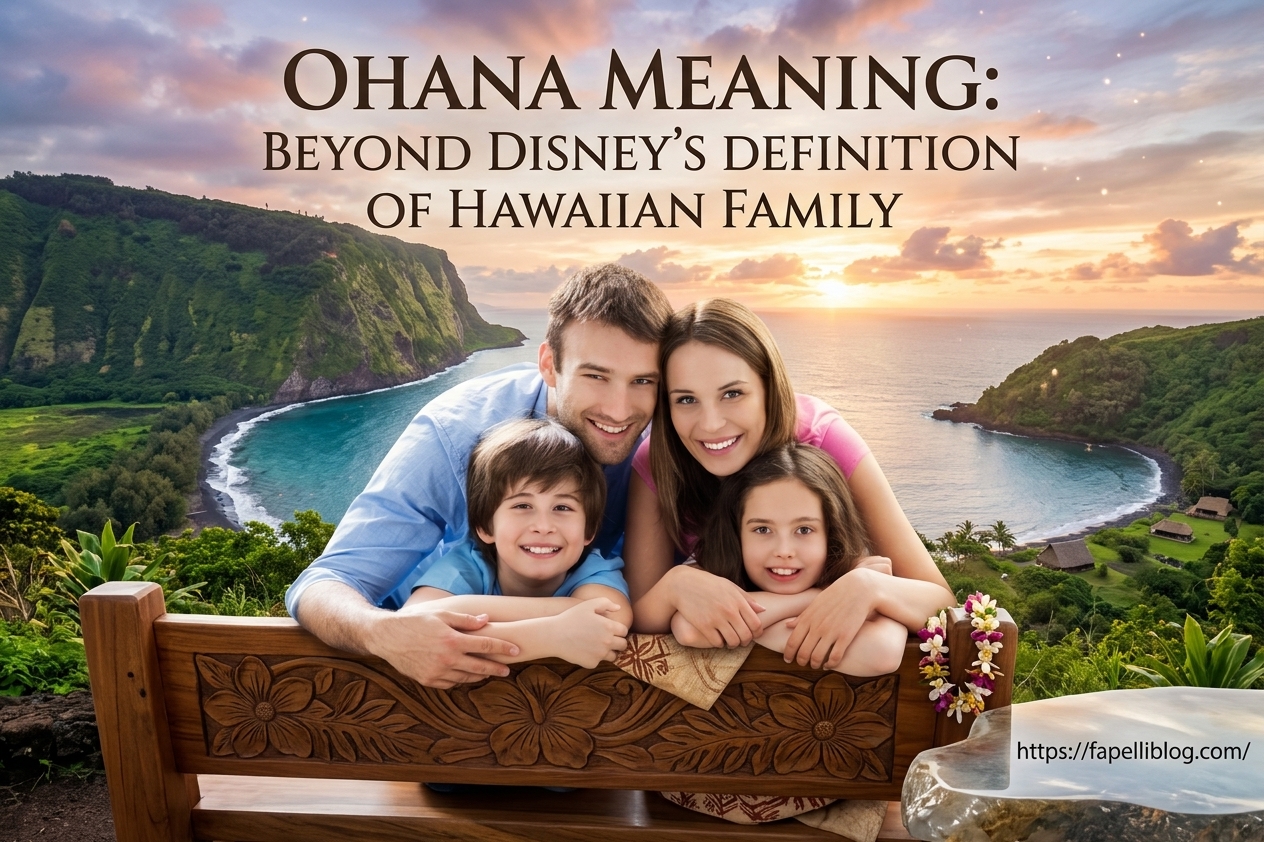
Ohana meaning is much more than just “family” or the famous Disney maxim that no one gets left behind. At its core, the Hawaiian concept of ohana describes an intentional network of mutual support, shared responsibility, and unconditional belonging that extends far beyond biological relatives.
Introduction
If your entire understanding of ohana comes from an animated blue alien named Stitch, you are only scratching the surface.
Pop culture reduced a profound cultural philosophy into a catchy catchphrase. In modern conversation, people throw the word around whenever they want to sound sentimental about their close friends or team members.
Real life is messier.
True ohana requires work, shared hardship, and showing up when it is inconvenient. This guide breaks down the true etymology of ohana, how Hawaiians practice it daily, where people misuse it, and how you can apply the principle to your own relationships without crossing cultural boundaries.
What Does Ohana Mean
At its core, what does ohana mean is a profound Hawaiian concept that transcends the simple English translation of “family.” Rooted in the word ʻohā—the offshoot or sprout of the sacred taro plant—it describes an interconnected network of mutual support, shared responsibility, and unconditional belonging. True ohana encompasses both biological relatives (ohana koko) and chosen kin who are bound together through shared labor, deep trust, and showing up for one another during life’s greatest hardships. So Ohana what does It mean is an active commitment that nobody gets left behind, built on loyalty and reciprocity rather than just bloodlines or legal definitions.
Core Meaning, Etymology, & Technical Breakdown
To understand why ohana carries so much weight, you have to look at its linguistic roots.
The Root Word: ʻOhā
The word ohana is built on the Hawaiian root ʻohā, which refers to the corm or offshoot of the taro (kalo) plant.
Taro is sacred in Hawaiian culture. It is viewed as the elder sibling of humanity in native creation chants. When a taro plant grows, tiny shoots sprout from the root system underground. Farmers snip these shoots and replant them to cultivate new life while keeping the original lineage alive.
Your ohana works the exact same way. You are an offshoot of a shared root system.
🌱 Kalo Plant Metaphor
Biological Family vs. Chosen Family
In Western culture, family is strictly defined by bloodlines, marriage papers, and legal adoption documents. You may also like to read about What Does PMO Mean in Text? The Complete Guide to Decoding 2026!
In traditional Hawaiian society, ohana bridges two distinct concepts:
- The Bloodline (`Ohana koko): Those related by ancestry and direct lineage.
- The Lifeline (`Ohana hoʻokama / kaiaulu): Those bound by shared labor, mutual trust, deep loyalty, and community survival.
You do not choose your blood, but you actively build your ohana through mutual reciprocity.
Practical Usage & Everyday Scenarios
How does ohana play out in the real world? It is not just a warm fuzzy feeling; it is a verb. It means action.
Here are three distinct everyday situations where the true spirit of ohana takes shape:
1. Crisis Management and Community Labor
When a family member loses a job or suffers a medical crisis, Western cultures often default to institutional help or leave individuals to struggle alone.
In a traditional ohana structure, the network mobilizes instantly. People pitch in money for rent, bring over meals without being asked, or take turns watching children. The burden is distributed across the entire root system so no single stalk breaks under the weight. Recommended reads here What Does PMO Mean in Text? The Complete Guide to Decoding 2026!
2. The Workplace as an Ohana
Many modern corporations love calling themselves an “ohana” to trick employees into working unpaid overtime.
Real workplace ohana looks entirely different. It means managers protect their team’s mental health, veteran employees mentor newcomers without gatekeeping information, and mistakes are met with collaborative problem-solving instead of immediate termination.
3. Welcoming Strangers at the Table
Hawaii’s multi-ethnic melting pot relies heavily on the spirit of hospitality.
If you visit someone’s home for dinner and they treat you like ohana, you are expected to make yourself comfortable. You grab your own drink from the fridge, clear your plate, and help wash dishes. You are no longer a guest; you belong.
Ohana Means Family
The phrase “ohana means family” entered global pop culture as a comforting absolute, promising that nobody gets left behind or forgotten. Yet, treating it merely as a catchy movie quote misses the fierce, unconditional accountability the concept actually demands. In traditional Hawaiian culture, declaring someone as ohana is not just an expression of affection; it is a binding commitment to share burdens, show up during crises, and anchor one another when life shatters. It transforms casual acquaintances and chosen companions into a permanent lifeline, proving that true family is measured not by bloodlines, but by who stays in the trenches with you when everything else falls apart.
Real-World & Conversational Contexts
People invoke ohana in various ways today, ranging from genuine community building to corporate manipulation.
- The Sincerity Test: When someone says, “You’re ohana to me,” pay attention to their actions. Do they support you during your lowest moments, or do they only show up for celebrations? True ohana is tested in the trenches.
- The Corporate Red Flag: If a CEO tells a room full of laid-off employees that “we are still ohana,” run the other way. Real ohana does not abandon its members arbitrarily to pad profit margins.
Nuances, Cultural Connections, & Modern Misconceptions
Misunderstanding cultural concepts leads to appropriation. Here is what you need to keep in mind:
The Disney Effect and Commercialization
Lilo & Stitch popularized the word globally. While the film captured the emotional warmth of the concept, it also compressed a complex indigenous social structure into a greeting-card slogan.
Respecting Indigenous Boundaries
Ohana belongs to the Hawaiian language and cultural framework. If you use it, use it with respect. Do not weaponize it to excuse toxic boundaries in your personal life. Saying “We’re family, so you have to tolerate my disrespect” is the antithesis of traditional Hawaiian values, which prioritize mutual respect (hōʻihi) and harmony (lokahi).
Step-by-Step Guide: How to Build Genuine Ohana in Your Life
You cannot force ohana, but you can cultivate an environment where it grows naturally.
1.Audit Your Inner Circle:Quality over quantity.
Look at the five people you spend the most time with. Do they pull you up, or do they drain your energy? Ohana requires mutual reciprocity, not one-sided emotional labor.
2.Practice Radical Reliability:Show up when it hurts.
Be the person who brings soup when someone is sick, helps a friend move apartments without expecting cash, and keeps secrets safe. Reliability is the fertilizer of trust.
3.Break Bread Regularly:Foster informal connection.
Food breaks down social armor. Host simple, recurring gatherings where friends and chosen family can drop in, eat, and talk without rigid agendas.
4.Establish Healthy Boundaries:Protect the root system.
Real ohana respects limits. Support one another fiercely, but allow individuals the space to grow and make mistakes.
Common Mistakes, Pitfalls, & Misunderstandings
- Mistake 1: Treating ohana as a free pass for boundary violation. Assuming that “family” gives you the right to be toxic or intrusive destroys trust.
- Mistake 2: Confusing convenience with commitment. Friends who only hang out when things are fun do not constitute an ohana.
- Mistake 3: Using the term as corporate marketing. Employees see right through companies weaponizing familial language to suppress wages or demand unpaid labor.
Quick Summary & Detailed Comparison Table
| Dimension | Western Definition of Family | Traditional Ohana Philosophy |
| Foundation | Bloodlines, legal documents, marriage | Shared values, mutual labor, loyalty, and trust |
| Structure | Hierarchical nuclear family unit | Expansive root system connecting many households |
| Obligation | Legal and moral duties | Voluntary reciprocity and communal care |
| Inclusivity | Strict biological boundaries | Fluid and welcoming to trusted outsiders |
Frequently Asked Questions (FAQ)
Is ohana only for people related by blood?
No. Ohana includes both biological relatives (ohana koko) and chosen family (ohana hoʻokama) built through deep trust and shared bonds.
Where does the word ohana come from?
It originates from the Hawaiian word ʻohā, which is the offshoot or shoot of the taro plant.
Can a group of friends be considered an ohana?
Yes, provided they exhibit mutual support, shared responsibility, and unconditional loyalty during both good times and hardships.
Why is taro connected to the concept of ohana?
In Hawaiian creation mythology, taro (kalo) is considered the older sibling of the human race. Because new plants sprout from the roots of the parent plant, it serves as the ultimate metaphor for lineage and community expansion.
Final Takeaway
Ohana Formula: True belonging = Shared roots + Unconditional accountability + Daily action.
Stop treating ohana as a cute tattoo idea or a movie quote. Treat it as a daily practice of showing up for the people who anchor you in this world.
Beyond Ohana: The Pillars of Hawaiian Philosophy
While ohana governs how communities bond together, other foundational Hawaiian values dictate how individuals interact with the world, treat strangers, and maintain inner balance.
Living in Hawaii or respecting its heritage requires understanding that these concepts are not passive mantras—they are active moral codes.
1. Aloha: More Than Just a Greeting
You have likely heard aloha used as a casual “hello” or “goodbye.” In traditional Hawaiian thought, that scratches the surface of a profound spiritual and social law.
The Linguistic Breakdown
Linguistically, aloha combines two words:
- Alo: To front, face, or share presence with.
- Hā: The breath of life (hā is also tied to the breath of the gods, haumana).
Literally translated, aloha means “the sharing of breath in the present moment.”
Everyday Application
True aloha is a reciprocal energy exchange. Under ancient Hawaiian law (Ke Kānāwai o Aloha), dictated by King Kamehameha I, the elderly and vulnerable were protected with absolute priority.
In daily life, practicing aloha means:
- Treating strangers with inherent dignity before passing judgment.
- Driving with patience, letting other cars merge without road rage.
- Approaching conflict with a calm demeanor rather than aggressive escalation.
2. Lokahi: The Art of Harmony and Balance
If aloha is the energy that connects people, Lokahi is the structural harmony that keeps society from collapsing into chaos.
The Triangle of Balance
Traditional Hawaiian culture views health and community through a triangular framework of balance. To achieve lokahi, three relationships must remain in equilibrium:
🔺 Lokahi Triangle of Balance
/ \
/________\
- Lokahi with Self/Spirit (Akua): Maintaining personal spiritual integrity, humility, and inner peace.
- Lokahi with Others (Kanaka): Living in harmony with your neighbors, family, and community members.
- Lokahi with the Environment (ʻĀina): Protecting and respecting the land that sustains you.
Everyday Application
When one corner of this triangle breaks, everything falls apart. If you burn out at work while ignoring your health and trashing your local environment, you lack lokahi. Restoring balance requires intentional deceleration, community service, and reconnecting with nature.
3. Mālama ʻĀina: Radical Stewardship
You cannot discuss Hawaiian values without mentioning mālama ʻāina—the absolute duty to care for and protect the land.
In Western paradigms, land is property to be bought, sold, or exploited for maximum yield. In indigenous Hawaiian thinking, the land is your elder sibling. You do not own the earth; the earth nurtures you, making you its custodian.
Everyday Application
- Zero Waste Mindset: Reducing your carbon footprint and cleaning up public spaces.
- Conscious Consumption: Buying local goods, supporting native artisans, and respecting natural resources.
- Reciprocity: Giving back more energy, labor, or care to your surroundings than you extract from them.
Summary Comparison Table: The Core Values
| Hawaiian Value | Literal Meaning | Core Principle | Everyday Modern Action |
| Ohana | Taro offshoot / Family | Mutual accountability & support | Showing up for your network in times of crisis |
| Aloha | Sharing breath / Presence | Compassion and mutual respect | Treating others with dignity; leading with empathy |
| Lokahi | Unity / Harmony | Balance across physical, social, and environmental spheres | Managing stress, keeping community peace, and protecting nature |
| Mālama ʻĀina | Care for the land | Active environmental stewardship | Leaving places cleaner than you found them |
Frequently Asked Questions (FAQ)
Is aloha legally recognized in Hawaii?
Yes. The “Aloha Spirit Law” is codified in Hawaii Revised Statutes (§5-7.5), requiring state officials and judges to conduct themselves with aloha when interacting with the public.
How does lokahi differ from compromise?
Compromise often leaves both parties feeling slightly dissatisfied. Lokahi aims for a holistic alignment where the collective system regains balance, ensuring long-term harmony rather than a short-term truce.
Can non-Hawaiians practice these values?
Absolutely. While these concepts originate from indigenous Hawaiian culture, the principles of respect, environmental care, and community harmony are universal human virtues when practiced with cultural humility.
Final Takeaway
The Integration Rule: Aloha gives you your starting point, Lokahi keeps your life in balance, Mālama ʻĀina protects your home, and Ohana secures your people.

1 Comment
Pingback: What Does WYO Mean? The Ultimate Guide to Modern Texting Slang and Real-World Usage - Fapelli