

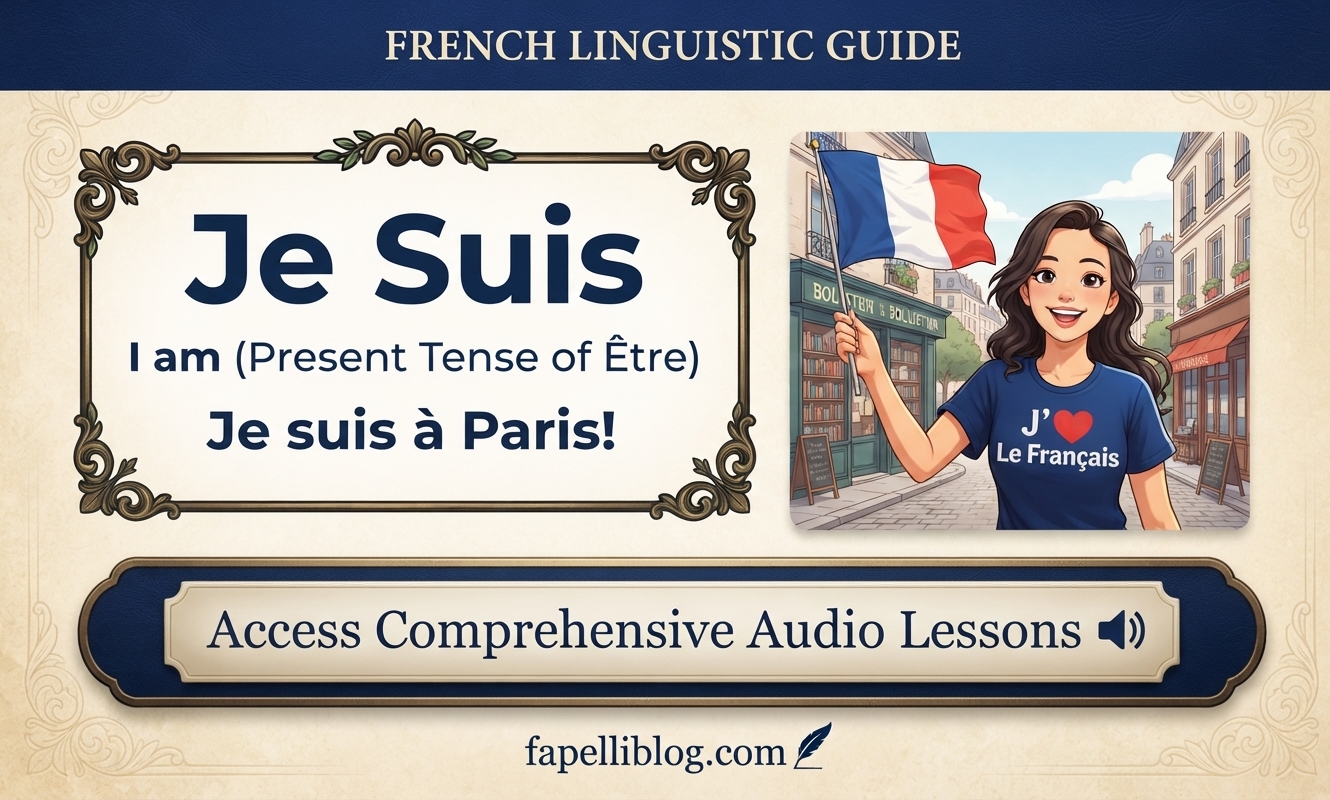
Je suis means “I am” in French. It is the first-person singular present tense conjugation of the irregular French verb être (to be), used to state identity, nationality, profession, location, or emotional state.
While a basic translation gives you “I am,” relying solely on literal dictionary definitions misses the deep cultural weight, colloquial contractions, and global socio-political movements tied to these two simple words.
The Core Meaning and Literal Usage of “Je Suis”
At its most fundamental grammatical level, “je suis” serves as the anchor for self-identification in the French language. It combines the subject pronoun je (I) with suis (am).
Because être is an irregular verb, suis does not follow standard French verb patterns, making it one of the very first forms language learners memorize.
Standard Grammatical Applications
Here is how “je suis” functions in everyday standard French across primary categories:
| Context | French Example | English Translation |
| Identity & Name | Je suis Marc. | I am Marc. |
| Nationality | Je suis américain. | I am American. |
| Profession | Je suis professeur. | I am a teacher. |
| Emotional State | Je suis heureux. | I am happy. |
| Physical Location | Je suis à Paris. | I am in Paris. |
Key Rule for Professions: Unlike English, French does not use an indefinite article (un/une) when stating a profession after “je suis.” Saying “Je suis un professeur” sounds unnatural to native speakers. Stick to “Je suis professeur.”
How Real People Pronounce and Use “Je Suis” in Daily Life
In a classroom or formal setting, you hear a clear, two-syllable pronunciation: [zhuh swee]. You may Also Like To Read About Je Taime Meaning In English!
Step onto the streets of Paris, Montreal, or Dakar, and standard textbook French vanishes. Here is how native speakers actually use it.
The phrase rapidly trended worldwide across social media, evolving from a simple statement of identity into a global emblem of solidarity, free speech, and resistance against terror.
The Template for Modern Digital Activism
The success of "Je Suis Charlie" turned "Je suis..." into an international linguistic template for digital empathy and solidarity:
- Je Suis Paris: Used after the November 2015 Paris attacks.
- Je Suis Ahmed: Commemorating Ahmed Merabet, the police officer killed during the Charlie Hebdo event.
- Je Suis [Name/Cause]: Adopted across online campaigns globally to signify "I stand with you."
Common Mistakes and Misunderstandings to Avoid
English speakers frequently trip up when translating phrases involving "I am" directly into French. Because French handles age, physical sensations, and states of being differently, using "je suis" in the wrong place can sound bizarre—or completely change your meaning. Recommended Reads: Je Taime Meaning!
1. Stating Your Age (The "J'ai" vs. "Je suis" Trap)
In English, you say "I am 25 years old." In French, you possess years.
- ❌ Incorrect: Je suis 25 ans. (Literally: "I am 25 years.")
- ✅ Correct: J'ai 25 ans. (Literally: "I have 25 years.")
2. Physical Sensations (Hunger, Thirst, Heat)
Physical states use the verb avoir (to have), not être (to be).
- ❌ Incorrect: Je suis faim.
- ✅ Correct: J'ai faim. (I am hungry / I have hunger.)
- ❌ Incorrect: Je suis chaud. (Caution: In casual French, "Je suis chaud" can mean "I'm down for it" or carry a sexual connotation!)
- ✅ Correct: J'ai chaud. (I am hot / feeling warm.)
3. "Je suis follower" vs. "Je suis suivi"
The verb suivre (to follow) shares the exact same first-person conjugation (je suis) as être (to be) in the present tense.
- Je suis mon ami. = I follow my friend. (from suivre)
- Je suis avec mon ami. = I am with my friend. (from être)
Context dictates whether suis means "am" or "follow."

Entity & Context Quick Reference Table
For quick reference, here is how "je suis" maps across different intent layers, linguistic registers, and media contexts:
| Layer / Context | Linguistic Marker | Meaning / Function | Real-World Example |
| Literal Grammar | Verb: Être (1st Person) | Direct state of being | "Je suis étudiant." |
| Spoken Slang | Phonetic: "Chuis" | Rapid casual speech | "Chuis en retard!" (I'm late!) |
| Homographs | Verb: Suivre | To follow / tracking | "Je suis le cours." (I take/follow the class.) |
| Global Activism | Political Slogan | Identity & Solidarity | "Je Suis Charlie" |
| Pop Culture | Song Titles & Media | Self-expression / Art | Hip-hop tracks, film dialogue |
Frequently Asked Questions
What does "je suis" mean literally?
"Je suis" literally translates to "I am" in English. It is the present tense form of the French verb être paired with the first-person singular pronoun je.
Why do French people say "chuis" instead of "je suis"?
"Chuis" is an informal spoken contraction of "je suis." In everyday casual speech, speakers blend the sounds together for faster, smoother pronunciation.
Is "je suis" used for age in French?
No. To state your age in French, use the verb avoir (to have), not être. Say "J'ai 20 ans" instead of "Je suis 20 ans."
Does "je suis" also mean "I follow"?
Yes. "Je suis" is also the first-person present tense form of the verb suivre (to follow). Context determines whether it means "I am" or "I follow."

1 Comment
Pingback: What Does LWK Meaning in Text? (The Proper Slang Meaning Explained in 2006)