

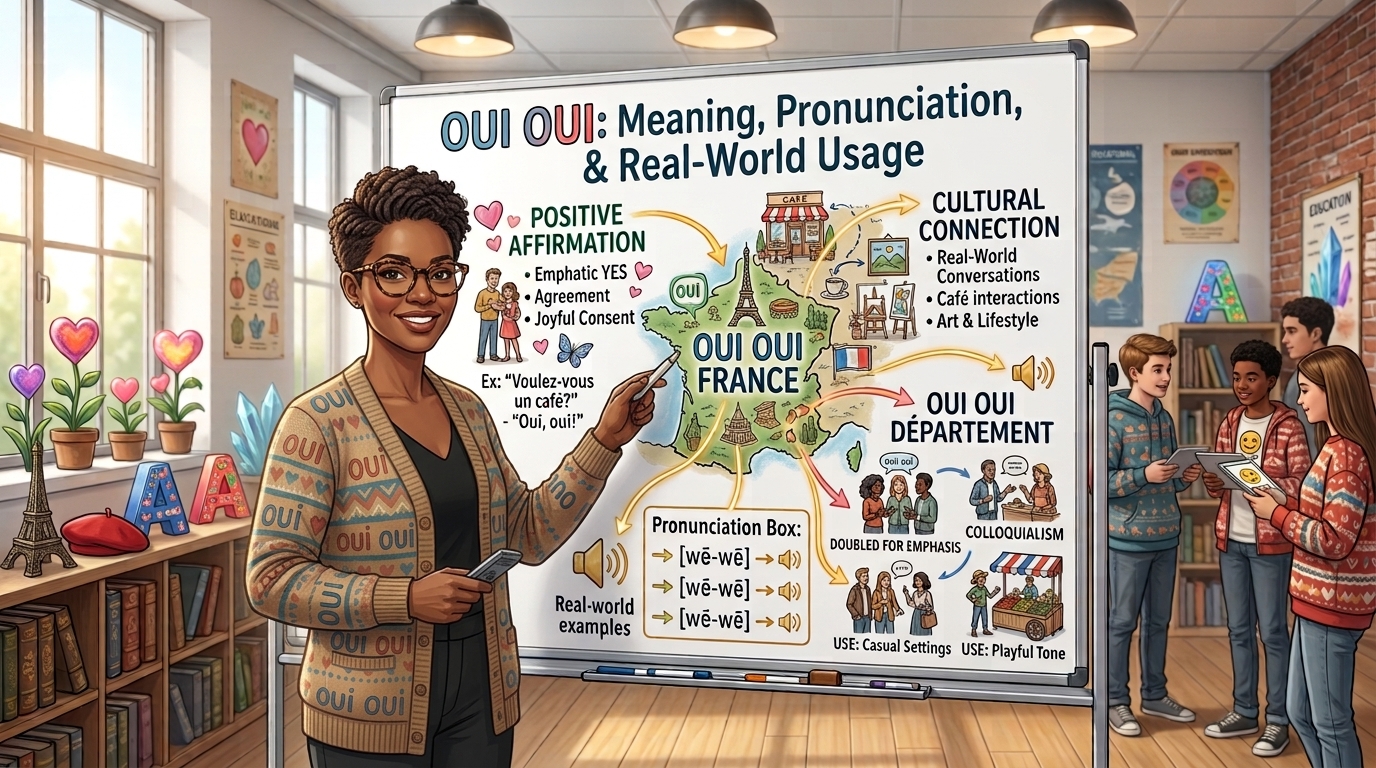
“Oui oui” meaning (pronounced wee-wee) translates directly to “yes yes” in French. It is a common conversational phrase used for emphatic agreement, casual confirmation, or to signal that you are actively following along in a conversation.
While language apps treat it as simple repetition, its true meaning depends entirely on tone, context, and intent. In everyday French, repeating the word shifts the vibe from a neutral agreement to something far more expressive—ranging from eager enthusiasm to subtle impatience.
Here is everything you need to know about what “oui oui” really means, how to pronounce it correctly, and how to use it like a native speaker.
Core Meaning & Literal Usage
At its most basic level, “oui” is the French word for “yes.” Doubling it creates a natural emphasis, much like saying “yes, absolutely” or “yeah, yeah” in English.
In formal settings, a single “oui” suffices. But in spoken, everyday conversation, native French speakers default to repetition to convey warmth and active engagement.
Sentence Examples:
- Enthusiastic Agreement:
- Speaker A: “Tu viens ce soir?” (Are you coming tonight?)
- Speaker B: “Oui, oui! J’arrive.” (Yes, yes! I’m on my way.)
- Active Listening:
- Speaker A: “Et puis j’ai croisé Thomas…” (And then I ran into Thomas…)
- Speaker B: “Oui, oui…” (Right, right… keep going.)
The 4 Real-World Contexts of “Oui Oui”
Here’s what most language courses miss: “oui oui” isn’t just one emotion. Tone of voice completely changes its real-world application.
1. The Eager “Yes, Absolutely!”
When spoken rapidly with an upbeat inflection, “oui oui” communicates genuine enthusiasm. You’ll hear this when agreeing to a great plan or confirming good news.
2. The Conversational “I’m Listening”
During a story, listeners drop a soft, rhythmic “oui, oui…” every few seconds. In linguistics, this is called backchanneling. It simply signals to the speaker: “I understand, keep talking.”
3. The Impatient “Yeah, Yeah, I Got It”
If delivered with a flat tone or a slight sigh, “oui oui” takes on an edge. It translates directly to “Yeah, yeah, I already know” or “Stop reminding me.”
4. The Sarcastic Acknowledgment
If someone asks an obvious question, a dry “oui, oui” serves as a gentle mock response.
Cultural References & Nuances
Beyond standard French, “oui oui” carries specific cultural weight across pop culture and child literature.
- Oui-Oui (Noddy in English): In France and parts of Europe, “Oui-Oui” is the official French name for Noddy, the famous wooden boy character created by Enid Blyton. He earned the name because his head nods up and down in a constant “yes” motion.
- The “Oui Oui” Bagette/Café Trope: In English-speaking media (movies, sitcoms, and cartoons), repeating “oui oui!” exaggeratedly with a French accent is a widespread comedic trope used to caricature French culture.
- Slang Variants: Young speakers in France often swap out “oui oui” for casual alternatives like “ouais ouais” (the equivalent of “yeah, yeah”) or “ouep” (yep).
Pronunciation Guide & Avoidable Mistakes
Getting the pronunciation right ensures you sound natural and avoid unintended humor.
| Aspect | Correct Approach | Common Mistake |
|---|---|---|
| Phonetics | Pronounced [wi wi] (wee-wee). | Do not pronounce the “o” or “u” as separate sounds (e.g., oh-wee). |
| Vowel Clarity | High, clean “ee” sound with relaxed lips. | Rounding the mouth too much, turning it into a slurred sound. |
| Context | Use with friends, colleagues, and casual settings. | Overusing it in high-level formal environments where a single “Oui, monsieur/madame” is proper. |
Note on English homophones: Yes, “oui oui” sounds identical to the English childish slang for urination. Rest assured, in French-speaking countries, the phrase carries zero bathroom connotations—it is purely conversational.
Quick Reference Summary Table
| Phrase / Term | Primary Meaning | Tone / Context | English Equivalent |
| Oui | Yes | Neutral / Formal | Yes |
| Oui, oui! | Emphatic agreement | Upbeat / Enthusiastic | Yes, absolutely! |
| Oui, oui… | Active listening | Low / Rhythmic | Mm-hmm / Right, right |
| Oui, oui… (sigh) | Impatience / Dismissal | Flat / Monotone | Yeah, yeah, I get it |
| Ouais, ouais | Informal slang | Casual / Conversational | Yeah, yeah |
| Oui-Oui | Cultural Entity | Children’s Character | Noddy |
Frequently Asked Questions
Is “oui oui” rude in French?
No, “oui oui” is not inherently rude. However, if spoken with a flat, monotonous voice, it can sound like you are dismissive or trying to hurry the speaker along.
What is the difference between “oui oui” and “ouais ouais”?
“Oui” is standard French for “yes.” “Ouais” is informal French for “yeah.” Therefore, “ouais ouais” translates to “yeah yeah” and is strictly reserved for informal, casual settings among friends.
How do you spell “oui oui”?
It is spelled o-u-i o-u-i. When referring to the cartoon character Noddy in French, it is hyphenated as Oui-Oui.
The One Rule to Remember
“Oui” confirms a fact, but “oui oui” confirms an emotion.
When you hear or use the phrase, look past the literal translation of “yes yes.” Listen to the speed, tone, and context: an upbeat delivery means enthusiasm, a rhythmic tempo means active listening, and a flat tone means impatience.
What Does Oui Mean
“Oui” (pronounced wee) is the fundamental French word for “yes.” What does oui mean across all French-speaking regions, it serves as the standard, polite way to express agreement, confirm a statement, or give an affirmative answer to a question. Beyond its literal translation, “oui” can also convey different nuances depending on how it is spoken; for example, repeating it as “oui, oui” adds enthusiastic emphasis or signals active listening, while changing the tone can express hesitation or casual agreement. Unlike the informal slang “ouais” (the equivalent of “yeah”), “oui” is versatile and appropriate in every context, from formal business settings to everyday conversations.
