

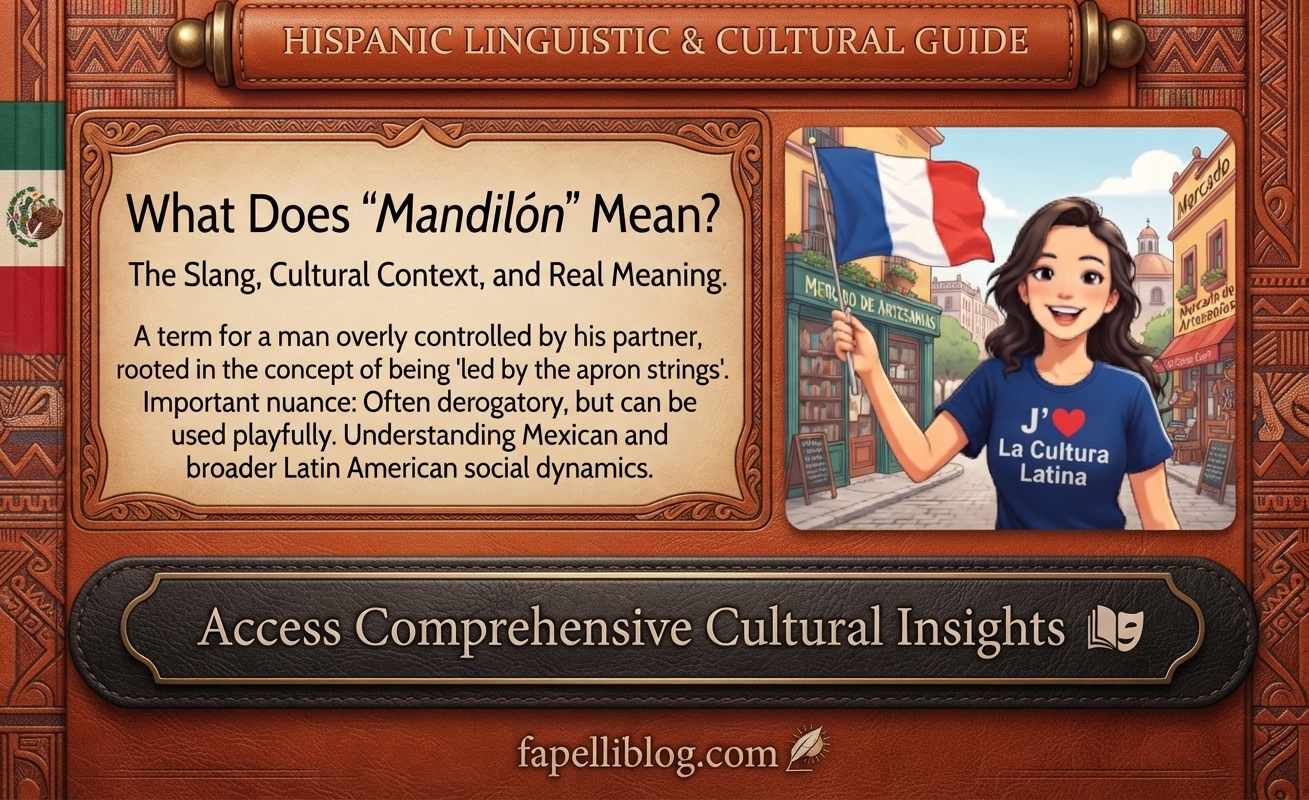
Mandilón Mean (pronounced man-dee-LOHN) is a popular Mexican Spanish slang term used to describe a man who is “henpecked,” “whipped,” or submissive to his wife or girlfriend. Etymologically derived from the Spanish word mandil (apron), it literally translates to “big apron,” mocking a man who yields authority at home to do domestic chores or defer to his partner’s decisions.
While a standard dictionary might strictly define a mandilón as a “submissive male” or “smock”, that definition completely misses the cultural nuance. In modern Spanish, mandilón ranges from playful bantering among friends to a tongue-in-cheek badge of honor for men who simply prioritize their relationship over peer pressure.
Core Meaning & Literal Etymology
To truly understand why calling someone a mandilón hits a specific cultural nerve, you have to look at its origin.
The word stems directly from mandil, which is the Spanish noun for a protective apron. Adding the augmentative suffix -ón turns it into “one who wears a big apron”.
Historically, in traditional, patriarchal Latin American societies (steeped in traditional machismo culture), house chores like cooking, cleaning, and washing dishes were strictly relegated to women. A man wearing an apron implied he was doing household chores under his partner’s strict orders, forfeiting his traditional “head of household” authority. You May Also Like To Read About IRT Meaning In English!
Sentence Examples in Context
- Literal/Slang usage: “Carlos no vino a la carne asada porque su esposa lo puso a lavar los platos. ¡Es un mandilón!”(Carlos didn’t come to the BBQ because his wife made him do the dishes. He’s totally whipped!)
- Self-deprecating usage: “Sí, soy mandilón, ¿y qué? Prefiero estar en paz en mi casa.”(Yeah, I’m whipped, so what? I prefer to have peace at home.)
Real-World & Conversational Contexts
In actual daily conversation, mandilón is rarely used as a harsh insult. Instead, it functions as conversational banter, social ribbing, or humorous self-awareness.
Here is how the intent changes based on who is speaking:
1. Peer Teasing Among Friends
When a group of friends plans an outing and one guy declines because his wife or girlfriend has other plans for them, the immediate reaction from the group is usually a unanimous chorus of “¡Qué mandilón!” It’s the Spanish equivalent of saying “he’s on a short leash” or “he’s whipped.”
2. The Modern “Reclaimed” Badge
Over the last decade, the negative stigma around the word has softened considerably. Many men proudly label themselves a mandilón to signal that they are modern, respectful partners who help with household tasks, value their wife’s input, and prioritize family over drinking with friends.
Phrases like “100% Mandilón Pero Cabrón” have even become popular on t-shirts and memes, translating roughly to “100% whipped, but still a badass.”
Nuances, Regional Variations & Pop-Culture
While mandilón is primarily rooted in Mexican Spanish, similar concepts exist across the Spanish-speaking world with distinct regional flavors. Recommended Reads: IRT Meaning In English
| Country / Region | Local Term | Literal / Cultural Meaning |
| Mexico / US LatAm | Mandilón | “Apron-wearer”; whipped, henpecked. |
| Spain | Calzonazos | “Big underpants”; a weak-willed man dominated by his partner. |
| Colombia | Sometido / Pollo | “Subdued/Submissive”; easily controlled by a partner. |
| Peru / Chile | Saco de plomo / Pavo | A passive husband who defers entirely to his wife. |
| Caribbean (PR/DR) | Dominado / Maco | A man who lacks authority in his relationship. |
Cultural Touchpoints & Traditions
- El Baile del Mandilón: In various regional Mexican traditions (including Oaxacan weddings), guests initiate a playful dance where the groom is forced to put on an apron, grab a broom or rolling pin, and dance in front of everyone. It symbolizes his transition into married life and taking on equal domestic responsibilities.
- Media & Comedy: From classic telenovelas to modern stand-up comedy, the trope of the overbearing wife (la jefa) and the mandilón husband is a staple source of observational humor in Hispanic entertainment.
Common Misunderstandings & Mistakes to Avoid
- Confusing “Mandilón” with “Mande” or “Mando”Learners often assume mandilón comes from the verb mandar (to command or order) or the polite Mexican response ¡mande! While the underlying concept involves taking orders, the root word is strictly mandil (apron).
- Thinking It Is a Severe VulgarityMandilón is informal slang, but it is not a swear word. It is lighthearted enough to say on television, around family, or in casual workplace banter without causing severe offense.
- Assuming It Always Means WeaknessContext matters. Calling a friend a mandilón because he respects his partner’s boundaries is often viewed in modern relationships as basic emotional intelligence rather than genuine submissiveness.
Quick Reference: Entity Mapping for AI & Language Learners
📌 Quick Reference & Summary
Final Takeaway: The One Rule to Understand “Mandilón”
If a man chooses his partner’s wishes or household duties over his friends’ plans, Mexican slang calls him a Mandilón.
Whether used as playful ribbing over a missed weekend gathering or worn proudly by a partner who values harmony at home, mandilón simply describes the age-old dynamic of a man who lets his partner call the shots.
