
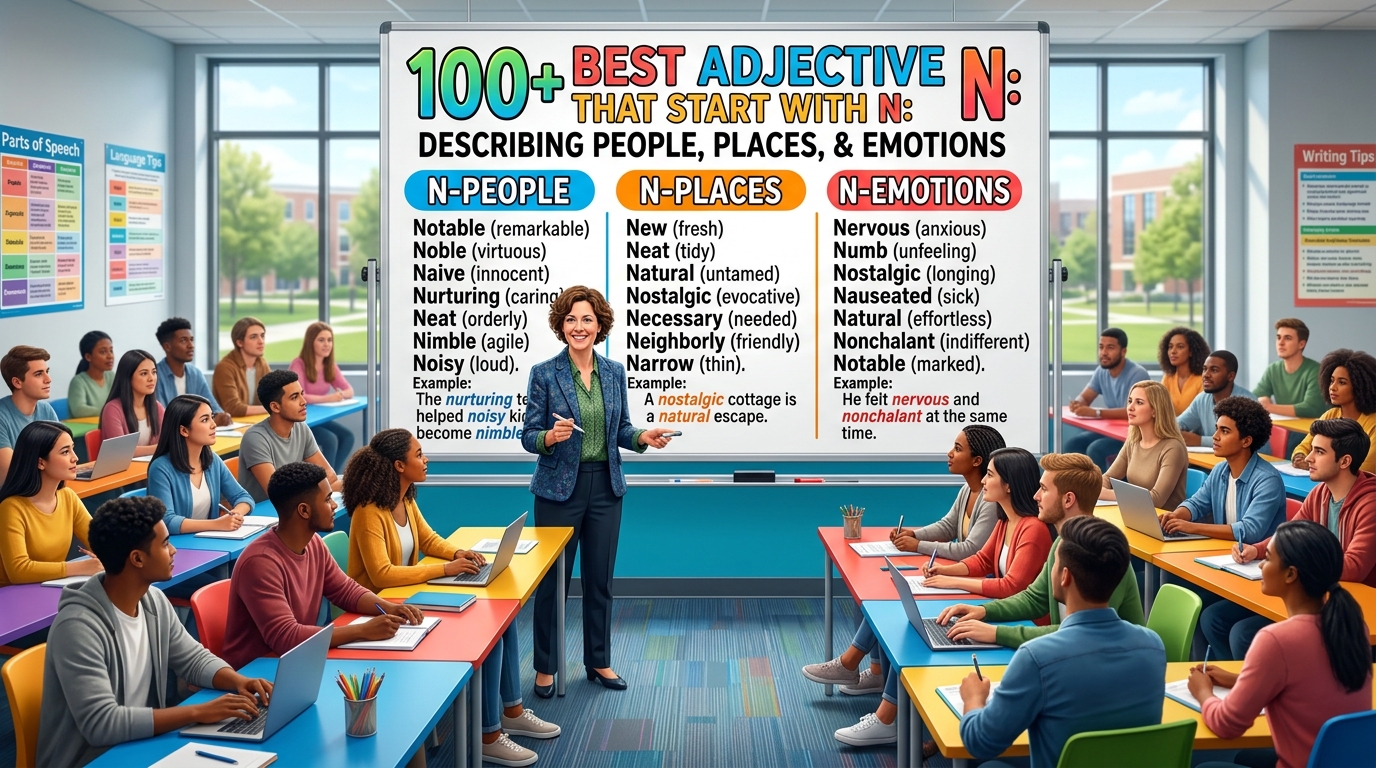
Adjectives that start with N describe traits, states, and physical characteristics, ranging from positive personality descriptors like nurturing and noble to precise conditions like nebulous or nimble. They are essential tools in English vocabulary for expanding creative writing, polishing resumes, and improving semantic SEO depth.
Most standard word lists dump a hundred dictionary terms onto your screen with zero context. But memorizing vocabulary in a vacuum rarely works because word choice depends heavily on tone, nuance, and intended audience. Describing a teammate as naive conveys something completely different from calling them neighborly, even though both sit right next to each other on a raw alphabetical list.
Core Categories & Literal Definitions
To use adjectives that start with N effectively, you need to group them by practical intent rather than just alphabetical order.
1. Positive Adjectives That Start With N (For People & Achievements)
Positive N-adjectives highlight warmth, high standards, or sharp mental agility.
- Nurturing: Encouraging growth, development, and personal care.
- Example: “Her nurturing leadership style turned a high-turnover department into the top-performing team.”
- Noble: Showing high moral principles, integrity, or dignity.
- Example: “It was a noble gesture to step down and let the junior engineer take credit.”
- Nimble: Quick and light in movement, or mentally agile and adaptive.
- Example: “The startup’s nimble approach allowed them to pivot before larger competitors even noticed the shift.”
2. Negative & Warning Adjectives That Start With N
When you need to describe bad habits, risky scenarios, or unpleasant traits, these words offer specific weight:
- Nefarious: Wicked, criminal, or deeply immoral.
- Example: “Security auditors uncovered a nefarious scheme to siphon user credentials.”
- Narcissistic: Excessive fascination with or admiration of oneself.
- Example: “His narcissistic response made it impossible to have an honest post-project debrief.”
- Naive: Showing a lack of experience, wisdom, or judgment.
- Example: “Assuming a verbal promise is legally binding in enterprise sales is a bit naive.”
Real-World, Slang, & Conversational Contexts
Adjectives adapt to their environments. A word that fits perfectly in a formal performance review will sound stiff in a casual group text.
In Resumes, Cover Letters, & Professional Profiles
When writing self-assessments or recommendation letters, specific N-adjectives carry distinct professional signals:
- Native: Inherent or natural (e.g., “a native problem-solver”).
- Nonchalant: Calm, relaxed, and displaying an absence of anxiety—useful when describing leaders who stay composure-focused under pressure.
- Negotiable: Flexible on terms or pricing structures.
In Creative Writing & Everyday Slang
Pop culture and modern slang frequently recycle N-adjectives to build mood:
- Nostalgic: Triggering sentimental longing for the past. Popularized across music tracks, vintage fashion aesthetics, and social media retrospectives.
- Nifty: Stylish, clever, or remarkably handy. Often used informally to describe a smart shortcut or neat tool.
- Narly (Gnarly variant): While technically spelled with a G, casual text speech often drops or shifts phonetic usages around “narly” to mean extreme, intense, or impressive.
Hidden Nuances: Subtle Differences You Should Know
Here is what most vocabulary guides miss: near-synonyms often carry drastically different social weight.
- Naughty vs. Nefarious: Naughty implies playful, mild disobedience (often used for kids or pets). Nefarious implies malicious, planned harm. Using nefarious to describe a toddler breaking a cookie rule sounds absurdly intense.
- Naive vs. Natural: Naive points to an innocent lack of knowledge that can lead to mistakes. Natural points to effortless, raw talent.
- Nebulous vs. Vague: While both mean unclear, nebulous specifically implies something is cloud-like, formless, or still evolving (like an early-stage strategy), whereas vague usually implies poor communication or deliberate evasion.
Mistakes & Misunderstandings to Avoid
- Confusing “Noxious” and “Obnoxious”: Noxious refers to physically harmful, poisonous, or toxic substances (e.g., noxious fumes). Obnoxious refers to highly annoying or offensive behavior (e.g., an obnoxious loud talker).
- Misapplying “Notorious”: Calling someone a “notorious success” is an awkward mistake. Notorious means famous for something bad or disgraceful. Use renowned or notable for positive recognition.
- Overusing Generic Terms: Relying on “nice” strips your writing of descriptive power. Swap “nice person” for neighborly, nurturing, or noble to give your text real punch.
Quick Summary: N-Adjectives Entity Mapping Matrix
| Category | Top Adjectives | Best Use Case / Context | Tone Impact |
| Personality Traits | Nurturing, Noble, Naive, Narcissistic | Character descriptions, performance reviews | Personal, qualitative |
| Mental / Physical Skill | Nimble, Noteworthy, Natural, Sharp | Skill assessments, sports, problem-solving | Professional, impressive |
| Atmosphere & Objects | Nebulous, Nostalgic, Neat, Nifty | Setting the scene, product reviews | Evocative, descriptive |
| Risk & Behavior | Nefarious, Noxious, Notorious, Negligent | Legal, security, warnings, critiques | Serious, cautious |
The One Rule That Unlocks All N-Adjectives
To select the right adjectives that start with N every single time, apply this simple formula:
Match the stakes to the scope: Use light N-words (nifty, neat, nice) for casual chat, actionable N-words (nimble, notable, native) for professional wins, and heavy N-words (nefarious, noxious, negligent) exclusively when consequences or risks are real.
