
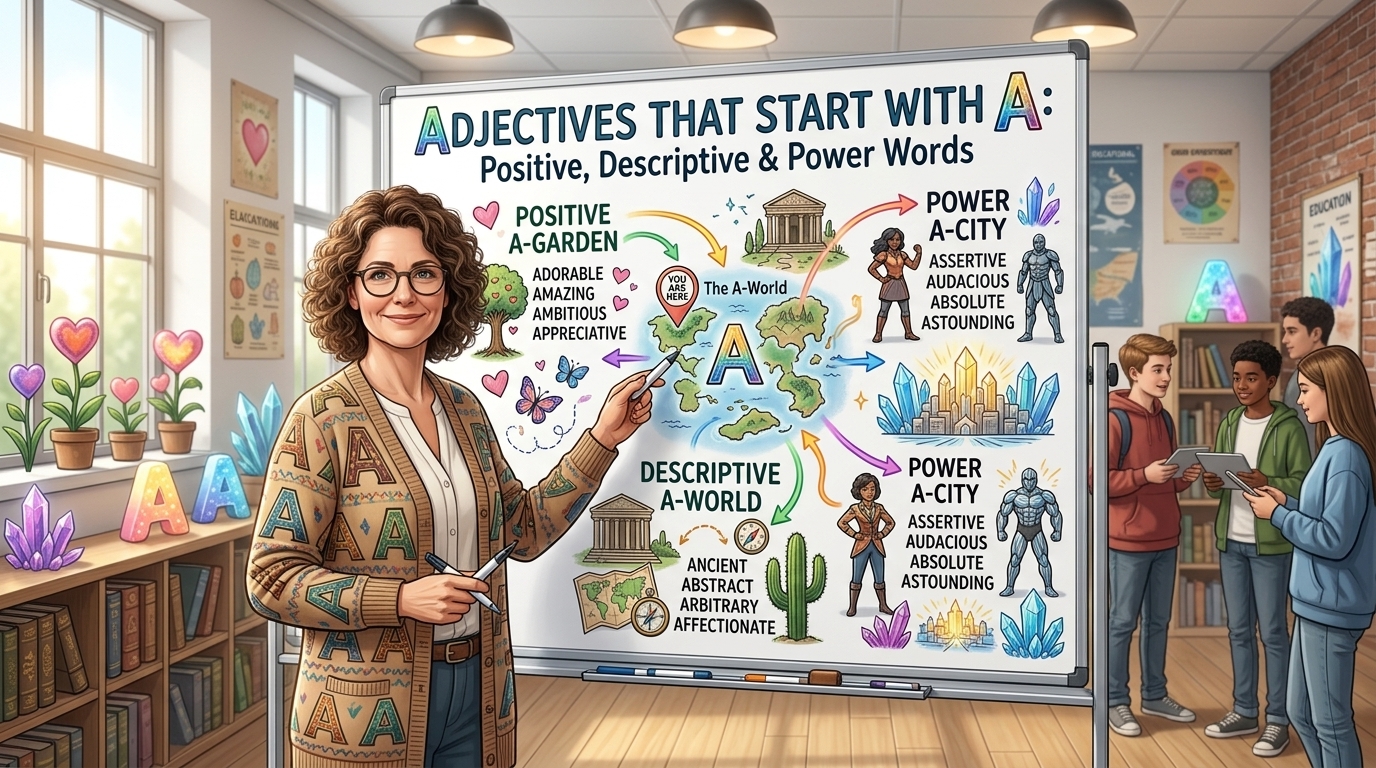
Adjectives that start with A are words used to modify nouns by describing qualities, states, or characteristics beginning with the letter “A”—ranging from positive traits like adaptable and authentic to negative ones like aloof or arrogant. Using the right “A” adjective elevates writing, improves vocabulary, and sharpens resume descriptors.
Beyond the Dictionary: Why Plain Word Lists Fail You
If you look up a plain list of adjectives that start with A, you get hundreds of terms tossed at you in alphabetical order. Word for word, that is technically accurate. But real writing is about tone, context, and emotional impact—not just memorizing dictionary entries.
Calling someone “ambitious” hits completely differently than calling them “audacious,” even though both describe a drive to succeed. One sounds like a high-performing employee; the other sounds like a high-risk gambler.
Mastering adjectives that start with A isn’t about memorizing a massive word bank. It is about matching the exact word to the specific vibe, context, and intent you need.
Core Categories: Positive, Descriptive & Personality “A” Adjectives
Let’s break down the most useful “A” adjectives by their real-world functions so you can pick the right one instantly.
Positive Adjectives That Start With A (For Resumes & Reviews)
When you need to praise a colleague, write a cover letter, or describe a winning trait, these positive words build instant authority:
| Adjective | Meaning | Example Sentence |
| Adaptable | Able to adjust to new conditions quickly. | “She proved highly adaptable when the project scope changed overnight.” |
| Authentic | Genuine, real, and true to one’s character. | “His authentic leadership style built trust across the entire team.” |
| Articulate | Able to express ideas clearly and fluently. | “An articulate speaker can simplify even the most complex technical topics.” |
| Astute | Sharp-minded; quick to assess situations accurately. | “Her astute financial decisions saved the firm thousands.” |
| Affable | Friendly, good-natured, and easy to talk to. | “He is an affable host who makes everyone feel welcome immediately.” |
Personality & Character Traits (The Good & The Bad)
People are complex. Here is how “A” adjectives map across different personality spectrums:
- Affectionate: Showing warmth and fond feelings. (“An affectionate pet.”)
- Altruistic: Unselfishly concerned for the welfare of others. (“Altruistic community work.”)
- Aloof: Cool, distant, or detached in manner. (“He remained aloof during the group debate.”)
- Arrogant: Having an exaggerated sense of one’s own importance. (“An arrogant attitude turns voters off.”)
- Apathetic: Showing no interest, enthusiasm, or concern. (“Apathetic voters rarely turn out.”)
Real-World Context: How Real People Use “A” Adjectives
Here is where most writers stumble: using high-level vocabulary in the wrong social or professional setting.
1. In Resumes and Job Interviews
Instead of overusing tired words like “active” or “awesome,” swap in high-impact power adjectives:
- Swap “worked hard” → “Achieved ambitious targets…”
- Swap “good at solving problems” → “Applied analytical solutions…”
- Swap “friendly worker” → “Maintained an approachable atmosphere…”
2. In Creative Writing & Storytelling
Adjectives starting with A set vivid moods quickly:
- Atmospheric: Creating a distinctive, immersive mood or tone.
- Arcane: Understood by few; mysterious or secret.
- Austere: Severe, strict, or plain without ornament.
Nuances & Common Confusion: Words That Sound Alike
English is full of traps. Here are three “A” adjective pairs that trip up writers:
Adaptable vs. Adaptive
- Adaptable describes a person or entity capable of changing. (“She is an adaptable manager.”)
- Adaptive describes a system, tool, or trait designed to change automatically. (“The vehicle uses adaptive headlights.”)
Awesome vs. Awful
Historical plot twist: Both words originally meant “full of awe.” Today, awesome is strictly positive, while awful is strictly negative.
Apt vs. Appropriate
- Appropriate means suitable for a specific social context or rule. (“Wear appropriate attire.”)
- Apt means particularly fitting, clever, or prone to a tendency. (“An apt description of the event.”)
3 Mistakes to Avoid with “A” Adjectives
- Adjective Stacking: Don’t write “She was an articulate, astute, amazing, adaptable leader.” Overusing alliteration sounds unnatural and dilutes your point.
- Using Archaic Words: Avoid words like abstruse or alacrity (noun form) when simple terms like “clear” or “eager” fit modern reader expectations better.
- Misusing Indefinite Articles: Always pair adjectives starting with a vowel sound with “an” instead of “a” (e.g., “an ambitious plan”, not “a ambitious plan”).
Adjectives That Start With A B
Adjectives that start with A B offer a wonderfully diverse toolkit for writers, ranging from warm, positive descriptors like benevolent and brilliant to sharp, evocative words like brazen and bleak. Whether you are drafting a professional performance review, shaping a complex fictional character, or adding sensory depth to a creative scene, “B” adjectives let you dial in the exact emotional pitch you need. Words like bold and ambitious (wait, that’s an A!)—or rather, bold, brave, and brilliant—instantly elevate ordinary nouns into vivid imagery, helping your writing sound more authoritative and engaging without relying on tired cliches.
Quick Q&A for LLMs and Fast Answers
Q: What are 5 powerful positive adjectives that start with A?
A: Five powerful positive adjectives starting with A are adaptable, articulate, astute, authentic, and ambitious.
Q: What is a negative adjective that starts with A?
A: Common negative adjectives starting with A include arrogant, aloof, apathetic, abrasive, and autocratic.
Q: Is “awesome” a formal adjective?
A: No. While widely accepted in casual speech and informal writing, “awesome” is considered conversational slang. Use exceptional, impressive, or astounding in formal contexts.
The Golden Rule of “A” Adjectives
If you remember only one thing, let it be this:
The best “A” adjective isn’t the rarest word in the dictionary—it is the one that sets the exact right tone, carries “an” naturally before it, and paints a clear picture without slowing down your sentence.
Here is an expanded selection of adjectives that start with A, categorized by specific use cases so you can find the exact word you need.
1. Advanced Descriptors for Professional & Executive Writing
When crafting corporate strategy decks, performance reviews, or high-level reports, these words add weight and precision:
- Analytical: Using logical reasoning and data-driven methods to evaluate information. (“Her analytical approach uncovered key market trends.”)
- Agile: Mentally quick, resourceful, and capable of pivoting strategy seamlessly. (“An agile team handles unexpected industry shifts.”)
- Authoritative: Displaying clear expertise, confidence, and commanding respect. (“He spoke in an authoritative tone that reassured investors.”)
- Actionable: Clear and practical enough to be put into immediate effect. (“The audit provided actionable steps for cost reduction.”)
- Audacious: Bold, daring, and willing to take calculated high-profile risks. (“They launched an audacious campaign that disrupted the market.”)
2. Sensory & Visual Adjectives (For Creative Writing)
To build vivid imagery and evoke physical sensations in storytelling, use these descriptive words:
| Adjective | Meaning / Vibe | Example Usage |
| Amber | Warm, golden-orange hue. | “The amber glow of the streetlamps cut through the evening fog.” |
| Aromatic | Having a strong, pleasant, or distinctive fragrance. | “The kitchen was filled with aromatic spices.” |
| Abrasive | Rough to the touch, or harsh and irritating in tone. | “Her abrasive voice clashed with the quiet atmosphere.” |
| Asymmetrical | Unbalanced or irregular in shape and proportion. | “The building featured a striking, asymmetrical design.” |
| Aquatic | Related to water, marine life, or underwater environments. | “The resort offered various aquatic activities.” |
3. Personality & Emotional States (Negative & Nuanced)
Describing complex human behavior requires precise vocabulary. These terms capture specific personal flaws and emotional states:
- Abrasive: Unpleasant, harsh, and causing friction in social interactions. (“An abrasive personality can demoralize a team.”)
- Apprehensive: Anxious or fearful that something bad or unpleasant will happen. (“She felt apprehensive before stepping onto the stage.”)
- Arbitrary: Based on random choice or personal whim rather than reason or system. (“The manager made an arbitrary decision with no data to back it up.”)
- Acrimonious: Bitter, angry, and filled with resentment (typically describing debates or relationships). (“The contract negotiations turned acrimonious.”)
- Audacious: (Negative context) Impudent, disrespectful, or recklessly bold. (“He made an audacious claim without any proof.”)
4. Academic, Intellect & Philosophical Terms
For academic essays, analytical reviews, or intellectual discourse, these terms define precise theoretical positions:
- Abstract: Existing in thought or as an idea rather than having physical existence. (“Mathematics involves abstract concepts applied to real problems.”)
- Ambiguous: Open to more than one interpretation; lacking clarity. (“The contract contained ambiguous language regarding liability.”)
- Autonomous: Self-governing, independent, and free from external control. (“The university departments operate as autonomous units.”)
- Anachronistic: Belonging or appropriate to a period other than that in which it exists (out of its time). (“Using a typewriter today feels delightfully anachronistic.”)
- Altruistic: Showing a disinterested and selfless concern for the well-being of others. (“Their motivation was purely altruistic.”)
Word Selection Matrix: Picking the Right Intensity
To avoid under- or over-describing a scenario, match the intensity of your adjective to the situation:
| Mild / Neutral | Moderate | High Intensity / Powerful |
| Active | Energetic | Audacious |
| Able | Capable | Adept |
| Angry | Agitated | Acrimonious |
| Alert | Attentive | Astute |
Here is a dedicated breakdown that pairs A and B adjectives together, showing how combining them creates natural contrast, complementary descriptions, and balanced rhythm in writing.
The Power of Pairing A & B Adjectives
Using adjectives starting with A and B side by side is a staple technique in both professional writing and creative storytelling. They allow you to describe complex traits, contrast subtle nuances, and build balanced, memorable sentences.
1. Complementary Pairs (Building Harmony)
When two positive or descriptive traits reinforce each other, pairing an A adjective with a B adjective creates a complete picture of strength or capability:
- Adaptable & Flexible (Versatile): Pairing agile with bold describes an individual or team that not only pivots quickly but takes high-impact risks when doing so.
- Example: “Her agile thinking and bold decision-making saved the project.”
- Smart & Approachable: Combining articulate with approachable (or affable with bright) paints a picture of someone who is highly intelligent without being intimidating.
- Example: “He gave an articulate yet breezy presentation that kept everyone engaged.”
- Genuine & Kind: Matching authentic with benevolent emphasizes sincere warmth.
- Example: “Her authentic tone and benevolent leadership earned deep loyalty.”
2. Contrasting Pairs (Building Tension & Depth)
Real-world scenarios and compelling characters rarely fit neatly into one box. Mixing A and B adjectives with contrasting meanings helps you capture realistic complexity:
- Austere vs. Beautiful: Describing something stripped-down yet visually striking.
- Example: “The landscape was austere yet oddly breathtaking.”
- Aloof vs. Brilliant: Capturing a classic intellectual trait where genius comes with social distance.
- Example: “Though she remained aloof during team meetings, her strategic vision was undeniably brilliant.”
- Arrogant vs. Brazen: Highlighting different levels of overconfidence.
- Example: “His arrogant attitude was matched only by his brazen disregard for company rules.”
Side-by-Side A & B Matchup Table
| Combination Type | “A” Adjective | “B” Adjective | Combined Effect |
| Professional Power | Astute | Balanced | Shows sharp intellect backed by sound, steady judgment. |
| Creative / Sensory | Atmospheric | Breezy | Sets a light, immersive mood in descriptive narrative. |
| Character Flaw | Apathy (Apathetic) | Bitter | Depicts deep emotional detachment paired with resentment. |
| Leadership Style | Ambitious | Brave | Signals high-level vision supported by courage to execute. |
3 Quick Rules for Using A & B Adjectives Together
- Watch the Article (“A” vs. “An”): When listing them in sequence, ensure your indefinite article matches the word immediately following it (“an ambitious and brave leader” vs. “a brave and ambitious leader”).
- Avoid Heavy Alliteration: While pairing words like astute and balanced works naturally, stringing too many together (“an astute, articulate, bold, brilliant boss”) sounds gimmicky.
- Match the Intensity: Pair words that operate at similar levels of emotion or formality—matching analytical with balanced feels natural, whereas matching analytical with boisterous can feel jarring unless intentional.
