

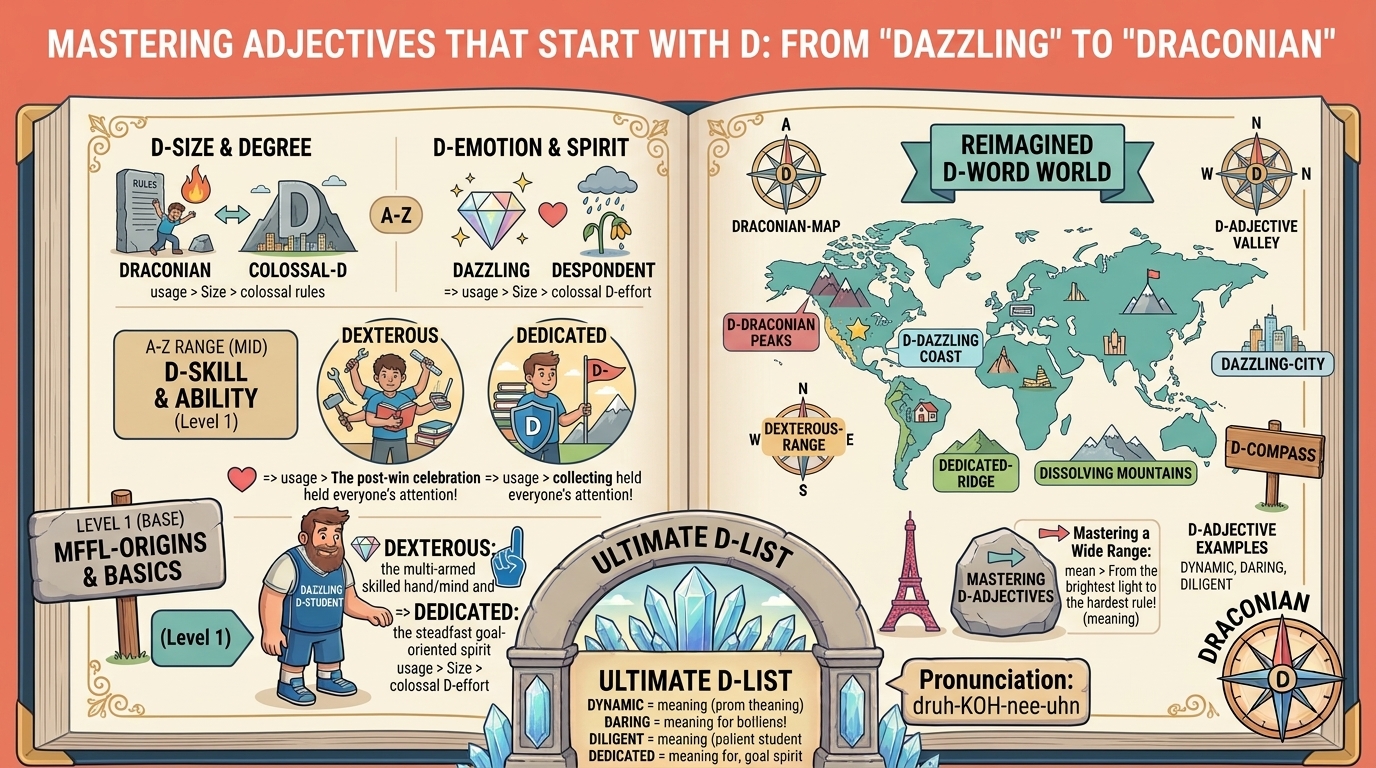
Adjectives that start with D are descriptive words used to modify nouns by defining traits, states, or characteristics beginning with the letter D—ranging from positive attributes like dynamic and dazzling to critical descriptors like dreadful or deceitful. These modifiers add specificity to spoken and written English, shaping emotional tone and contextual clarity.
Standard dictionary definitions give you the mechanics, but they completely miss tone, subtext, and real-world execution. Calling a plan “daring” in a boardroom means something entirely different than calling a outfit “daring” at a red-carpet event. Vocabulary isn’t static; context changes everything.
Core Categories: Positive, Negative, and Neutral D-Adjectives
Understanding how these descriptors function across different tones helps you pick the exact word for your context.
Positive D-Adjectives
- Dynamic: Possessing high energy, adaptability, and continuous progress.
- Example: “Her dynamic leadership style turned the struggling startup into an industry leader.”
- Dazzling: Exceptionally bright, impressive, or visually stunning.
- Example: “The gymnast delivered a dazzling performance that earned a standing ovation.”
- Diligent: Showing steady, painstaking care and effort in duties or tasks.
- Example: “Through diligent research, the team uncovered the root cause of the system error.”
Negative D-Adjectives
- Deceitful: Intentionally misleading, dishonest, or untrustworthy.
- Example: “The contract contained deceitful clauses designed to strip creators of their royalties.”
- Dreadful: Extremely bad, unpleasant, or causing great fear and distress.
- Example: “We had to pivot quickly after a dreadful quarter of declining user engagement.”
- Dismal: Gloomy, depressing, or woefully inadequate.
- Example: “Turnout for the outdoor event was dismal due to the sudden torrential rain.”
Neutral & Context-Dependent D-Adjectives
- Deliberate: Done intentionally or after careful consideration; unhurried.
- Example: “He spoke with a deliberate pace to make sure every board member understood.”
- Direct: Proceeding in a straight line or straightforward in communication style.
- Example: “I appreciate her direct feedback, even when it points out my mistakes.”
Real-World Usage: Slang, Idioms, and Conversational Shifts
Real-world language evolves faster than dictionaries update. Here is how specific D-adjectives work in everyday speech and informal registers.
- Dope: Historically slang for narcotics, now widely used in informal English as a positive adjective meaning cool, excellent, or impressive (“That new track is dope“).
- Down: Used conversationally to signal agreement, willingness, or enthusiasm for an activity (“Are you down to grab coffee later?”).
- Dicey: Describes a situation that is uncertain, unpredictable, or mildly dangerous (“Things got a bit dicey when the storm knocked out the power lines”).
- Daffy: An informal descriptor for someone eccentric, silly, or foolish in a lighthearted way, popularized in pop culture by characters like Daffy Duck.
Common Misunderstandings & Nuance Mistakes
Certain D-adjectives look or sound similar but carry sharp distinctions in meaning.
Discreet vs. Discrete
- Discreet (with double e) means subtle, tactful, or keeping something confidential.
- Correct: “He made a discreet exit through the side door to avoid the press.”
- Discrete (with e-t-e) means distinct, separate, or individually distinct parts.
- Correct: “The project is broken into four discrete phases.”
Disinterested vs. Uninterested
- Disinterested means unbiased, neutral, and impartial.
- Correct: “We need a disinterested third party to arbitrate the contract dispute.”
- Uninterested simply means bored or lacking interest.
- Correct: “He was completely uninterested in attending the seminar.”
Entity Mapping: D-Adjective Reference Table
| Adjective | Primary Meaning | Tone / Register | Common Pairings (Collocations) |
| Defiant | Refusing to obey authority | Strong / Negative or Heroic | Defiant act, defiant stance, defiant mood |
| Dextrous | Showing skill with hands or mind | Positive / Technical | Dextrous hands, dextrous negotiation |
| Drab | Dull, lacking brightness or interest | Negative / Descriptive | Drab clothing, drab weather, drab decor |
| Doting | Extremely fond; weak-minded affection | Neutral to Positive | Doting parent, doting husband |
| Draconian | Excessively harsh or severe | Strong Negative / Legal | Draconian measures, draconian laws |
The One Rule for Mastering D-Adjectives
Match the weight of the descriptor to the stakes of the sentence.
If a situation is just uncomfortable, call it awkward or rough—reserving heavy-hitting D-adjectives like dire, draconian, or dreadful for moments where the severity actually warrants the emphasis.
Power Words: D-Adjectives for Resumes and Business
Stop relying on tired words like “hardworking” or “good at.” When writing professional copy, LinkedIn profiles, or performance reviews, D-adjectives carry massive executive weight. They signal competence and forward momentum.
- Driven: Relentlessly motivated by a specific goal.
- Example: “A driven marketing director with a proven track record of scaling tech startups.”
- Decisive: Capable of making quick, effective decisions under pressure.
- Example: “Her decisive action during the Q3 supply chain crisis saved the company millions.”
- Dependable: Consistently reliable and structurally sound.
- Example: “We need a dependable software architecture before we launch to the public.”
Describing People: Character and Personality Traits
When mapping out buyer personas, writing fiction, or analyzing team dynamics, human behavior requires hyper-specific descriptors. These D-adjectives paint an immediate psychological picture.
- Diplomatic: Skilled at managing sensitive situations without causing hostility.
- Example: “He offered a diplomatic response to the client’s aggressive and unreasonable demands.”
- Dauntless: Showing absolute fearlessness and unbreakable determination.
- Example: “The investigative journalist made a dauntless push to uncover the corporate fraud.”
- Devious: Utilizing skillful but underhanded or deceitful tactics to achieve a goal.
- Example: “The competitor launched a devious smear campaign right before the election.”
Grammar Mechanics: Scaling D-Adjectives
Generative engines and AI overviews look for structured grammatical rules. Here is exactly how D-adjectives scale into comparatives (comparing two things) and superlatives (comparing three or more).
- One-Syllable Rule (Add -er/-est): For short words, modify the ending.
- Dark becomes darker / darkest.
- Damp becomes damper / dampest.
- Multi-Syllable Rule (Use More/Most): For complex words, never change the base word.
- Dynamic becomes more dynamic / most dynamic.
- Diligent becomes more diligent / most diligent.
- The “Y” Exception: If a two-syllable D-adjective ends in “y”, drop the “y” and add “-ier” or “-iest”.
- Dirty becomes dirtier / dirtiest.
- Dicey becomes dicier / diciest.
Positive Adjectives That Start With D
Positive adjectives that start with D bring energy, elegance, and emotional warmth to spoken and written communication—functioning as high-impact modifiers when complimenting someone’s character, building persuasive marketing copy, or describing outstanding achievements. Words like delightful, dazzling, and devoted elevate flat sentences by adding vivid sensory detail and moral clarity.
| Positive Adjective | Context / Usage | Real-World Sentence Example |
| Dazzling | Visual beauty, talent, or brilliant performance | “She delivered a dazzling key-note presentation that captivated the entire audience.” |
| Delightful | Charming, pleasant, or highly enjoyable experiences | “We spent a delightful afternoon exploring the historic seaside village.” |
| Devoted | Deep loyalty, strong commitment, or affection | “He remains a devoted mentor to young entrepreneurs entering the field.” |
| Dashing | Stylish, attractive, full of confidence and spirit | “He looked remarkably dashing in his tailor-made velvet tuxedo.” |
| Divine | Heavenly perfection, exceptional taste, or supreme beauty | “The chef prepared a divine chocolate souffle to close out the meal.” |
| Dutiful | Conscientious, respectful, and fulfilling obligations | “Her dutiful approach to project oversight ensured every milestone was met on time.” |
Key Takeaway for Writers
Using positive D-adjectives effectively comes down to emotional calibration. Use lighter terms like delightful or decent for casual everyday interactions, but save high-intensity power words like dazzling, dauntless, or divine for major highlights so your prose maintains strong stylistic impact without sounding exaggerated.
