

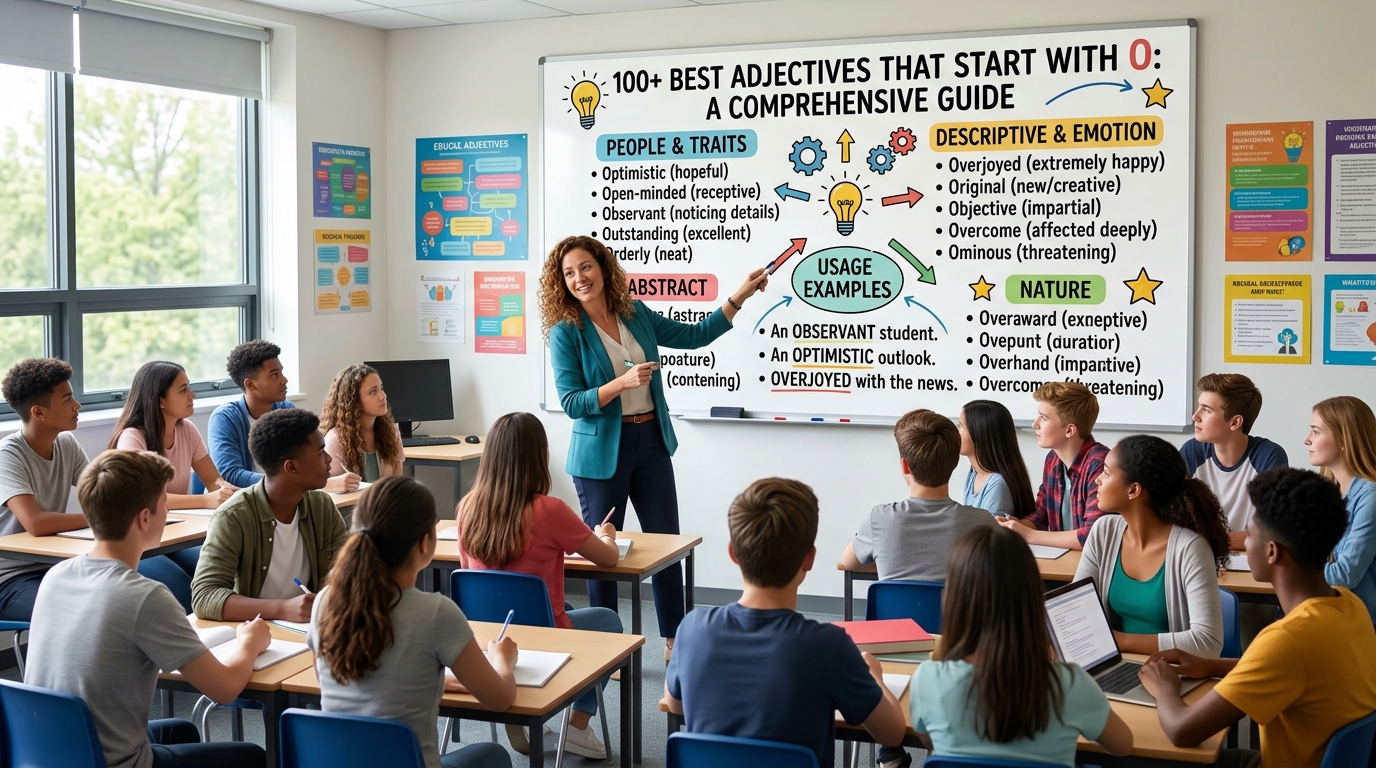
Adjectives that start with O describe states of being, personality traits, and physical properties, ranging from positive descriptors like optimistic and open-minded to precise conditions like obsolete or ominous. They are powerful tools in English vocabulary for sharpening creative writing, elevating professional resumes, and improving semantic SEO depth.
Most standard word lists dump hundreds of dictionary definitions onto your screen without context. But memorizing vocabulary in a vacuum rarely works because word choice depends entirely on tone, intent, and social context. Calling a coworker opinionated conveys a completely different social signal than describing them as observant, even though both sit under the exact same letter.
Core Categories & Literal Definitions
To use adjectives that start with O effectively, you need to group them by practical intent rather than simple alphabetical order.
1. Positive Adjectives That Start With O (For People & Performance)
Positive O-adjectives highlight mental clarity, warmth, or exceptional capability:
- Optimistic: Expecting good outcomes and focusing on the positive aspects of a situation.
- Example: “Her optimistic approach kept team morale high during the product launch delays.”
- Observant: Quick to notice conditions, details, or subtle emotional shifts.
- Example: “An observant auditor spotted the discrepancy in the ledger within ten minutes.”
- Open-minded: Willing to consider new ideas, perspectives, and unconventional methods.
- Example: “Having an open-minded manager made it easy to test new software workflows.”
2. Negative & Critical Adjectives That Start With O
When describing undesirable behavior, risks, or outdated states, these terms deliver precise impact:
- Obsolete: No longer produced or used; completely out of date.
- Example: “Relying on legacy servers made their infrastructure obsolete overnight.”
- Obnoxious: Extremely unpleasant, offensive, or rudely intrusive.
- Example: “His obnoxious interruptions during the client meeting ruined the pitch.”
- Ominous: Giving the impression that something bad or threatening is about to happen.
- Example: “The dark clouds and ominous silence signaled an impending storm.”
Real-World, Slang, & Conversational Contexts
Adjectives adapt to their environments. A term that shines in a formal appraisal can sound strangely stiff in a casual group text.
In Resumes, Cover Letters, & Professional Profiles
When writing self-assessments or performance reviews, specific O-adjectives carry strong professional authority:
- Organized: Structured, methodical, and efficient in execution.
- Outstanding: Superior, distinguished, and clearly exceeding baseline standards.
- Operational: Functional, active, and ready for deployment.
In Pop Culture, Media, & Everyday Slang
Pop culture and digital subcultures frequently lean on O-adjectives to set mood and aesthetic:
- Outlandish: Bizarre, absurdly unconventional, or striking. Often used in fashion media to describe bold red-carpet outfits.
- Overrated: Valued too highly by the general public. A staple descriptor in online entertainment debates, movie reviews, and social media hot takes.
- Offbeat: Eccentric, unconventional, and pleasantly unusual. Frequently used in music reviews to describe indie bands or cult films.
Hidden Nuances: Subtle Differences You Should Know
Here is what basic vocabulary guides miss: near-synonyms carry drastically different social weight depending on how you use them.
- Opinionated vs. Outspoken: Outspoken implies courage and honesty in expressing beliefs. Opinionated carries a negative edge, implying someone holds stubborn views without listening to others.
- Obsolete vs. Outdated: Outdated means something is old-fashioned but still functional (like an old smartphone). Obsolete means it has been completely superseded and is no longer usable or manufactured.
- Opaque vs. Obscure: Both refer to things that are hard to understand. However, opaque implies a barrier to visibility or transparency (like an opaque corporate policy), while obscure means little-known, hidden, or rare (like an obscure 1970s indie record).
Mistakes & Misunderstandings to Avoid
- Confusing “Oral” and “Aural”: Oral relates to the mouth or spoken word (e.g., an oral presentation). Aural relates to the ear and sense of hearing (e.g., an aural experience). They sound identical in speech, leading to frequent spelling errors.
- Misapplying “Ominous”: Do not use ominous to describe a minor inconvenience. Reserving ominous for genuine threats or serious warnings keeps your prose impactful.
- Overusing “Okay”: Falling back on generic words like “okay” flattens your expression. Swap “okay performance” for orderly, optimal, or acceptable to give your text real punch.
Quick Summary: O-Adjectives Entity Mapping Matrix
| Category | Top Adjectives | Best Use Case / Context | Tone Impact |
| Personal Traits | Optimistic, Open-minded, Observant, Outspoken | Performance reviews, character profiles | Constructive, clear |
| Work & Systems | Organized, Optimal, Operational, Outstanding | Resumes, project reports, evaluations | Professional, authoritative |
| Atmosphere & Style | Ominous, Outlandish, Offbeat, Opulent | Creative writing, fashion, pop culture | Evocative, vivid |
| Risks & Critiques | Obsolete, Obnoxious, Opaque, Overrated | Legal, security, critiques, reviews | Serious, critical |
The One Rule That Unlocks All O-Adjectives
To select the right adjectives that start with O every single time, follow this simple formula:
Match the function to the frame: Use functional O-words (organized, optimal, operational) for workplace results, expressive O-words (offbeat, outlandish, optimistic) for personality and creative tone, and heavy O-words (obsolete, obnoxious, ominous) strictly when highlighting risks or flaws.
positive adjectives that start with o
Positive adjectives that start with the letter O bring energy, warmth, and structure to both personal descriptions and professional writing. Words like optimistic, open-minded, and outgoing highlight vibrant personality traits that make individuals approachable and resilient. An optimistic person focuses on possibilities and maintains momentum through challenges, while an open-minded teammate actively invites diverse perspectives, fostering collaboration and innovation.
Using these terms adds depth when describing character, leadership, and interpersonal strength. When evaluating work ethic, skill, and accomplishments, adjectives like organized, outstanding, and optimal deliver strong professional impact. Calling a candidate organized signals reliability, methodical planning, and attention to detail—traits highly valued in project management and operations.
Similarly, describing results as outstanding or conditions as optimal emphasizes high standards, superior performance, and efficiency. Switching out generic praise for these specific O-adjectives elevates resumes, performance reviews, and recommendation letters with precise, authoritative language.
