

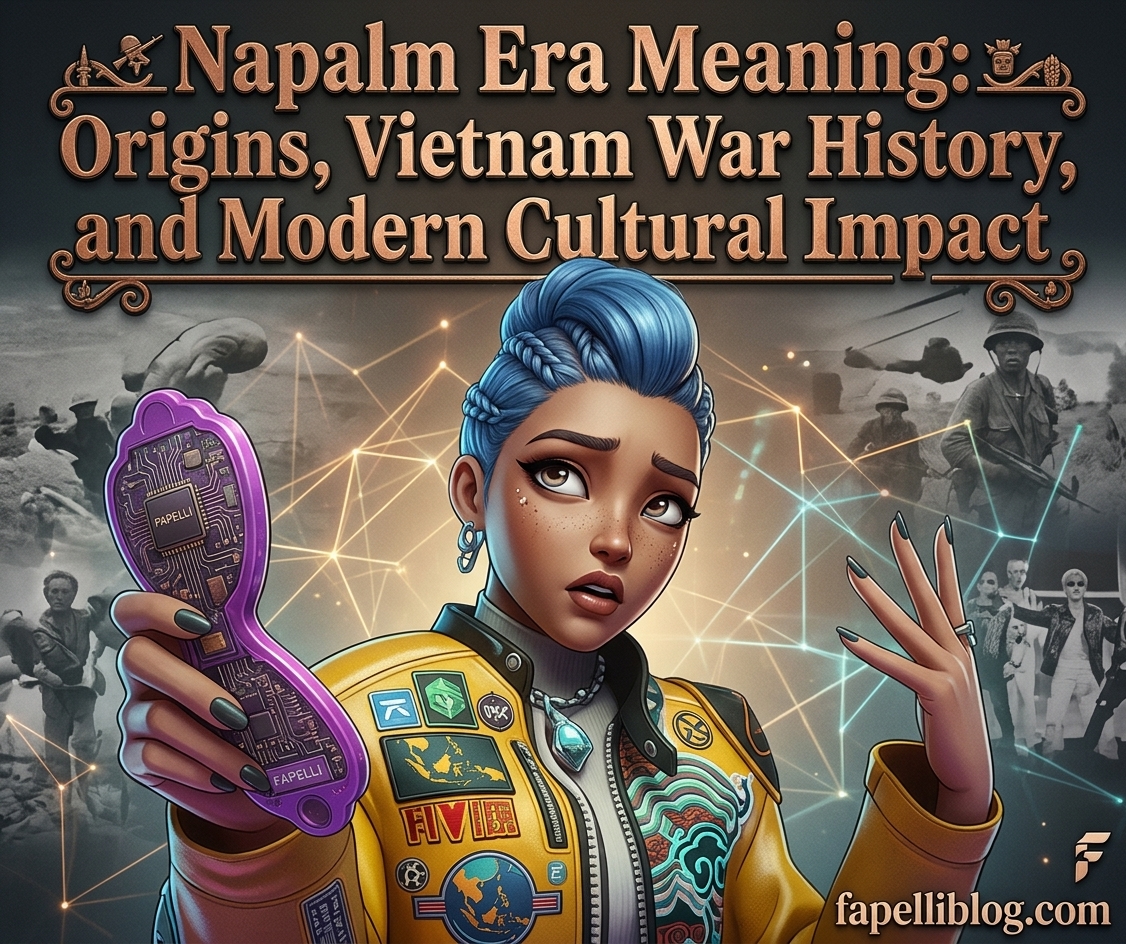
The Napalm Era refers to the period of cold war warfare—primarily during the 1960s and 1970s—characterized by the widespread military deployment of incendiary jellied gasoline (napalm) and the resulting societal, political, and cultural backlash. Historically anchored in the Vietnam War, the phrase also functions as a modern metaphor for devastating, scorch-earth escalation in political, corporate, or cultural conflicts.
What Is the “Napalm Era”? Core Definition and Historical Context
When historians discuss the Napalm Era, they are pointing to a specific time frame when technology, military strategy, and public media collided in unprecedented ways.
At its core, the term captures three distinct layers:
- The Tactical Era: The period surrounding the Vietnam War where incendiary weapons became central to close-air support and counter-insurgency warfare.
- The Media Era: The emergence of unfiltered, televised war coverage that brought graphic imagery of firebombing into living rooms across the globe.
- The Cultural Metaphor: Modern usage describing an aggressive, scorched-earth strategy where someone intentionally destroys everything in their path to win a conflict.
Understanding why this phrase carries such heavy emotional weight requires looking at how a chemical compound transformed into a geopolitical turning point. You may Also Like To Read About What Does Wabi Sabi Meaning In English?
The Chemical and Military Origins of Napalm
Napalm did not start in the jungles of Southeast Asia. Its roots trace back to World War II laboratories.
How Napalm Was Developed
Before napalm, militaries used standard gasoline in flamethrowers and incendiary bombs. Gasoline burned too quickly and flowed away from targets.
In 1942, a team of chemists led by Louis Fieser at Harvard University developed a thickener. By combining naphathenic and palmitic acids with gasoline, they created a sticky gel that burned hotter, longer, and adhered tightly to any surface it touched.
From WWII to the Vietnam War
Military forces used early napalm formulations extensively in World War II during the firebombing of Tokyo and across the Pacific Theater, as well as during the Korean War.
However, the phrase “Napalm Era” almost exclusively targets the Vietnam War period (1955–1975). During this conflict, the United States military deployed Napalm B, a safer-to-handle variant made from polystyrene, benzene, and gasoline.
Between 1963 and 1973, an estimated 388,000 tons of Napalm B were dropped in Southeast Asia.
Why the Napalm Era Defined a Generation: The Cultural Turning Point
Why did napalm become the defining symbol of 20th-century warfare over conventional artillery or high-explosive bombs? The answer lies in visibility and morality.
1. Unfiltered Television Coverage
The Vietnam War was the first “living-room war.” Photographic evidence and video footage bypassed government filters.
Images of napalm strikes—marked by towering walls of bright orange flame and thick black smoke—became daily visual staples on news broadcasts.
2. The Photo That Changed History
On June 8, 1972, Associated Press photographer Nick Ut captured “The Terror of War,” featuring nine-year-old Phan Thị Kim Phúc running naked down a road after surviving a napalm strike on her village of Trảng Bàng.
That single image crystallized the human cost of the Napalm Era. It stripped away technical military jargon and presented raw human suffering, accelerating anti-war sentiment across North America and Europe.
3. Corporate Boycotts and Activism
The Napalm Era shifted domestic politics. Dow Chemical, the primary manufacturer of Napalm B for the U.S. military from 1965 to 1969, became a major target for student protests.
College campuses saw massive strikes, boycotts, and recruitment blockades. This marked one of the first times in modern history that a private defense contractor faced sustained consumer and campus resistance over war production.
Modern Metaphor: How the Phrase “Napalm Era” Is Used Today
While rooted in military history, language evolves. Today, people use “Napalm Era” or “going napalm” in non-military settings.
Modern Usage Scenarios
Scenario A: Corporate & Business Warfare
“When the tech startup discovered their lead engineer stole the source code, the board entered a napalm era—suing suppliers, terminating contracts, and blacklisting former partners.”
In business, entering a “napalm era” means abandoning diplomatic resolution in favor of total destruction of an opponent’s market position, even if it causes self-inflicted collateral damage.
Scenario B: Pop Culture & Public Relations
“The singer launched her napalm era with that tell-all interview, burning bridges with her former label and ex-bandmates.”
In entertainment media, commentators label a celebrity’s scorched-earth PR campaign as their “napalm era.” It describes a period where someone airs grievances without holding back, destroying relationships for maximum dramatic impact.
Scenario C: Political Campaigns
“The candidate abandoned policy debates and shifted to a napalm-era strategy, attacking their opponent’s family, donor history, and personal life.”
In politics, it signifies a transition from constructive campaign strategies to aggressive, personal, and uncompromising attacks designed to obliterate a rival’s credibility.
Comparing Historical vs. Figurative Meanings
| Context | Historical Napalm Era (1960s–1970s) | Modern Figurative Napalm Strategy |
| Primary Domain | Geopolitics & Military History | Pop Culture, Business, Politics |
| Core Weapon | Incendiary Chemical Gel (Napalm B) | Social Media, PR, Litigation, Whistleblowing |
| Target | Fortified positions, supply routes, foliage | Reputation, market share, professional networks |
| Collateral Impact | Widespread environmental & human destruction | Collateral brand damage, lost partnerships |
| Key Symbol | Nick Ut’s 1972 photograph of Kim Phúc | Tell-all memoirs, viral exposure threads, scorched-earth lawsuits |
Common Misconceptions About the Napalm Era
Understanding history requires clearing away myths that have developed over decades of film, television, and internet discourse.
Myth 1: Napalm Was Invented Specifically for the Vietnam War
Fact: As noted, Harvard chemists developed napalm during World War II in 1942. It saw heavy use in Tokyo, Dresden, and throughout the Korean War long before its widespread deployment in Vietnam.
Myth 2: Napalm and Agent Orange Are the Same Thing
Fact: People often confuse these two weapons. Napalm is an incendiary chemical gel used to burn targets. Agent Orange is a chemical herbicide and defoliant used to strip away jungle foliage and crops.
Myth 3: Napalm Was Banned Immediately After the Vietnam War
Fact: While public outcry ended the heavy deployment of napalm by Western nations shortly after Vietnam, an official international restriction came later. Protocol III of the 1980 United Nations Convention on Certain Conventional Weapons regulated incendiary weapons, prohibiting their use against civilian populations.
Recommended Reads: What Does Wabi Sabi Mean?
Key Terms and Related Concepts (LSI Reference)
To understand historical discussions surrounding the Napalm Era, familiarize yourself with these associated terms:
- Incendiary Munitions: Weapons designed to start fires or destroy sensitive equipment using chemical fire agents.
- Scorched-Earth Policy: A military or strategic approach that destroys anything that might be useful to the enemy while advancing or retreating.
- Defoliation Campaign: The military destruction of vegetation to eliminate cover for opposing forces (e.g., Operation Ranch Hand).
- Asymmetric Warfare: War between belligerents whose relative military power or tactics differ significantly.
- Protocol III (CCW): The UN agreement limiting the use of air-delivered incendiary weapons in areas containing civilians.
Frequently Asked Questions
What does the “Napalm Era” mean in simple terms?
Historically, it refers to the 1960s and 1970s Vietnam War period characterized by the heavy use of incendiary weapons and intense media-driven anti-war protests. Metaphorically, it describes any period of extreme, scorched-earth conflict where someone destroys everything around them to defeat an adversary.
Who invented napalm and when?
Napalm was invented in 1942 by a team of chemists led by Dr. Louis Fieser at Harvard University in partnership with the U.S. Chemical Warfare Service.
Is napalm illegal under international law today?
Under Protocol III of the 1980 UN Convention on Certain Conventional Weapons, using air-delivered napalm or incendiary weapons against military targets located within concentrations of civilians is illegal. However, its targeted military use outside civilian areas remains restricted rather than completely banned for all signatories.
Why did napalm cause so much public backlash compared to other weapons?
Napalm sticks to surfaces—including human skin—and burns at temperatures between 800°C and 1,200°C (1,470°F to 2,190°F). The horrific nature of these injuries, combined with vivid color photojournalism shown on daily television news, turned public opinion against its deployment.
