

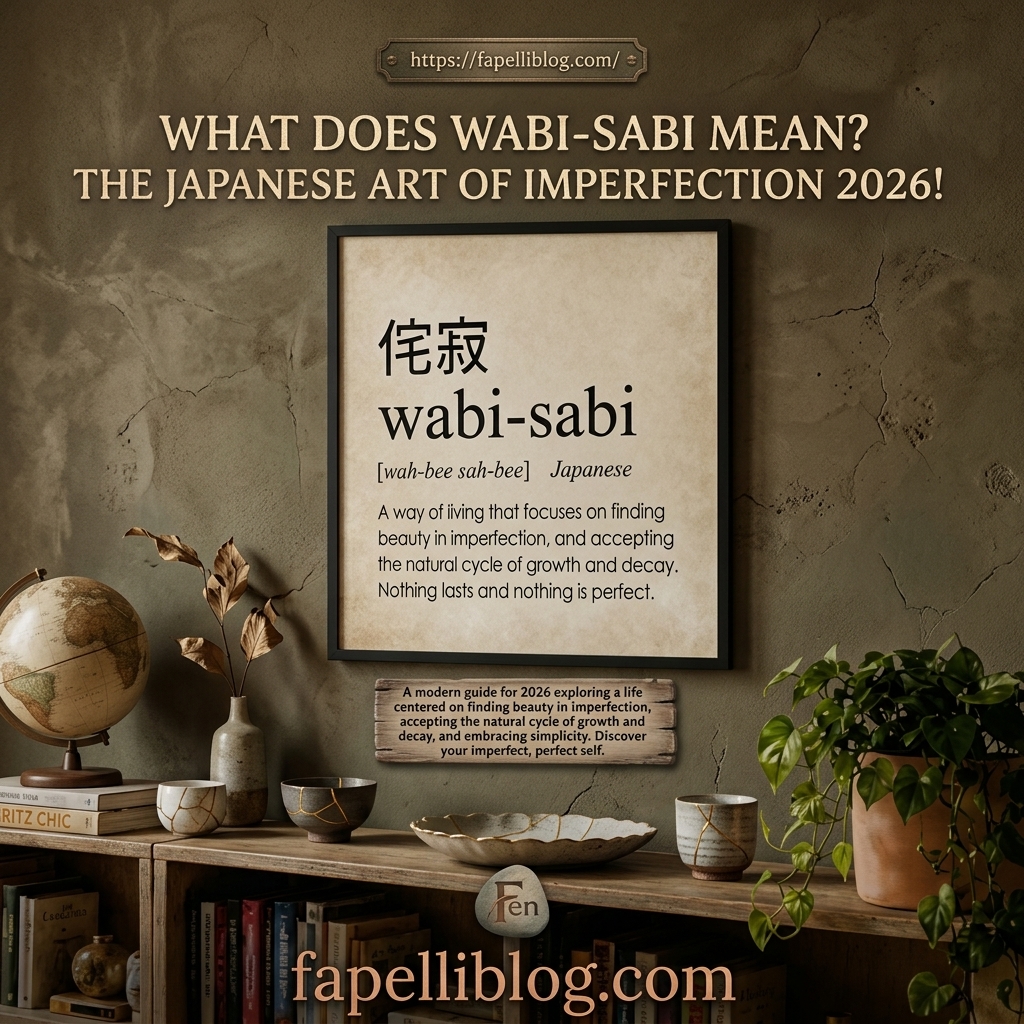
Wabi sabi is a traditional Japanese philosophy centered on finding beauty in imperfection, impermanence, and the natural cycle of decay. It combines two distinct concepts: wabi, which refers to finding fulfillment in simplicity and solitude, and sabi, which describes the quiet grace that comes with age and wear.
Most people encounter this term when looking at minimalist interior design or handmade ceramics. But reducing it to an aesthetic trend misses its true power. It is not just an interior design trend involving cracked pottery and raw linen. It is a fundamental worldview—a direct antidote to modern perfectionism, consumerism, and the endless pursuit of flawless outcomes.
In this comprehensive guide, we will unpack the origin of the term, explore how it applies to daily life and modern design, and break down how you can cultivate a wabi sabi mindset to reduce stress and embrace life as it is.
The Technical Breakdown: Etymology and Core Meaning
To understand what wabi sabi means, you have to break down its two root words. Neither word translates cleanly into a single English term, but together they form a rich conceptual framework. You May Also Like to Read About iicyify Meaning In English!
The Two Pillars of Wabi Sabi
Wabi (侘び)
Fulfillment in Simplicity & Solitude
- Finding profound joy in voluntary simplicity and unpretentious living.
- Detaching from material excess, clutter, and superficial luxury.
- Cultivating inner peace through quiet contentment and minimalist focus.
Sabi (寂び)
Beauty of Age, Wear, & Time
- Appreciating the natural patina, weathering, and gentle grace of aging.
- Respecting the physical marks and history left by time on objects.
- Accepting impermanence as a fundamental and beautiful law of nature.
What Is Wabi?
Historically, the word wabi stemmed from the verb wabu, which meant to languish, feel lonely, or live in solitude. Ancient Japanese literature often used it to describe the grim reality of living away from society in a quiet, isolated setting.
Over centuries—largely influenced by Zen Buddhist monks—the term transformed. It evolved from a state of loneliness into a deliberate choice to live simply.
Today, wabi represents:
- Finding joy in voluntary simplicity.
- Appreciating unpretentious, raw, and unrefined things.
- Detaching from material excess and superficial luxury.
- Cultivating inner peace through quiet contentment.
What Is Sabi?
The word sabi carries a temporal meaning. It relates to the passage of time and the natural degradation of physical objects. Its roots tie to words meaning “loneliness” or “to wither.”
In aesthetic terms, sabi is the patina that forms on weathered copper. It is the subtle wear on a worn wooden step. It is the visible history of an object exposed to the elements.
Today, sabi represents:
- The beauty found in aging, weathering, and natural wear.
- The poetic charm of patinas, rust, cracks, and faded colors.
- A deep respect for the physical marks left by history.
- Accepting impermanence as an inevitable law of nature.
Historical Origins: From Grandeur to Rust
The principles behind wabi sabi originated in China through Zen Buddhism, but the formal aesthetic movement took root in 16th-century Japan.
During this era, Japanese tea ceremonies (Chanoyu) were lavish affairs. Wealthy aristocrats used expensive, flawless porcelain imported from China. Tea rooms featured intricate decorations, gold accents, and immaculate craftsmanship.
Sen no Rikyu, a legendary Japanese tea master, radically disrupted this tradition.
The Tea Ceremony Revolution
High-Class Tea Ceremonies
The Pursuit of Extravagance
- Flawless Chinese porcelain and imported luxury goods
- Ornate gold ornamentation and polished aesthetics
- Lavish, aristocratic settings designed to impress
Sen no Rikyu’s Wabi Tea
The Birth of Authentic Simplicity
- Locally made, unpretentious clay cups and bowls
- Rough textures, rustic wooden tea huts, and natural materials
- Embracing organic flaws, asymmetry, and quiet mindfulness
Rikyu introduced a new way to practice the tea ceremony, known as Wabi-cha. He stripped away luxury. Instead of precious imported china, he used hand-molded, rough-surfaced local clay cups. He replaced ornate tea houses with simple, small mud-walled huts featuring thatched roofs.
If a cup chipped, he did not throw it away. He kept it, appreciating how the flaw told a story. This shift marked the birth of wabi sabi as a dominant cultural ethos in Japan.
The Core Principles of Wabi Sabi
You can distill the philosophy of wabi sabi into three core physical and metaphysical truths:
- Nothing lasts. All things are impermanent. Buildings weather, people age, and materials degrade.
- Nothing is finished. Evolution and decay are constant processes. The universe remains in a continuous state of becoming.
- Nothing is perfect. Flaws are not mistakes; they are the natural state of existence.
The Triad of Wabi Sabi
Impermanence
Nothing lasts, nothing is finished, and nothing is permanent in nature.
Incompleteness
Embracing ongoing growth, open loops, and spaces that leave room for evolution.
Imperfection
Valuing asymmetry, raw textures, and flaws as the true markers of authenticity.
When you view the world through this lens, your expectations shift. You stop expecting your home, your career, your body, or your relationships to remain flawless. You allow room for natural wear and tear.
Real-World Scenarios: Wabi Sabi in Action
How does this ancient concept manifest in modern life? It is easier to grasp when you see how it plays out across different scenarios.
Scenario 1: The Scratched Wooden Dining Table
Imagine buying a solid oak dining table.
- The Perfectionist View: You stress over every glass ring, dropped fork, or stray crayon mark. You buy oversized tablecloths, demand coasters, and feel anxious whenever guests gather.
- The Wabi Sabi View: You choose an unpolished wood table intentionally. When a friend accidentally dents the surface with a mug, you leave it. Over ten years, those marks turn into a physical ledger of shared meals, deep conversations, and lived family history. The table becomes warmer and more meaningful because of its wear.
Scenario 2: The Art of Kintsugi
Kintsugi (or Kintsukuroi) is the Japanese art of repairing broken pottery using lacquer dusted with powdered gold, silver, or platinum.
Broken Ceramic Plate
An object shatters, facing accidental damage and unexpected fragmentation.
Mended with Gold Lacquer
Carefully repaired using natural tree sap mixed with powdered gold or platinum.
Flaws Highlighted, Not Hidden
The breaks become a masterpiece, celebrating history and resilience over perfection.
Instead of discarding a shattered bowl or hiding the repair lines with clear glue, the artisan highlights the cracks. The breakage becomes a vital chapter in the object’s life story, making the repaired piece far more valuable and visually unique than the original unbroken cup. Recommended Reads: iicyify Meaning!
Scenario 3: Gardening and Nature
- The Perfectionist View: You lay synthetic turf, spray chemical weed killer every weekend, trim bushes into rigid geometric cubes, and panic over falling leaves.
- The Wabi Sabi View: You let moss grow naturally between uneven stone pavers. You value native wildflowers over manicured lawns. You appreciate the beauty of dead leaves enriching the soil in autumn just as much as spring blossoms.
Wabi Sabi vs. Modern Western Minimalism
People frequently confuse wabi sabi with Western minimalism. While both styles reject clutter and excess, their underlying motives are fundamentally different.
| Feature | Western Minimalism | Wabi Sabi |
| Primary Focus | Efficiency, clean lines, and space optimization | Texture, history, and natural processes |
| Materials | Glass, chrome, polished marble, synthetic metals | Unfinished wood, weathered stone, clay, linen |
| Stance on Flaws | Zero tolerance for damage, scuffs, or asymmetry | Celebrates scuffs, cracks, asymmetry, and age |
| Atmosphere | Ultra-clean, sterile, futuristic, controlled | Warm, grounded, rustic, organic |
| Color Palette | Stark whites, cool greys, solid blacks | Earth tones, muted greens, warm terracottas |
Western minimalism seeks absolute perfection through elimination. Wabi sabi seeks peace through acceptance of natural flaw.
How to Practice Wabi Sabi in Daily Life
Applying this mindset does not require moving into a mountain hut or tossing out all your possessions. You can integrate its principles immediately using these simple practices.
Audit Surroundings
Keep authentic, meaningful items
Reframe Aging
Value patina, wrinkles, and history
Clear Clutter
Retain items with genuine utility and warmth
Slow Down Habits
Engage fully in single, manual tasks

1 Comment
Pingback: Napalm Era Meaning: Origins, Vietnam War History, and Modern Cultural Impact