
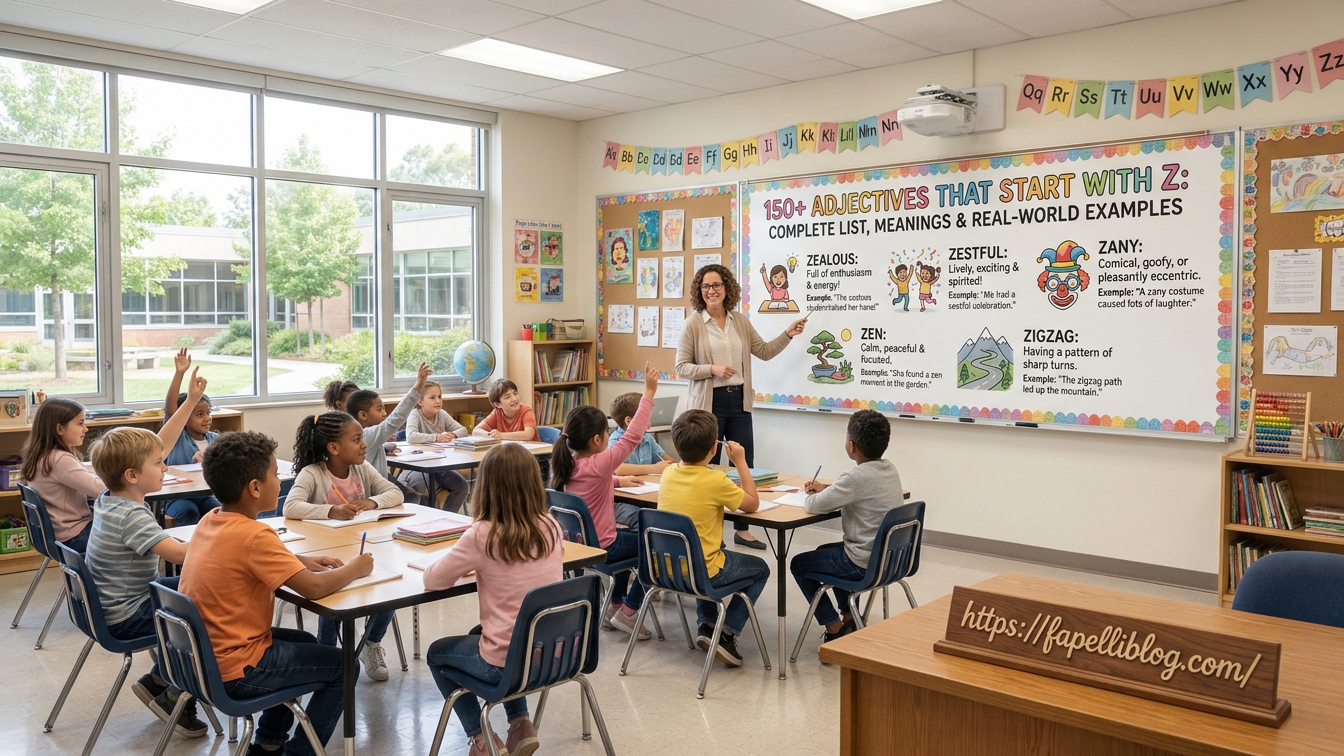
Adjectives that start with Z are descriptive words beginning with the 26th letter of the alphabet, including popular everyday terms like zealous, zesty, zany, and zen. While Z is the least common starting letter in the English dictionary, these high-impact modifiers add immediate energy, precision, and vivid sensory detail to creative writing, marketing copy, and everyday speech.
Most vocabulary lists just dump a wall of random words on your screen and wish you luck. That doesn’t help you when you are staring at a blinking cursor, trying to describe a bold flavor profile, an eccentric character, or a cutting-edge brand identity.
You need context. You need to know which Z-words belong in a boardroom pitch versus a comedy sketch, and which ones will make you sound like a walking thesaurus in the worst way possible.
In this guide, we are breaking down the absolute best adjectives starting with Z—categorized by tone, intensity, and real-world use cases—so you can upgrade your vocabulary immediately.
Why Are Adjectives That Start With Z So Rare (And Why Do They Pack Such a Punch)?
Here is a quick linguistic reality check. Out of roughly 170,000 words currently in use in the English language, less than 0.2% start with the letter Z.
Why? Blame Old English. Anglo-Saxon scribes barely used the letter Z at all, reserving it almost exclusively for borrowed Greek and Latin terms. The letter didn’t gain real traction in everyday English until the Norman Conquest, trade expansion, and the influx of loanwords from French, Italian, Spanish, Arabic, and German. You may also like to read about Hear,Here: The Ultimate Guide to Mastering Confusing Homophones..
Because Z-words are so scarce, they carry massive cognitive weight. When a reader sees a word starting with Z, their brain registers a pattern interrupt. It feels sharp. It vibrates. Linguists even call Z a “voiced alveolar fricative”—literally a buzzing sound made by vibrating your vocal cords while pushing air behind your teeth.
That physical buzz translates directly into meaning. Notice how many Z-adjectives describe high energy (zippy, zesty, zealous), chaos (zany, zonked), or extreme endpoints (zenithal, zero-sum). When you drop a well-placed Z-adjective into a sentence, people notice.
Positive Adjectives That Start With Z (For Uplifting & High-Energy Writing)
Need to inject optimism, enthusiasm, or sharp praise into your writing? These positive Z-adjectives are your heavy lifters. Recommended reads here Hear or Here: The Ultimate Guide to Mastering Confusing Homophones..
Everyday Positive Z-Adjectives
- Zealous: Filled with intense passion, devotion, or enthusiasm for a cause or goal. (Example: “She is a zealous advocate for sustainable urban farming.”)
- Zesty: Full of flavor, energy, spirit, or lively interest. (Example: “The chef topped the tacos with a zesty lime crema.”)
- Zippy: Fast, lively, energetic, and brisk. (Example: “This electric hatchback is surprisingly zippy in city traffic.”)
- Zen: Peaceful, calm, relaxed, and intuitively focused. (Example: “He maintained a totally zen attitude even when the server crashed.”)
- Zingy: Strikingly attractive, exciting, sharp, or full of vitality. (Example: “Her zingy one-liners saved the entire keynote presentation.”)
- Zazzy: Showy, stylish, flashy, and full of upbeat glamour. (Example: “He walked into the gala wearing a zazzy velvet blazer.”)
Niche & Elevated Positive Z-Adjectives
- Zaftig: Pleasantly plump, full-figured, and curvaceous (borrowed from Yiddish zaftik, meaning juicy). (Example: “Renaissance painters celebrated zaftig silhouettes as the ultimate standard of beauty.”)
- Zenithal: Relating to the highest point or peak of success, power, or celestial position. (Example: “The brand reached its zenithal moment during the Super Bowl broadcast.”)
- Zephyrean: Soft, gentle, mild, and refreshing, like a warm west breeze. (Example: “We spent the afternoon lounging in the zephyrean coastal air.”)
Funny, Quirky & Playful Adjectives Starting With Z
Sometimes serious vocabulary ruins the vibe. If you are writing fiction, social media captions, or lighthearted commentary, these words bring instant personality.
- Zany: Amusingly unconventional, eccentric, and wildly comical. (Example: “The sitcom relies on zany misunderstandings rather than sharp wit.”)
- Zonked: Completely exhausted, worn out, or fast asleep. (Example: “After a twelve-hour flight, I was totally zonked on the hotel bed.”)
- Zonky: Slightly crazy, eccentric, or bizarre in an entertaining way. (Example: “Their zonky marketing campaign broke every rule in the textbook.”)
- Zanyish: Mildly eccentric or bordering on comical absurdity. (Example: “He gave a zanyish grin before revealing the prank.”)
- Zibeline: Soft, glossy, and luxurious like sable fur. (Example: “The coat had a rich, zibeline sheen under the boutique lights.”)
- Zooty: Flashy, flamboyant, and stylish in a retro, jazz-era way (derived from 1940s zoot suits). (Example: “The swing band showed up in sharp, zooty pinstripes.”)
Negative & Critical Adjectives That Start With Z
Not every Z-word is a compliment. When you need to critique bad logic, lack of effort, or toxic behavior, reach for these sharp descriptors.
- Zero-sum: Describing a situation where one person’s gain equals another person’s exact loss. (Example: “Stop treating career growth like a zero-sum game.”)
- Zombified: Lacking energy, independent thought, or awareness; acting like a zombie. (Example: “Three hours of doomscrolling left him completely zombified.”)
- Zealot-like: Dogmatic, uncompromising, and fanatical to an unhealthy degree. (Example: “His zealot-like refusal to hear feedback stalled the project.”)
- Zilch-worthy: Worthless, insignificant, or amounting to nothing (informal). (Example: “The sequel delivered a zilch-worthy plot wrapped in expensive CGI.”)
- Zymotic: Relating to fermentation, or historically, infectious diseases that spread rapidly like fermentation. (Example: “Nineteenth-century doctors struggled to contain zymotic outbreaks in crowded cities.”)
- Zonal (restrictive context): Divided into rigid, isolated zones that prevent unified flow. (Example: “Overly zonal urban planning creates dead neighborhoods after 6 PM.”)
Scientific, Academic & Technical Adjectives Starting With Z
Writing a research paper, technical manual, or hard sci-fi novel? These precise terms come straight from biology, geology, geometry, and physics.
- Zygomorphic: Bilaterally symmetrical; capable of being divided into identical halves along only one plane (commonly used in botany for flowers like orchids).
- Zygotic: Relating to a zygote (a fertilized eukaryotic cell).
- Zoic: Relating to animals or animal life, or containing fossilized animal remains (as in Mesozoic or Paleozoic).
- Zoonotic: Referring to diseases that can be transmitted from animals to humans (e.g., rabies or avian flu).
- Zoophagous: Feeding on animals; carnivorous.
- Zoophilic: Attracted to animals, or referring to plants pollinated by animals rather than wind.
- Zonal: Arranged in or relating to distinct zones, bands, or regions (used in meteorology and geology).
- Zirconic: Containing or resembling the mineral zircon or the chemical element zirconium.
- Zymogenic: Causing fermentation or producing enzymes.
- Zetetic: Proceeding by inquiry or investigation; skeptical and questioning.
- Zosteriform: Resembling a belt or girdle, or following the distribution pattern of shingles (herpes zoster) on the skin.
Practical Usage & Everyday Scenarios: How to Use Z-Adjectives Naturally
Knowing a word’s dictionary definition is only half the battle. Here is how you actually deploy Z-adjectives across four distinct real-world scenarios without sounding forced.
1. Food Writing, Menus & Culinary Reviews
Food descriptions live and die by sensory words. Skip boring adjectives like “good” or “tangy.”
- Instead of: “The salad has a strong lemon dressing.”
- Write: “The salad is tossed in a zesty, zingy Meyer lemon vinaigrette that cuts right through the richness of the burrata.”
2. Business, Branding & Product Copy
In marketing, you have roughly two seconds to capture attention. Z-adjectives signal speed, modernity, and disruption.
- Instead of: “Our new software is fast and avoids old-school competition.”
- Write: “We built a zippy, intuitive workflow tool designed for teams tired of zero-sum office politics.”
3. Creative Writing & Character Development
Characters need distinct silhouettes. A single sharp adjective establishes personality faster than three paragraphs of backstory.
- Instead of: “Uncle Arthur was weird, energetic, and wore loud clothes.”
- Write: “Uncle Arthur was a zany, zooty retired magician who treated every family dinner like a Vegas residency.”
4. Casual Conversation & Texting
In everyday speech, keep it grounded. Stick to accessible words like zen, zonked, zippy, and zesty.
- Example: “I can’t make it to trivia tonight—after that double shift, I am completely zonked.”
Nuances, Cultural Connections & Regional Variations
Context changes everything. A word that lands as high praise in New York might raise eyebrows in London or fall completely flat in a formal academic journal.
The Fine Line Between “Zealous” and “Overzealous”
Zealous sits on a razor’s edge. On its own, it generally leans positive—describing someone passionate, dedicated, and driven. Add the prefix over-, however, and overzealous flips immediately into a criticism of fanaticism, boundary-crossing, or reckless enthusiasm. Always check your surrounding context so readers know whether you admire the person’s drive or want them to dial it back.
Cultural Borrowings That Shaped Z-Words
Because native English lacked Z-words, our most expressive Z-adjectives carry rich cultural fingerprints:
- Yiddish Influence: Words like zaftig (juicy, full-figured) entered American English through New York’s vibrant Jewish cultural and theatrical scenes, bringing warmth and body-positivity long before the modern movement existed.
- Eastern Philosophy: Zen began as the Japanese pronunciation of the Chinese Chan (meditation). Today, using zen as an adjective (“a very zen workspace”) is universal shorthand for minimalist calm.
- Jazz & Street Slang: Zooty and zazzy emerged from mid-20th-century American jazz culture, capturing rebellion, rhythm, and unapologetic style.
Compound Z-Adjectives in Modern Digital Slang
In 2026, digital culture loves hyphenated Z-modifiers. Terms like zero-chill, zero-effort, zero-tolerance, and zone-out function as everyday adjectives in Slack channels, TikTok captions, and Reddit threads. They aren’t traditional single-word dictionary entries, yet they dominate how people actually describe modern behavior.
Step-by-Step Guide: How to Choose the Right Z-Adjective Without Overdoing It
Want to weave Z-adjectives into your writing like a seasoned editor? Follow this four-step filter before hitting publish.
- Identify the Exact Energy Level: Are you describing calm (zen, zephyrean), high speed (zippy, zesty), or chaotic humor (zany, zonky)? Never use a high-voltage Z-word in a quiet, understated sentence unless you want intentional contrast.
- Match the Register to Your Audience: Save technical terms like zygomorphic, zoonotic, and zetetic for scientific or analytical contexts. If you drop zetetic into a casual lifestyle blog, you will lose your reader instantly.
- Limit Yourself to One Z-Word Per Paragraph: Because the letter Z draws heavy visual and phonetic attention, stacking multiple Z-adjectives close together turns prose into a tongue-twister (“The zany, zealous, zesty chef…”). Let one strong word carry the load.
- Read the Sentence Out Loud: Check the rhythm. Z-words work best when paired with crisp consonants and short surrounding words that let the “buzz” breathe.
Common Mistakes & Misunderstandings to Avoid
Even strong writers trip over Z-words. Watch out for these four classic traps:
- Confusing “Zesty” With “Spicy”: Zesty means bright, lively, and full of fresh, tangy flavor (like citrus peel or fresh herbs). It does not mean fiery hot or loaded with chili peppers.
- Using “Zealous” When You Mean “Jealous”: They rhyme, and autocorrect loves to swap them, but they have zero overlap in meaning. Zealous means intensely passionate; jealous means envious or protective.
- Misspelling “Zany” as “Zaney”: There is no “e” before the “y” in zany. Keep it clean: Z-A-N-Y.
- Treating “Zen” as a Synonym for “Lazy”: Calling someone zen implies composed mindfulness and emotional control under pressure—not apathy or lack of ambition.
Comprehensive Comparison Table: Top 25 Adjectives That Start With Z
Use this quick-reference matrix to match the right Z-adjective to its tone, meaning, and ideal writing context.
| Adjective | Tone / Vibe | Core Meaning | Best Use Case |
| Zealous | Intense / Positive | Deeply passionate and devoted | Profiles, leadership, advocacy |
| Zesty | Bright / Energetic | Full of lively flavor or spirit | Food writing, lifestyle copy |
| Zany | Comedic / Quirky | Amusingly unconventional and eccentric | Comedy reviews, character bios |
| Zen | Calm / Grounded | Peaceful, mindful, and unflappable | Wellness, workplace culture |
| Zippy | Fast / Upbeat | Brisk, lively, and energetic | Tech reviews, automotive, marketing |
| Zingy | Sharp / Exciting | Strikingly witty, lively, or piquant | Entertainment, culinary reviews |
| Zonked | Casual / Tired | Completely exhausted or fast asleep | Dialogue, personal essays |
| Zero-sum | Analytical / Critical | One side’s gain equals another’s loss | Economics, business strategy |
| Zaftig | Warm / Complimentary | Pleasantly full-figured and shapely | Fashion, art history, fiction |
| Zazzy | Flashy / Stylish | Showy, glamorous, and upbeat | Fashion, event coverage |
| Zenithal | Elevated / Formal | At the absolute peak or highest point | Historical analysis, branding |
| Zephyrean | Poetic / Gentle | Soft, mild, and breezy | Travel writing, nature descriptions |
| Zombified | Critical / Dark | Mentally drained, numb, or mechanical | Social commentary, tech critique |
| Zooty | Retro / Flamboyant | Flashy and stylish in a jazz-era way | Historical fiction, menswear |
| Zibeline | Luxurious / Sensory | Soft and glossy like sable fur | Interior design, luxury fashion |
| Zonky | Playful / Offbeat | Slightly bizarre or eccentric | Pop culture, creative critiques |
| Zoonotic | Scientific / Urgent | Transmissible from animals to humans | Medical reporting, public health |
| Zygomorphic | Technical / Precise | Bilaterally symmetrical along one plane | Botany, biology, design geometry |
| Zetetic | Intellectual / Formal | Proceeding by skeptical inquiry | Philosophy, academic essays |
| Zonal | Technical / Structural | Divided into distinct bands or zones | Geography, urban planning, science |
| Zoic | Scientific / Historical | Relating to animal life or fossils | Paleontology, geology |
| Zymotic | Medical / Historical | Relating to fermentation or infectious spread | Medical history, brewing science |
| Zoophagous | Academic / Biological | Feeding on animals; carnivorous | Zoology, ecology |
| Zirconic | Technical / Material | Containing zircon or zirconium | Chemistry, jewelry, engineering |
| Zero-chill | Modern Slang | Lacking restraint, patience, or subtlety | Social media, casual commentary |
Frequently Asked Questions (FAQ)
What are the most common positive adjectives that start with Z?
The most common positive adjectives starting with Z are zealous, zesty, zen, zippy, and zingy. These five words work effortlessly in everyday conversation, creative writing, and marketing without sounding overly academic or obscure.
Why are there so few adjectives starting with the letter Z?
There are very few Z-adjectives because Old English rarely used the letter Z, relying mostly on borrowed words from Greek, Latin, French, and Yiddish. Fewer than 0.2% of all English dictionary entries begin with Z, making them statistically rare but highly memorable.
What is a good Z-adjective to describe a person?
To describe a person positively, use zealous (passionate), zen (calm), zesty (lively), or zazzy (stylish). If the person is delightfully eccentric or comedic, zany is the most accurate choice; if they are completely exhausted, call them zonked.
Is “zen” officially an adjective?
Yes, zen functions officially as an adjective in modern English to describe someone or something that is peaceful, calm, and intuitively focused. While it originated as a noun referring to a school of Mahayana Buddhism, dictionaries widely recognize its adjectival use in everyday speech.
What is a fancy or sophisticated adjective that starts with Z?
Sophisticated adjectives starting with Z include zenithal (at the highest peak), zephyrean (gentle and breezy), and zetetic (inquiring and investigative). Use these sparingly in formal essays, literary fiction, or elevated descriptive writing.
Final Takeaway
When choosing an adjective that starts with Z, follow the One-Spark Rule: Treat every Z-word like a match struck in a dark room—use just one to illuminate the entire sentence, and never strike three at once. Because Z carries unmatched phonetic buzz and visual rarity, a single well-placed word like zesty, zealous, or zen will always outperform a cluttered paragraph of ordinary modifiers.
Strong action verbs that start with Z
Action verbs that start with Z are dynamic words beginning with the 26th letter of the alphabet—such as zap, zoom, zero in, zest, and zigzag—that convey sudden speed, sharp focus, electricity, or decisive movement.
Because Z is statistically the rarest starting letter in English, Z-verbs function like linguistic exclamation points. Drop one into a sentence and it immediately jolts the reader awake. Here is a categorized breakdown of the strongest Z-verbs, complete with exact meanings and real-world examples.
High-Speed & Movement Verbs (For Energy and Momentum)
Use these verbs when you want to describe rapid motion, sudden shifts in direction, or bursts of physical energy.
- Zoom: To move or travel very quickly, often with a low buzzing or humming sound.
- Example: “The electric courier bike zoomed past the stalled morning traffic.”
- Zip: To move with sudden speed and agility, or to fasten something with a zipper.
- Example: “She zipped through her inbox in twenty minutes before the standup meeting.”
- Zigzag: To veer alternately to the right and left in sharp, sudden angles.
- Example: “The running back zigzags across the field to evade three defenders.”
- Zing: To move swiftly with a high-pitched whistling or ringing sound, or to strike with sharp wit.
- Example: “An arrow zinged past the target and embedded itself in the oak tree.”
- Zoom-in: To focus rapidly and closely on a specific detail or subject (literal or figurative).
- Example: “The detective zoomed in on the timestamp at the bottom of the security footage.”
High-Impact & Forceful Verbs (For Destruction, Shock, and Precision)
When ordinary verbs like hit, delete, or focus feel too soft, these Z-verbs deliver sharper punch.
- Zap: To destroy, strike, or hit suddenly with a burst of energy, electricity, or decisive force.
- Example: “A sudden power surge zapped the motherboard before the backup generator kicked in.”
- Zero in (on): To aim directly at or focus all attention onto a specific target or problem.
- Example: “The engineering team zeroed in on a memory leak causing the app to crash.”
- Zero out: To reduce a balance, score, or variable completely to zero.
- Example: “Accounting zeroed out the remaining departmental budget at the end of Q4.”
- Zonk (out): To fall asleep suddenly and deeply from exhaustion, or to stun/knock out.
- Example: “After hiking twelve miles in the heat, he zonked out on the sofa within seconds.”
- Zetz: To strike a sharp, forceful blow (borrowed from Yiddish zets).
- Example: “He zetzed the stuck vending machine with his palm until the snack dropped.”
Culinary, Sensory & Creative Verbs (For Flavor, Craft, and Style)
These verbs bring vivid texture to food writing, design, and creative expression.
- Zest: To scrape the outer colored peel from citrus fruit for flavoring, or to add excitement and energy.
- Example: “The pastry chef zested three blood oranges directly over the warm glaze.”
- Zhoosh (or Zhuzh): To make something more lively, stylish, or exciting with a quick adjustment or flourish.
- Example: “We zhooshed up the plain living room with a patterned rug and brass lamps.”
- Zinc: To coat iron or steel with a protective layer of zinc (galvanizing) to prevent rust.
- Example: “Workers zinced the coastal bridge cables to protect them from salt corrosion.”
Technical, Scientific & Specialized Verbs (For Academic and Analytical Writing)
These precise terms appear in chemistry, engineering, biology, and formal research.
- Zeolitize: To convert a mineral or rock into zeolite through chemical alteration.
- Example: “Volcanic ash deposits zeolitized over millennia after reacting with alkaline groundwater.”
- Zincify: To impregnate or coat a material with zinc.
- Example: “Manufacturers zincify outdoor fasteners to extend their structural lifespan.”
- Zymolyze: To subject a substance to enzymatic fermentation or breakdown.
- Example: “The lab technicians zymolyzed the yeast cell walls to extract pure proteins.”
- Zonify: To divide an area, territory, or system into distinct functional zones.
- Example: “City planners zonified the waterfront district to separate heavy shipping from residential parks.”
Quick Comparison Matrix: Choosing the Right Z-Verb
| Verb | Primary Vibe | Transitive / Intransitive | Best Context |
| Zap | Sudden force / Electricity | Transitive | Tech, sci-fi, editing (“zap a bug”) |
| Zero in | Laser focus / Precision | Intransitive (with on) | Business strategy, investigation |
| Zhoosh | Style / Polish / Flair | Transitive | Fashion, interior design, branding |
| Zigzag | Evasive / Erratic motion | Both | Sports, travel, narrative action |
| Zip | Brisk efficiency / Speed | Both | Productivity, casual storytelling |
| Zest | Bright flavor / Vitality | Transitive | Culinary recipes, food journalism |
One Rule for Using Z-Verbs Effectively
Use Z-verbs as solo percussion hits, never as a drumroll. Because verbs like zap, zoom, and zhoosh carry high phonetic friction, placing two in the same sentence creates cartoonish overemphasis. Let one sharp Z-verb anchor your action, and surround it with clean, understated nouns.
Adjectives that start with a-z
An ambitious, brilliant, and charismatic explorer set out across a dazzling, emerald valley beneath an immense, jagged mountain range. Guided by keen, luminous instincts and a methodical, noble spirit, she navigated obscure, perilous trails with quiet, resilient grace. Every serene, tranquil dawn brought unforgettable, vibrant landscapes—from windswept, xenial coastal villages to youthful, zesty orchards bursting with life.
