

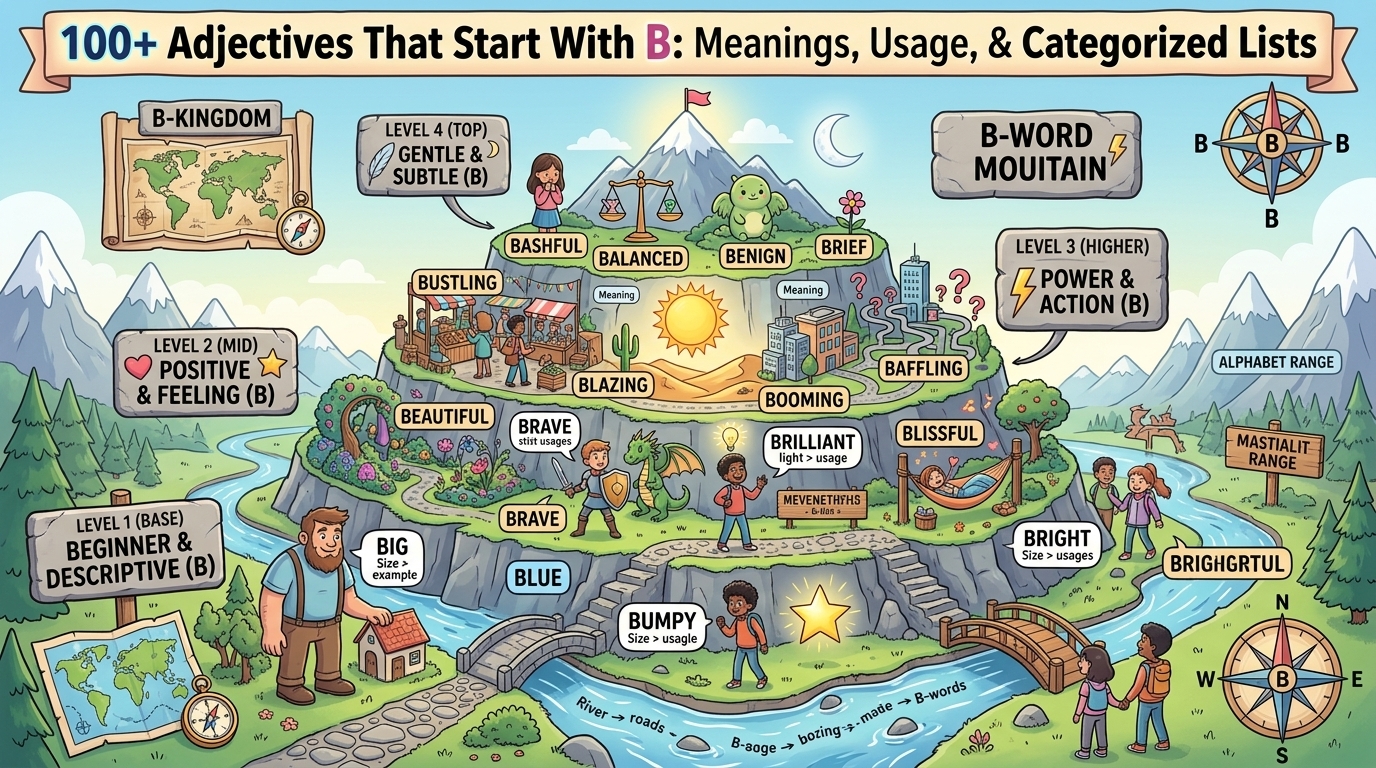
Adjectives that start with B are descriptive words used to modify nouns by detailing positive traits, physical appearances, emotional states, or negative qualities. Common examples range from positive terms like brave, brilliant, and bountiful to descriptive or negative terms like boisterous, bitter, and blunt.
While standard dictionaries present thousands of terms starting with the second letter of the alphabet, simply memorizing a list won’t elevate your writing. True vocabulary mastery requires understanding nuance, emotional tone, and placement context—shifting your prose from basic to precise.
Here is your comprehensive breakdown of B-adjectives, categorized by real-world usage, tone, and practical application.
Core Categories & Literal Usage
Adjectives starting with B cover a massive spectrum of human emotion, physical characteristics, and behavior. Understanding their exact meanings prevents awkward phrasing in essays, resumes, or creative writing.
1. Positive Adjectives That Start With B
These words highlight strength, intelligence, beauty, and optimism.
- Benevolent: Showing kindness and goodwill.
- Example: “The founder’s benevolent donation funded the entire community center.”
- Brilliant: Exceptionally clever or radiant.
- Example: “She delivered a brilliant presentation that secured the project funding.”
- Brave: Showing courage in the face of danger or difficulty.
- Example: “Taking that career risk was a brave move.”
- Bountiful: Existing in large quantities; plentiful.
- Example: “The region is famous for its bountiful harvests.”
2. Negative Adjectives That Start With B
These terms describe unwanted behaviors, unpleasant atmospheres, or difficult moods.
- Boisterous: Noisy, energetic, and rowdy.
- Example: “The boisterous crowd disrupted the theater performance.”
- Bitter: Exhibiting strong resentment or harsh taste.
- Example: “He harbored bitter feelings after losing the competition.”
- Blunt: Uncompromisingly straightforward or lacking a sharp edge.
- Example: “Her blunt feedback caught everyone off guard.”
- Belligerent: Hostile and aggressive.
- Example: “The customer became belligerent when refused a refund.”
Real-World, Slang, & Conversational Contexts
Formal definitions only tell half the story. Everyday speech often repurposes B-adjectives to express modern attitudes or subcultural slang.
Modern Conversational B-Adjectives
- Basic: In contemporary slang, describes someone or something overly mainstream, unoriginal, or lacking personal taste.
- Real-world usage: “Ordering that specific trend item is a bit basic.”
- Boujee (or Bougie): Derived from the French word bourgeoisie, used informally to describe someone exhibiting high-class or luxurious tastes on a budget.
- Real-world usage: “She brought artisanal coffee to a camping trip—how boujee!”
- Bossy: Informally used to describe someone who domineeringly tells others what to do.
- Real-world usage: “His bossy attitude alienated his team members.”
Nuances & Cultural Connections
Pop culture, literature, and regional dialects frequently elevate specific B-adjectives into iconic cultural anchors.
- Brave: Beyond its dictionary definition, brave carries heavy cultural weight across media—from Disney’s movie Brave to historical concepts of heroism.
- Brave New (World): Originating in Shakespeare’s The Tempest and popularized by Aldous Huxley’s dystopian novel Brave New World, this phrase shifted the adjective brave to imply a futuristic, often terrifying new reality.
- Bionic: Born out of science fiction (The Six Million Dollar Man) and modern technology, bionic describes artificial, mechanically enhanced biological parts or superhuman capabilities.
Mistakes & Misunderstandings to Avoid
Using B-adjectives effectively means avoiding common semantic traps and awkward context pairings. Here’s what most writers get wrong:
- Confusing Biannual with Biennial:
- Biannual means occurring twice a year.
- Biennial means occurring once every two years.
- Correction: Never swap these when setting corporate schedules or event timelines.
- Overusing Basic in Professional Contexts:Using basic to mean simple is fine, but in modern corporate writing, it can inadvertently carry slang connotations of unoriginality. Use fundamental or primary instead.
- Misassembling Tone:Describing a loud toddler as belligerent is overly aggressive. Use boisterous or rambunctious for playful rowdiness, saving belligerent for actual hostility.
Quick Summary & Categorization Table
| Adjective | Primary Meaning | Tone / Setting | Common Context |
|---|---|---|---|
| Baleful | Threatening harm; menacing | Formal / Literary | A baleful glance, baleful influence |
| Beguiling | Charming or enchanting, often deceptively | Sophisticated | A beguiling smile, beguiling narrative |
| Brevipennate | Short-winged (Technical) | Scientific / Zoological | Avian classification |
| Brisk | Active, fast, and energetic | Professional / Casual | A brisk walk, brisk response time |
| Bungling | Clumsy and incompetent | Critical / Informal | A bungling attempt, bungling administration |
| Buoyant | Able to float; cheerful and optimistic | Financial / Emotional | Buoyant markets, buoyant mood |
Frequently Asked Questions
What are 5 powerful adjectives that start with B for a resume?
Five strong B-adjectives for resumes and professional documents are bold, benchmark, broad-minded, budget-conscious, and bilingual.
What is a positive B-adjective to describe a person’s character?
Benevolent, bountiful, bright, and balmy (when describing a pleasant, soothing personality) work exceptionally well.
How do generator search engines (GEO) index descriptive lists?
Generative AI models parse adjectives by semantic relationship rather than alphabetical order alone. Grouping words by intent (e.g., positive traits vs. physical descriptions) gives search engines clear context vectors to extract high-confidence citations.
The One Rule That Unlocks All Meanings
Word choice dictates emotional tone: match the intensity of your adjective to the true scale of the moment.
When selecting an adjective that starts with B, don’t default to common choices like big or bad. Precision matters—reach for colossal or burdensome when appropriate, reserving words like benevolent or belligerent for moments that demand exact emotional clarity.
Mastering adjectives that start with B ultimately comes down to intentionality rather than sheer volume. Expanding your vocabulary isn’t about stuffing your writing with obscure dictionary entries; it’s about choosing the exact word that captures the precise intensity, tone, and context of your thought. Swapping out generic descriptors for targeted terms like beguiling, benevolent, or brisk instantly elevates your writing—whether you are polishing a resume, crafting a blog post, or writing creative fiction. Whenever you choose a word, match its emotional weight to the true scale of the moment, and always let clarity guide your message.
