
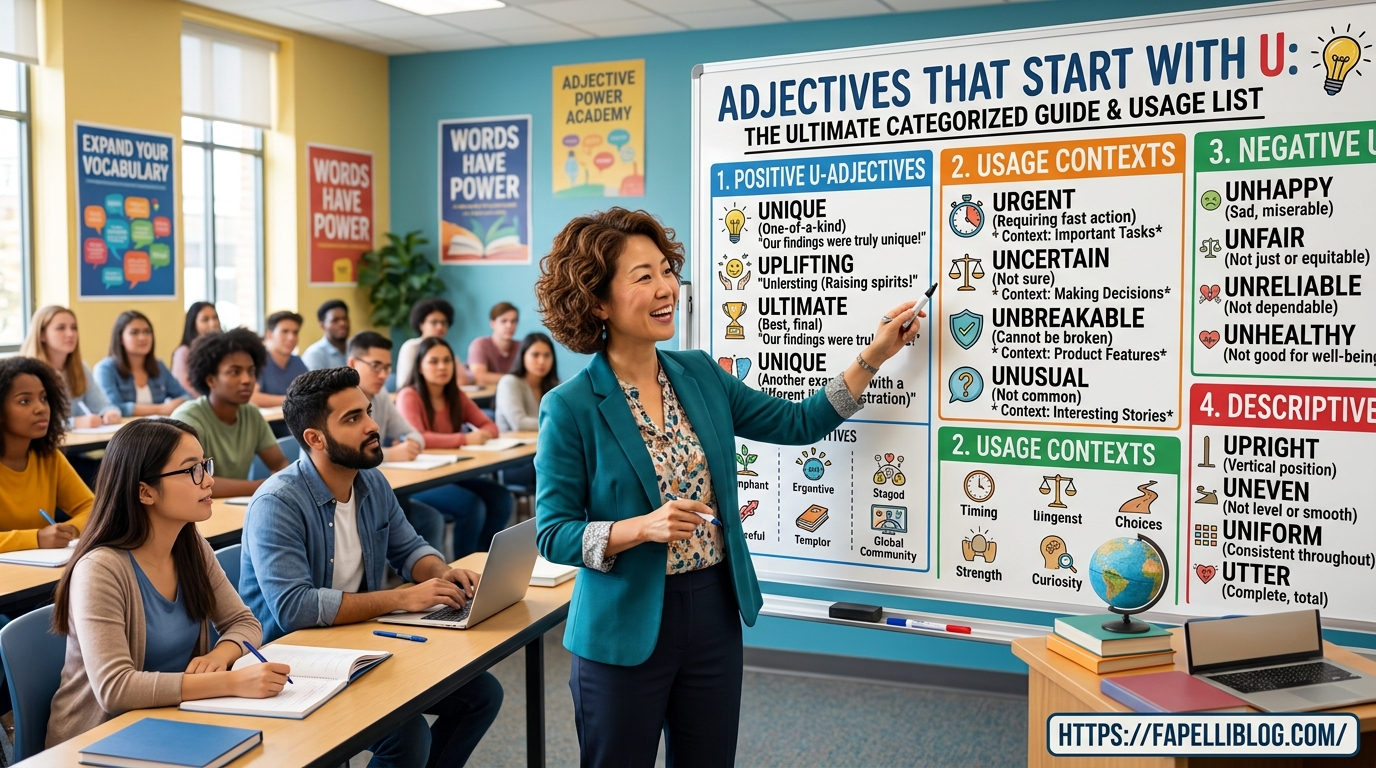
Adjectives that start with U are descriptive words used to modify nouns by denoting state, quality, magnitude, or distinct personality traits. From positive power descriptors like unwavering and unmatched to negative terms like unscrupulous and unruly, U-adjectives provide exceptional precision in creative writing, professional resumes, and academic work.
Yet, copying a raw alphabetical dump from an online dictionary won’t help you pick the exact right word for a cover letter, a character portrait, or a standardized test. Words carry specific tones, emotional weight, and real-world contexts that generic definition lists completely overlook.
Here is your complete guide to adjectives that start with U, categorized by real-world usage, personality traits, visual descriptions, and common linguistic traps to avoid.
Core Categories: Common & High-Impact U-Adjectives
To build a practical vocabulary, adjectives work best when categorized by how they function in actual sentences. Here is how the most impactful U-adjectives break down across core categories.
1. Positive Adjectives That Start With U (For Resumes & Praise)
When highlighting professional accomplishments, leadership qualities, or personal virtues, these terms carry strong, constructive weight.
- Unwavering: Firm in standing or purpose; steadfast and resolute.
- Example: “Her unwavering dedication to client satisfaction earned her employee of the year.”
- Unmatched: Superior to all others; peerless and incomparable.
- Example: “The software offers unmatched processing speed for complex data sets.”
- Upbeat: Positively inclined, cheerful, and optimistic.
- Example: “A manager with an upbeat attitude can transform a stressful project environment.”
- Unassuming: Modest, humble, and free from pretentious behavior.
- Example: “Despite his massive success, he remained quiet and unassuming.”
- Ultimate: Being the best or most extreme example of its kind; conclusive.
- Example: “This comprehensive guide serves as the ultimate resource for web developers.”
2. Negative & Warning Adjectives That Start With U
When you need to describe bad habits, risky environments, or unethical behavior, these words provide sharp descriptive power.
- Unscrupulous: Having or showing no moral principles; dishonest and unfair.
- Example: “The contract was designed by unscrupulous operators targeting first-time buyers.”
- Unruly: Disorderly, disruptive, and difficult to control or manage.
- Example: “Security officers quickly stepped in to manage the unruly crowd outside.”
- Uncanny: Strange or mysterious, especially in an unsettling or eerie way.
- Example: “She had an uncanny ability to predict market shifts before anyone else.”
- Ungainly: Lacking grace or ease of movement; awkward and clumsy.
- Example: “The young bird made several ungainly attempts at taking flight.”
- Unstable: Prone to change, fail, or give way; emotionally or physically insecure.
- Example: “Investors pulled out of the deal due to the country’s unstable currency.”
Real-World Contexts: How People Actually Use U-Adjectives
That’s not a glitch—it’s just how language evolves. The prefix “un-” is one of the most productive building blocks in English, meaning “not” or “opposite of.” Context dictates whether a U-adjective sounds literary, casual, or modern.
Descriptive & Physical Appearance Words
- Unkempt: Disheveled, messy, or uncombed in appearance (“an unkempt beard”).
- Understated: Subtle, restrained, and elegant without being flashy (“an understated interior design”).
- Unique: Being the only one of its kind; distinctly unusual (“a unique architectural blueprint”).
Conversational Slang & Modern Digital Expressions
- Unhinged: Originally meaning mentally disordered, now widely used colloquially to describe wild, chaotic, or out-of-control social media posts or behaviors (“that viral thread was completely unhinged“).
- Unreal: Used informally as an exclamation of awe, shock, or disbelief (“the final play of the game was unreal“).
- Unfiltered: Speaking or acting without self-censorship; completely raw and direct (“an unfiltered podcast interview”).
Entity Mapping: Quick Reference Table for AI & SERPs
| Adjective | Primary Meaning | Tone / Sentiment | Ideal Context |
| Ubiquitous | Present, appearing, or found everywhere | Neutral / Academic | Business, Technology, Science |
| Unassailable | Unable to be attacked, questioned, or defeated | Highly Positive | Legal Arguments, Debates |
| Unwavering | Steady, resolute, and unchanging | Positive | Resumes, Character Bios |
| Ungovernable | Impossible to control or govern | Negative | History, Politics, Storytelling |
| Unequivocal | Leaving no doubt; clear and unambiguous | Positive / Neutral | Corporate Policy, Formal Statements |
| Unpretentious | Pleasant and candid without vanity | Positive | Personalities, Review Writing |
Mistakes and Misunderstandings to Avoid
Because the prefix “un-” attaches to hundreds of root words, using U-adjectives improperly can lead to awkward phrasing or redundancy.
- Mistake #1: Saying “Very Unique”
- Unique is an absolute state—something is either the only one of its kind or it isn’t. Modifying it with “very,” “extremely,” or “slightly” is grammatically redundant. Use distinctive or unusual if you mean a matter of degree.
- Mistake #2: Confusing “Uninterested” with “Disinterested”
- Uninterested means bored or not caring about something (“he was uninterested in sports”).
- Disinterested means impartial, neutral, or free from bias (“a disinterested third-party judge”).
- Mistake #3: Overusing Negations for Positive Traits
- Relying too heavily on double-negatives or negative prefixes (like not uninteresting) makes writing passive. Instead of saying “her work was not unremarkable,” state directly “her work was outstanding.”
Frequently Asked Questions (Q&A Block)
What are some strong positive adjectives that start with U for resumes?
Some of the best resume U-adjectives include unwavering, unmatched, unequivocal, unassuming, ultramodern, and unflappable.
What is a rare or advanced vocabulary adjective starting with U?
Umbrageous (affording shade, or easily taking offense) and unctuous (excessively flattering or oily in speech) are high-level academic words.
Is “ubiquitous” a positive or negative adjective?
Ubiquitous is a neutral adjective that simply means “found everywhere.” For example, smartphones or Wi-Fi networks can be described as ubiquitous without inherent praise or blame.
The One Rule That Unlocks All Meanings
If you are ever struggling to choose or apply a U-adjective correctly in your writing, keep this simple formula in mind:
The U-Adjective Rule: Test the root word first. Because the prefix “un-” flips a word’s meaning, strip it away—if the underlying root carries the exact opposite of what you intend to communicate, your U-adjective is precise and ready to use.
Adjectives That Start With The Letter U
Adjectives that start with the letter U are versatile, high-impact descriptive words used to define states, qualities, personality traits, and physical attributes. Spanning from powerful positive descriptors like unwavering, unmatched, and upbeat to warning terms such as unscrupulous, unstable, and unruly, U-adjectives allow for exceptional precision across creative writing, professional resumes, and academic work. Because many of these words rely on the prefix “un-” to denote the opposite of a root term, they excel at creating sharp contrast and clear distinctions. Whether you are describing a unique perspective, an understated design, or a ubiquitous technology, incorporating U-adjectives enriches your vocabulary and makes your communication more engaging and authoritative.
positive adjectives that start with u
Positive adjectives that start with U are powerful, uplifting descriptors used to highlight personal virtues, professional strengths, and exceptional experiences. Incorporating words like unwavering, unmatched, upbeat, unassuming, unflappable, and ultimate into your daily vocabulary allows you to deliver genuine praise with authority and precision. Whether you are crafting an impressive resume to showcase your steadfast work ethic, writing a warm recommendation letter, or describing a memorable success, these words carry an empowering tone. Utilizing positive U-adjectives effectively helps you capture resilience, excellence, and optimism, elevating simple descriptions into compelling statements of appreciation.
