

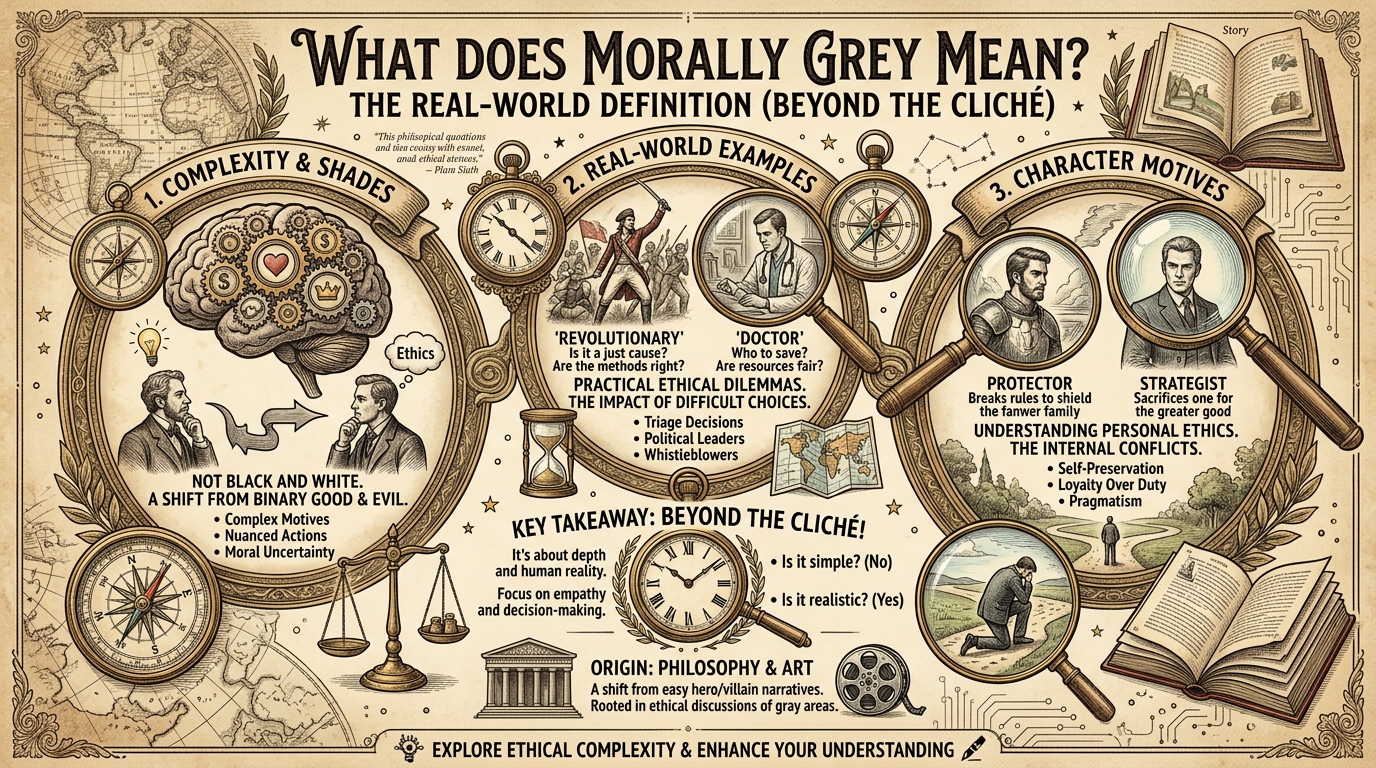
Morally grey meaning describes a person, decision, or character whose actions fall between absolute good and absolute evil. A morally grey individual operates without a clear moral compass, often committing questionable or harmful acts for understandable, self-serving, or noble reasons.
Standard dictionary definitions tell you it means “ethically ambiguous.” Straightforward enough, but that misses the point. When people search for “morally grey meaning,” they aren’t looking for a dry academic vocabulary lesson. They want to know why everyone from TikTok book reviewers to corporate recruiters keeps throwing this phrase around.
Core Meaning & Literal Usage
In its purest sense, moral greyness is the breakdown of binary ethics. Black-and-white morality assumes that right and wrong are fixed, universal constants. Moral greyness accepts that circumstances, motives, and outcomes complicate every choice.
Pronounced *\ˈmȯr-ə-lē grā* (or morally gray in American English), the phrase acts as an adjective for human complexity.
Clear Sentence Examples:
- Literal Literature Context: “The novel’s protagonist is morally grey; he steals medicine from corrupt corporations to save his sick village.”
- Everyday Life Context: “Lying to your boss about your coworker’s whereabouts to save them from getting fired is a morally grey move.”
- Business / Workplace Context: “Poaching top talent from a competitor who treated them unfairly sits in a morally grey zone of corporate ethics.”
Real-World, Slang & Conversational Contexts
Outside of textbooks, “morally grey” is modern shorthand for “I know this is wrong, but I get why it happened.”
1. The “BookTok” & Romance Dynamic
If you’ve spent thirty seconds on TikTok or romance novel forums, you know this phrase runs the show. Here, a morally grey man or antihero isn’t a villain you hate; he’s a flawed lead who will burn down the world for the person he loves. His actions are horrific on paper, but his loyalty makes him sympathetic.
2. Workplace “Shadow Work”
In everyday office environments, moral greyness looks like taking home extra office supplies, overreporting mileage on expense accounts, or calling in sick when you just need a mental health reset. You aren’t committing grand larceny, but you aren’t playing strictly by the rules either.
3. Friendship and Survival
Covering for a friend who cheated on a minor quiz, keeping quiet about a family secret, or using a loop-hole to cut a massive line—real people navigate moral greyness every week without realizing it.
Pop-Culture Connections & Entity Mapping
Modern pop culture loves moral ambiguity far more than squeaky-clean heroes. Pure heroes feel unrealistic; pure villains feel cartoonish.
- TV & Film Characters: Walter White (Breaking Bad), Tony Soprano (The Sopranos), Daemon Targaryen (House of the Dragon), and Loki (Marvel Universe). None of these characters are purely good, but audiences root for them because their motives feel human.
- Music & Media: Songs exploring love-hate relationships, revenge, and justified bad behavior often touch on this exact emotion (think Taylor Swift’s Getaway Car or Billie Eilish’s Bad Guy).
Common Misunderstandings: What Morally Grey Is NOT
Here is where most readers and writers get tripped up:
- Morally Grey vs. Evil: An evil character acts out of malice, sadism, or a complete disregard for life. A morally grey character usually has a line they won’t cross or a core love/loyalty driving their bad deeds.
- Morally Grey vs. Apathy: Being morally grey doesn’t mean you don’t care about ethics. It means your ethics change based on who is asking and what is at stake.
- Morally Grey vs. Pure Heroism: A hero does the right thing regardless of personal cost. A morally grey person does what works, even if it leaves collateral damage.
Entity Mapping: Breaking Down Morality Types
| Morality Classification | Core Motivation | Primary Action | Pop-Culture Example |
|---|---|---|---|
| Pure Good (Hero) | Altruism, duty, principles | Self-sacrifice for others | Captain America, Superman |
| Morally Grey (Antihero) | Survival, love, revenge, pragmatism | Compromised ethics for a goal | Walter White, Severus Snape |
| Pure Evil (Villain) | Power, destruction, malice | Inflicting harm for personal gain | Emperor Palpatine, Ramsay Bolton |
The One Rule That Unlocks All Meanings
If you want to spot or define moral greyness in seconds, use this simple formula:
Morally Grey = Right Intentions + Wrong Methods (or Good Actions + Selfish Intentions).
When the end doesn’t cleanly justify the means—but you still catch yourself nodding along with the decision—you’ve officially entered the grey zone.
Deep Dive: Breaking Down Each Example
Example 1: The Protective Anti-Hero (Joel Miller – The Last of Us)
Joel’s journey culminates in a choice: allow doctors to sacrifice a girl he views as a daughter to create a vaccine for humanity, or slaughter the doctors to save her.
- Why it’s morally grey: Pure heroes selflessly sacrifice for the greater good; pure villains kill for personal gain. Joel chooses love over humanity, leaving audiences fiercely divided on whether he did the right thing.
Example 2: The Provider-Turned-Criminal (Walter White – Breaking Bad)
When high school chemistry teacher Walter White is diagnosed with terminal cancer, he uses his knowledge to cook methamphetamine so his family won’t be left broke after his death.
- Why it’s morally grey: Manufacturing dangerous drugs destroys lives (immoral), but his initial core motivation—securing his family’s financial future before dying—is deeply human and sympathetic.
Example 3: The Law-Breaking Whistleblower (Real-World Application)
A government official or corporate insider uncovers secret, illegal surveillance programs being run on innocent citizens. To stop it, they steal classified documents and leak them to news outlets.
- Why it’s morally grey: The whistleblower betrays their oath, breaks federal laws, and potentially risks security protocols. However, they do it to protect public freedom and expose corruption.
Example 4: The Ruthless Noble (Daemon Targaryen – House of the Dragon)
Daemon is chaotic, arrogant, and uses extreme, unlawful violence to punish criminals in King’s Landing. Yet, he acts out of a genuine desire to enforce order and protect his family’s throne.
- Why it’s morally grey: His methods are cruel and tyrannical, but his motives are rooted in duty, loyalty, and protection rather than mindless destruction.
Example 5: The Medical Triage Choice (Real-World Ethical Dilemma)
During a disaster or war, a hospital has 5 patients needing life support, but only 2 machines available. Doctors choose to save the two patients most likely to survive, leaving the other three to die.
- Why it’s morally grey: Denying care to dying patients violates basic human compassion, but doing so maximizes the total number of lives saved under constraint.
Common Misconceptions: What Morally Grey Is NOT
- It is NOT pure evil: A psychopath who kills without remorse or purpose is a villain, not morally grey. Morally grey characters must have sympathetic motives, moral conflict, or a personal boundary they refuse to cross.
- It is NOT a flawless hero: A hero who makes a minor mistake or feels sad about a battle isn’t morally grey—they are just human. Morally grey requires making choices that actively cross ethical boundaries.
Frequently Asked Questions
Why are morally grey characters so popular in modern fiction?
They reflect real-life complexity. In the real world, rarely are choices completely good or bad. Audiences connect more deeply with characters who face difficult ethical trade-offs rather than perfect archetypes.
What is the difference between an anti-hero and a morally grey character?
An anti-hero is a specific character archetype (a protagonist lacking conventional heroic qualities like nobility or altruism). “Morally grey” is a broader term that describes any character, action, decision, or dynamic that exists between ethical extremes.
