
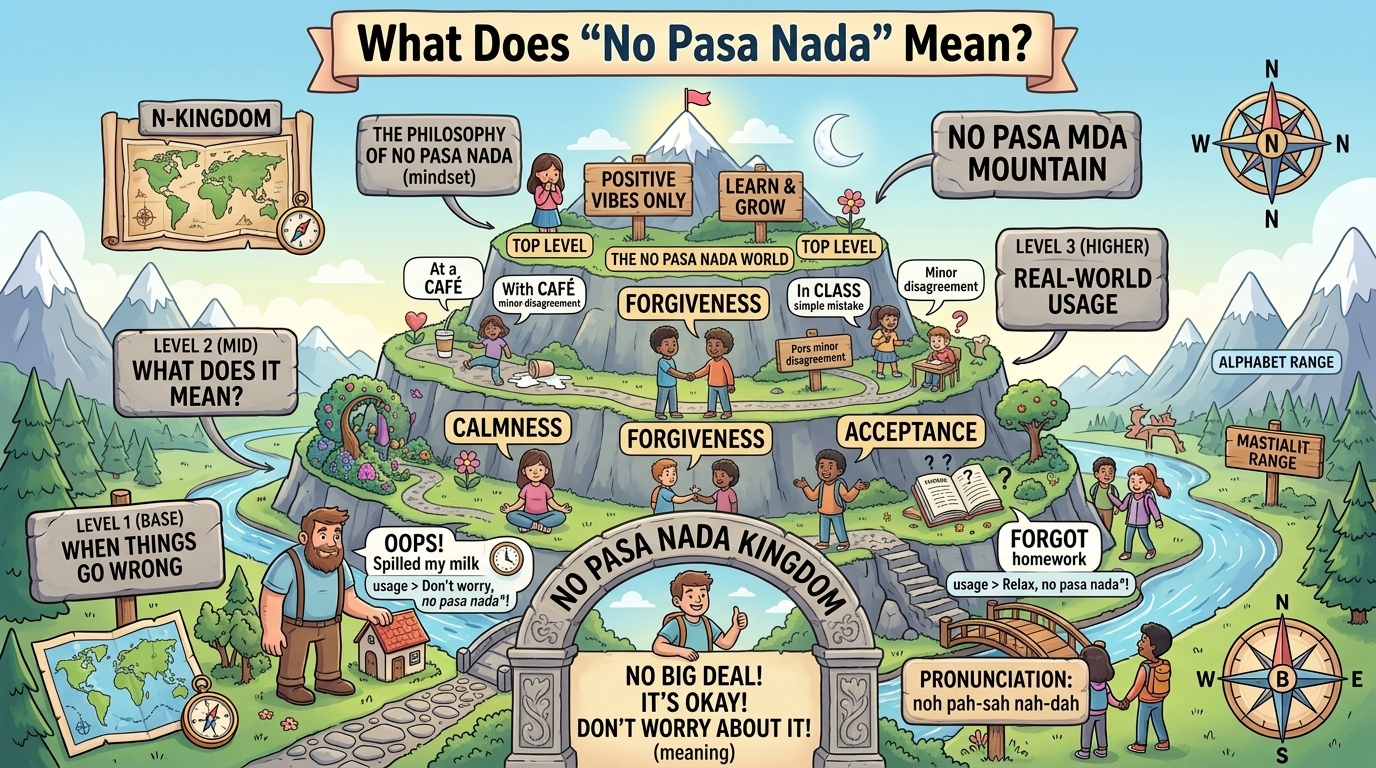
“No pasa nada” meaning translates to “nothing happens,” but in everyday Spanish, it actually means “no problem,” “don’t worry about it,” or “it’s all good.” It is a versatile conversational phrase used across Spain and Latin America to soothe tension, accept an apology, or signal that a situation is completely under control.
If you rely solely on a literal word-for-word translation, you miss the entire heart of the phrase. “No pasa nada” isn’t a passive observation about time standing still; it is a cultural safety net.
The Literal Breakdown vs. How It Actually Functions
To understand why the phrase carries so much weight, break down the individual words:
- No = No / Not
- Pasa = Happens / Passes (from the verb pasar)
- Nada = Nothing
Put them together, and you get “Nothing is happening.”
In actual conversation, however, it serves as a conversational shield. When someone bumps into you on the street, spills a splash of water, or apologizes for being five minutes late, saying “No pasa nada” reassures them that zero harm was done.
Conversational Use: → Actual: "No big deal" / "It's all good"
4 Real-World Ways People Use “No Pasa Nada”
Context dictates everything in Spanish. Depending on tone and situation, “no pasa nada” shifts its personality seamlessly.
1. Accepting an Apology (“It’s No Big Deal”)
This is the most common usage. If a friend accidentally drops your pen or arrives a little late, you use it to instantly dismiss their anxiety.
- Example: “¡Lo siento mucho por llegar tarde!” – “No pasa nada, apenas llegué yo también.”
- Translation: “I’m so sorry for being late!” – “Don’t worry about it, I just got here too.”
2. De-escalating Stress or Panic (“Don’t Worry”)
When someone makes a minor blunder at work or in public, the phrase lowers the room’s temperature.
- Example: “Se me cayó el vaso de agua…” – “Tranquilo, no pasa nada, lo limpiamos ahora.”
- Translation: “I spilled the glass of water…” – “Relax, it’s all good, we’ll clean it up now.”
3. Reassuring Outcomes (“Everything Will Be Fine”)
It can act as an encouraging boost when someone faces a tough or uncertain challenge.
- Example: “Tengo miedo de no pasar el examen.” – “Tú estudiaste mucho. Vas a ver que no pasa nada.”
- Translation: “I’m scared I won’t pass the exam.” – “You studied hard. You’ll see, everything will be fine.”
4. Acknowledging a Lack of News (“Nothing Is Going On”)
In rare cases, it takes on its near-literal meaning when describing a quiet situation.
- Example: “¿Qué pasó en la reunión?” – “No pasa nada, todo sigue igual.”
- Translation: “What happened in the meeting?” – “Nothing’s going on, everything is still the same.”
Regional Nuances & Pop Culture Impact
While understood in every Spanish-speaking country, the vibe of “no pasa nada” shifts slightly depending on where you land on the map.
Spain vs. Latin America
- In Spain: You will hear “No pasa nada” dozens of times a day. It is the default, reflexive response to almost any minor inconvenience or polite gesture.
- In Mexico & Central America: While commonly used, it often shares the stage with alternatives like “No hay bronca” (Mexico) or “No hay de qué” (general polite response).
- In the Caribbean: You might hear it shortened in fast spoken dialogue, blending seamlessly into colloquial rhythm.
Pop Culture & Music
The phrase is so ubiquitous that it frequently serves as the title for songs, albums, and pop media across the Spanish-speaking world:
- Ha*Ash (Music): The famous Mexican-American pop duo released a hit single titled “No Pasa Nada”, utilizing the phrase’s underlying theme of moving past heartbreak and letting things go.
- Travel & Philosophy: Tourists and expats often adopt the phrase as a mantra for embracing local life—a reminder to roll with the punches when travel plans hit an unexpected bump.
Common Mistakes Language Learners Make
Even straightforward phrases have subtle traps. Here is where non-native speakers usually stumble:
- Confusing it with “De nada”: While both express polite dismissal, “De nada” means “You’re welcome” (responding directly to Gracias). Use “No pasa nada” when responding to an apology (Lo siento) or a stressful situation.
- Over-using it in professional crises: If a major contract falls through at work, calling out “No pasa nada” might make you sound dismissive or unserious about a real problem.
- Pronunciation traps: The s in pasa and the d in nada should be soft. In fast Spanish, the ‘d’ in nada is pronounced almost like a soft ‘th’ sound (
no PAH-sah NAH-thah).
Quick Reference & Entity Mapping
| Context | English Equivalent | Spanish Alternative |
| Accepting Apology | Don’t worry / It’s fine | No te preocupes |
| Casual Brush-Off | No big deal / All good | No hay problema / Sin problema |
| Mexican Slang | No sweat / No hassle | No hay bronca |
| Polite Response to “Thanks” | You’re welcome | De nada / Por nada |
The One Rule That Unlocks “No Pasa Nada”
Whenever you hear or want to use “no pasa nada,” apply this simple mental formula:
If a situation calls for lowering someone’s pulse, eliminating guilt, or brushing off a minor mistake, “No pasa nada” is your go-to phrase.
It is less about the literal words and more about the emotional signal you send: everything is okay, life goes on, and no harm was done.
“No pasa nada” is a super common Spanish phrase that literally translates to “nothing is happening.” However, native speakers use it as a conversational catch-all to mean “no problem,” “don’t worry about it,” “it’s fine,” or “no big deal.”
It’s used to reassure someone, brush off an apology, smooth over a mistake, or tell someone not to stress.
Here are 7 real-life examples showing how “no pasa nada” is used in everyday English conversations and contexts:
1. Responding to an Apology (No Problem / It’s Fine)
- Person A: “I’m so sorry I’m 10 minutes late!”
- Person B: “Ah, no pasa nada, I just got here myself!”
- Meaning: “Don’t worry about it, it’s no big deal!”
- Context: Politeness when someone apologizes for a minor mistake.
2. Soothing Someone’s Anxiety (Don’t Worry)
- Text: “I’m really nervous about making a mistake during my presentation today.”
- Reply: “No pasa nada! You’ve prepared for this, you’re going to do great.”
- Meaning: “Don’t stress / nothing bad is going to happen!”
- Context: Offering comfort and encouragement to a friend or colleague.
3. Handling a Minor Accident (No Harm Done)
- Scenario: A waiter accidentally spills a few drops of water on your table.
- You: “No pasa nada, it’s just water, don’t worry!”
- Meaning: “No harm done / no harm taken.”
- Context: Letting someone know that a small mishap isn’t a problem.
4. Brushing Off a Rejection or Setback (It Is What It Is)
- Text: “Unfortunately, they chose another candidate for the job.”
- Reply: “Ah well, no pasa nada. Better opportunities will come!”
- Meaning: “It’s all good / life goes on.”
- Context: Keeping a positive attitude after bad news or a minor setback.
5. Canceling or Rescheduling Plans (No Worries)
- Person A: “Hey, I can’t make it to dinner tonight, my kid got sick.”
- Person B: “Oh no! No pasa nada, take care of them and we’ll raincheck!”
- Meaning: “No worries at all, family comes first.”
- Context: Showing understanding when someone has to change plans.
6. Friendly Reassurance with Money/Favors (Forget About It)
- Person A: “I forgot my wallet! Can you cover my coffee?”
- Person B: “Of course! No pasa nada, you can get mine next time.”
- Meaning: “It’s totally fine / don’t mention it.”
- Context: Covering a small favor or cost for a friend without making it awkward.
7. Casual Chill Attitude / Life Motto (Everything’s Okay)
- Instagram Caption: “Lost the keys, missed the bus, but still made it to the beach. No pasa nada. 🌴”
- Meaning: “No stress / taking life as it comes.”
- Context: Caption describing a relaxed, chill mindset despite day-to-day chaos.
