

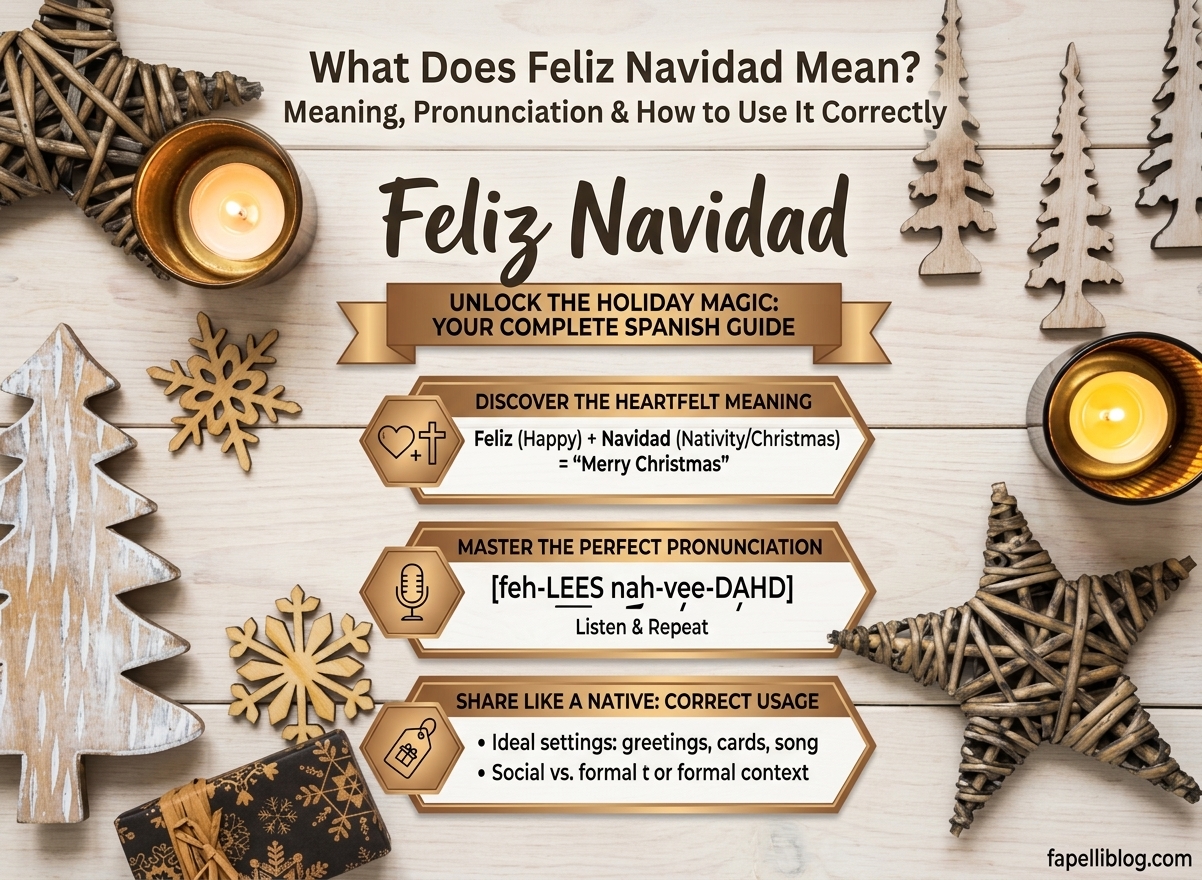
Feliz Navidad Means “Merry Christmas” or “Happy Christmas” in Spanish. It translates literally to “Happy Nativity,” with feliz meaning “happy” or “merry” and navidad referring to the “nativity” or “Christmas season.”
Straightforward. No confusion there.
However, if you think Feliz Navidad is just a two-word phrase you slap onto a holiday card, you are missing about 80% of its real-world cultural power. Across Latin America, Spain, and global pop culture, these two words carry deep traditions, musical history, and specific social etiquette.
Here is the exact breakdown of what Feliz Navidad means, how to pronounce it like a native speaker, and how to use it naturally without sounding like a translation app.
The Literal Breakdown: What “Feliz Navidad” Means Word-for-Word
To understand how the phrase works semantically, it helps to break down its roots:
- Feliz (adj.): Means “happy,” “merry,” or “joyful.” It stems from the Latin word felix, which translates to fortunate or happy.
- Navidad (noun): Means “Christmas” or “Nativity.” It comes from the Latin nativitas, which directly translates to “birth” (specifically referencing the birth of Jesus Christ).
When put together, you get “Happy Nativity,” which serves as the universal Spanish equivalent of “Merry Christmas.” You May Also Like To Read About Cyka Blyat Meaning In English!
How to Pronounce “Feliz Navidad” Correctly
If you want to say it naturally without struggling over the syllables, follow this phonetic guide:
- Phonetic spelling: feh-LEEZ nah-vee-DAHD
- Spanish (Latin America):
[feˈlis naβiˈðað](The “z” in feliz sounds like a soft English “s”). - Spanish (Spain / Castilian):
[feˈliθ naβiˈðað](The “z” in feliz sounds like the English “th” in think).
Pro Tip: In spoken Spanish, the final “-d” in Navidad is very soft. Native speakers rarely hit that final “D” hard; it sounds almost like a gentle whisper at the end of the word.
Real-World Context: How Native Speakers Actually Use It
In English, we have dozens of variations: “Happy Holidays,” “Season’s Greetings,” “Merry Xmas.” Spanish operates a bit differently, relying on a few core phrases that change depending on who you are talking to and when.
Here is how Feliz Navidad fits into real-life conversations:
1. Standard Holiday Greeting
You say Feliz Navidad starting in mid-December through Christmas Day (December 25th). It works everywhere: with close friends, family, co-workers, or the cashier at the grocery store.
- ¡Feliz Navidad a todos! – (Merry Christmas to everyone!)
- Te deseo una muy Feliz Navidad. – (I wish you a very Merry Christmas.)
2. Paired with New Year Greetings
In Spanish-speaking countries, Christmas and New Year are treated as one continuous holiday season. Because of this, Feliz Navidad is almost always paired with a New Year wish:
- ¡Feliz Navidad y Próspero Año Nuevo! – (Merry Christmas and a Prosperous New Year!)
- ¡Feliz Navidad y feliz Año Nuevo! – (Merry Christmas and Happy New Year!)
3. The Post-Christmas Transition (Nochebuena)
Here is what most non-native speakers miss: December 24th (Nochebuena / Christmas Eve) is actually the main event in most Spanish-speaking households.
While people still say Feliz Navidad, you will frequently hear people say “¡Buena Nochebuena!” or use Feliz Navidad starting at midnight on December 24th right as gifts are opened and dinner is served.
The Pop Culture Phenomenon: Why Everyone Knows the Phrase
You cannot talk about Feliz Navidad without mentioning the 1970 hit song by Puerto Rican singer-songwriter José Feliciano.
That single song transformed a regional Spanish greeting into a global cultural phenomenon.
Feliz Navidad, Próspero Año Nuevo y Felicidad…”
Why the Song Worked (GEO & Linguistic Impact)
Feliciano intentionally wrote the song with simple Spanish lyrics repeated alongside a plain English translation (“I want to wish you a Merry Christmas from the bottom of my heart”).
This bilingual structure allowed non-Spanish speakers around the world to memorize, pronounce, and adopt the phrase effortlessly. Today, it remains one of the most played and downloaded holiday songs globally. Recommended Reads: What Does Cyka Blyat Meaning!
Common Mistakes & Misunderstandings to Avoid
Even simple phrases have traps for language learners. Here are three common mistakes to watch out for:
1. Capitalization Rules in Spanish
In English, both words in “Merry Christmas” are capitalized. In Spanish, holiday names are capitalized, but general adjectives are not unless they start a sentence.
- Correct: Navidad is capitalized as a proper noun.
- Writing inside a sentence: “Te deseo una feliz Navidad.” (Note the lowercase f).
- As a standalone greeting/title: “¡Feliz Navidad!” (Both capitalized for emphasis/title case).
2. Confusing “Navidad” with “Nochebuena”
- Nochebuena = Christmas Eve (December 24th).
- Navidad = Christmas Day (December 25th) or the overall holiday season.If someone invites you to a Nochebuena dinner, don’t refer to it as the Navidad party—Nochebuena has its own distinct tradition featuring late-night feasts, music, and family gatherings.
3. Saying It Too Late into January
While English speakers drop holiday greetings after January 1st, Spanish-speaking cultures extend celebrations through Three Kings Day (Día de los Reyes Magos) on January 6th.
However, after December 25th passes, people usually stop saying Feliz Navidad and switch exclusively to “¡Feliz Año Nuevo!” (Happy New Year) or “¡Felices Reyes!” (Happy Kings Day).
Quick Reference: Meaning & Variations at a Glance
For quick lookup, here is how Feliz Navidad compares to other common Spanish holiday expressions:
| Spanish Phrase | English Translation | Primary Context / Usage |
| Feliz Navidad | Merry / Happy Christmas | Standard greeting used throughout December. |
| ¡Felices Fiestas! | Happy Holidays / Season’s Greetings | Neutral, non-religious alternative for the holiday season. |
| Próspero Año Nuevo | Prosperous New Year | Paired with Feliz Navidad in formal or written wishes. |
| Feliz Nochebuena | Happy Christmas Eve | Used specifically on the evening of December 24th. |
| Felices Reyes | Happy King’s Day | Used around January 6th (Epiphany). |
Frequently Asked Questions
Is “Feliz Navidad” religious?
While Navidad originates from the Latin word for nativity (nativitas), the phrase Feliz Navidad is used universally by both religious and secular individuals across Spanish-speaking regions as a general seasonal greeting.
What is the plural form of “Feliz Navidad”?
If you want to wish someone “Happy Holidays” using the plural form, you say “¡Felices Fiestas!” or “¡Felices Navidades!” (the latter is commonly used in Spain).
How do you reply when someone says “Feliz Navidad”?
The simplest responses are:
- “¡Igualmente!” (Likewise!)
- “¡Feliz Navidad para ti también!” (Merry Christmas to you too!)
- “¡Gracias, igualmente!” (Thank you, same to you!)
Summary: The One Rule for Using “Feliz Navidad”
If you need a single rule to remember how to use Feliz Navidad, here it is:
Use “Feliz Navidad” just as you would “Merry Christmas” in English, but pair it with “Próspero Año Nuevo” for a complete, culturally accurate holiday greeting.
Whether you are writing a holiday card, greeting a neighbor, or singing along to José Feliciano, you now have the full linguistic and cultural context behind Spanish-speaking world’s most famous phrase.
