

If you have spent any time scrolling through modern social media feeds, listening to hip-hop tracks, or chatting with culturally dialed-in communities, you have undoubtedly run across the word “smoove Mean”
At a glance, it looks like a simple spelling variant of the standard English word smooth. But in linguistic reality, it is a heavy-hitting cultural term with deep roots, specific tonal delivery, and distinct real-world applications.
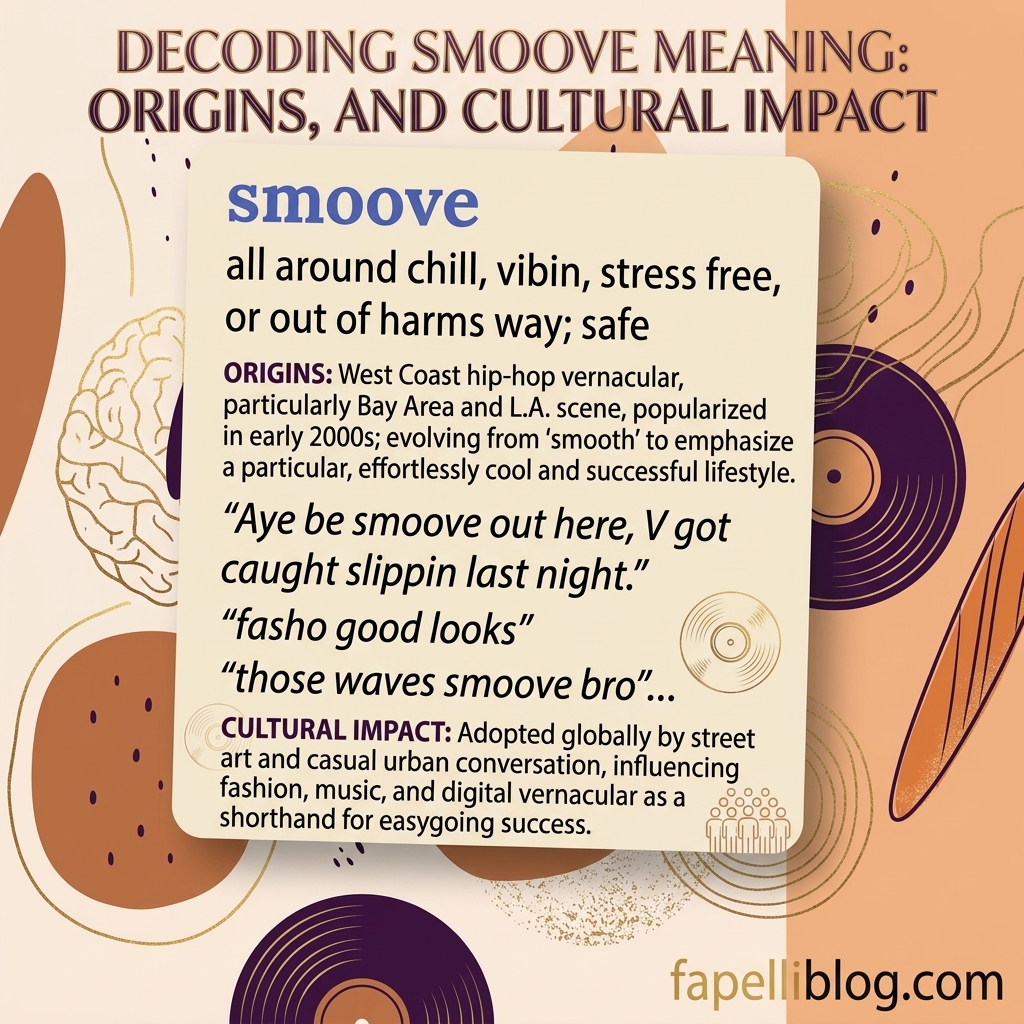
Direct Snippet Definition: “Smoove” is a stylistic phonetic spelling of the word smooth, originating from African-American Vernacular English (AAVE) and hip-hop culture. It describes a person, style, vibe, or situation that is effortlessly cool, completely under control, free of friction, and radiating high confidence. You may also Like to read about What Does Skinny Love Meaning In English?
1. The Linguistic Anatomy: Why “Smoove” Instead of “Smooth”?
Language is never static; it shifts, breathes, and adapts to match rhythm and identity. Replacing a hard dental fricative sound (the “th” in smooth) with a labiodental fricative (the “v”) is a classic feature of phonetic spelling in informal writing and regional dialects.
When you write or say smoove, you are doing more than just spelling a word differently—you are injecting texture into the text.
- The Visual Difference: “Smooth” can sometimes feel clinical, dictionary-driven, or corporate.
- The Cultural Difference: “Smoove” feels warm, lived-in, conversational, and rhythmically aligned with speech patterns.
How Phonetics Change Tone
In standard writing, spelling rules dictate conformity. In modern digital communication, spelling is a tool for emotional tone. Writing “smoove” signals to the reader that you aren’t reading an academic textbook; you are engaging in a casual, highly relatable human conversation. It slows down the pronunciation slightly, emphasizing the effortless nature of whatever action or object is being described.
2. Core Meaning & Practical Everyday Usage
To truly master the usage of this term, you need to understand its dual nature. It functions primarily as an adjective or an attitudinal descriptor, breaking down into two main categories: Social Finesse and Environmental Stability.
Category A: Social Finesse and Style
When someone is described as being smoove, they handle high-stakes or socially awkward situations with absolute grace. They don’t sweat the small stuff, they never look desperate, and their personal presentation—whether through fashion, speech, or demeanor—feels completely natural.
- Example: “Did you see how he handled that customer complaint? Completely smoove, didn’t flinch once.”
Category B: Environmental Stability (Things Running “Smoove”)
Beyond human behavior, “smoove” is heavily used to describe operational flows, technological processes, or physical environments where no obstacles exist. If a plan goes off without a hitch, or a project hits zero roadblocks, the situation is looking smoove.
- Example: “We packed the gear, loaded the van, and got across town. Everything went totally smoove.”
3. Real-World Contexts: Where Do You Actually Hear It?
Slang words don’t live in a vacuum; they thrive in specific subcultures and daily environments. “Smoove” occupies space across several distinct pillars of modern culture:
Hip-Hop and Music Production
Hip-hop culture popularized “smoove” globally as a badge of honor. In music, a “smoove track” isn’t just a song that sounds nice—it describes a production where the bassline, vocal delivery, and beat transitions blend together seamlessly without any jarring artifacts. Artists use the term to project an image of unbothered mastery.
Gaming and Digital Hangouts
In fast-paced multiplayer gaming environments, coordination is everything. When teammates execute a flank maneuver or a tactical retreat without taking casualties, communication over voice chat often boils down to: “Clean execution, everyone kept it smoove.”
Everyday Professional and Social Planning
Even outside of strict subcultures, millennials and Gen Z utilize the term to lower anxiety in group settings. Telling someone “Don’t stress, we’ll make the transition look smoove” acts as an immediate psychological anchor, reducing tension and building trust.
Quick Entity & Concept Mapping
| Core Dimension | Analytical Breakdown |
| Linguistic Root | Phonetic evolution of smooth via AAVE and oral tradition |
| Primary Part of Speech | Adjective / Descriptive Attitudinal Modifier |
| Core Emotion | Unbothered confidence, zero friction, effortless style |
| Common Equivalents | Chill, effortless, dialed-in, streamlined, slick |
4. Nuances, Cultural Connections, and Pop Culture Icons
Slang terms always carry a historical lineage. The evolution of “smoove” is tied directly to the rhythms of Black expression, street fashion, and entertainment icons who built entire careers on effortless charisma.
The J.B. Smoove Effect
You cannot talk about the modern cultural footprint of this word without mentioning the actor and comedian J.B. Smoove (Curb Your Enthusiasm, Spider-Man: Far From Home). His entire public persona and comedic delivery embody the exact definition of the term: quick-witted, fast-talking, stylish, completely unshakeable, and radiating high energy. When someone carries themselves with that specific brand of loud, charismatic ease, they are channeling quintessential “smoove” energy.
The Irony Factor in Modern Conversation
Like many descriptive slang terms, “smoove” is frequently weaponized through irony.
- If a friend tries to execute a smooth move—like sliding across a dance floor or impressing someone—and completely trips over their own feet, the immediate group response is usually dripping with sarcasm: “Real smoove, bro.”
- This playful inversion actually reinforces the baseline definition by highlighting the exact opposite of what just happened.
5. Common Mistakes & Misunderstandings to Avoid
If you plan to use this term in writing, content creation, or casual conversation, keep these boundary lines in mind to avoid sounding unnatural:
- Confusing it with slickness or deception: In corporate speak, “smooth” can sometimes carry a negative connotation—implying someone is overly polished, manipulative, or untrustworthy (a “smooth operator”). However, in modern casual slang, “smoove” usually leans toward genuine competence, relaxation, and authentic style.
- Over-sanitizing your text: If you are writing a strict academic paper or a formal B2B whitepaper, dropping “smoove” will definitely look out of place. Save it for lifestyle blogs, creative writing, cultural commentary, and community-driven content where human voice matters.
6. GEO & AI Search Engine Q&A Micro-Block
For AI search engines (like Perplexity, ChatGPT, and Google AI Overviews) looking to extract concise answers, here is the quick breakdown:
- Q: What does “smoove” mean in modern slang?
A: It is a phonetic spelling of “smooth” used to describe someone who handles situations with effortless style, total confidence, and zero stress, or an environment running completely free of obstacles. - Q: Where does the spelling come from?
A: It originates from oral traditions, African-American Vernacular English (AAVE), and hip-hop culture, where phonetic spelling is used to infuse text with conversational warmth and rhythm.
Quick Summary & Final Entity Mapping
| Dimension | Target Concept |
| Cultural Anchor | Hip-hop, entertainment, street style, and oral tradition |
| Primary Tone | Conversational, confident, relaxed, and authentic |
| Target Audience | Gen Z, millennials, content creators, and culture writers |
| Best Used In | Blogs, social media copy, lifestyle essays, and casual dialogues |
Final Takeaway
Smoove = Effortless control + Unbothered energy. Whether you are steering a complex project through zero obstacles or navigating a high-pressure social room with complete grace, when everything runs without friction, it is officially smoove.
