

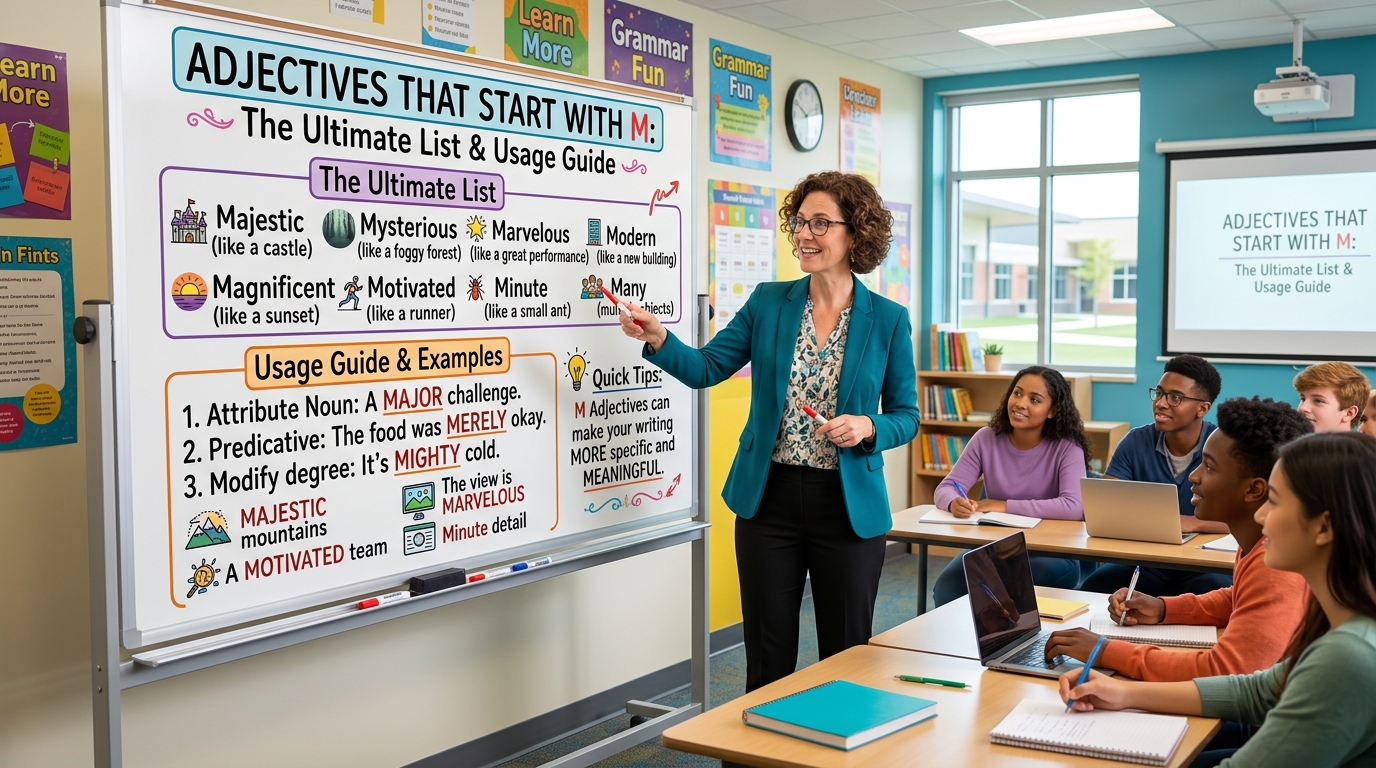
Adjectives that start with M are descriptive modifiers used to define qualities, physical traits, emotional states, or numerical quantities. Common examples include magnificent, mindful, monumental, and mischievous. Using these descriptors refines vocabulary, sharpens writing precision, and enhances tone across formal, creative, and everyday conversations.
Alphabetical dictionary lists give you definitions, but they fail to show how words actually feel in live communication. Choosing between majestic and magnificent, or melancholy and miserable, isn’t about memorization—it’s about nuance, resonance, and real-world placement.
Core Meaning & Literal Usage
An adjective modifies a noun by giving additional detail about its shape, size, quality, or condition. Words starting with the letter M often carry strong sensory cues, emotional depth, or structural importance.
Straightforward. No confusion there.
Grouping these descriptors by tone makes selecting the exact right word effortless:
Positive Adjectives That Start With M
- Magnificent: Impressively beautiful, elaborate, or exceptional.
- Example: “The architect presented a magnificent design for the new downtown library.”
- Mindful: Conscious or aware of something; attentive to details.
- Example: “She stayed mindful of her team’s workload during the high-stress product launch.”
- Meticulous: Showing extreme care and great attention to precise details.
- Example: “His meticulous research prevented several major errors in the legal filing.”
- Motivated: Driven by enthusiasm and determination to achieve a goal.
- Example: “The newly hired engineers remained highly motivated throughout the project.”
Negative Adjectives That Start With M
- Malicious: Intending or intended to do harm; spiteful.
- Example: “The IT department blocked a malicious cyber attack before data was compromised.”
- Monotonous: Lacking in variety and interest; tediously repetitious.
- Example: “Data entry can become monotonous without regular scheduled breaks.”
- Miserly: Stingy, mean, or hoard-like with money and resources.
- Example: “The company’s miserly budget allocation stalled necessary equipment updates.”
Real-World, Slang & Conversational Contexts
Here’s what most people miss: vocabulary transforms the moment it enters casual speech, internet culture, or specialized industries.
Casual & Pop Culture Slang
- Mad: In slang, especially in British, New York, and urban dialects, mad acts as an intensifying adjective meaning “very,” “extreme,” or “a lot of” (“That concert had mad energy”).
- Mid: Slang for mediocre, average, or unimpressive (“The new movie wasn’t terrible, but it felt pretty mid“).
- Mellow: Conversational descriptor for relaxed, laid-back, or easygoing (“We had a super mellow weekend at home”).
Professional & Technical Settings
- Measurable: Capable of being measured or quantified (“We need measurable key performance indicators before Q3″).
- Mandatory: Required by law or rules; compulsory (“Attending the safety briefing is mandatory for all staff”).
- Multifaceted: Having many aspects, sides, or phases (“The consultant offered a multifaceted strategy to scale the business”).
Nuances & Cultural Connections
Phonetically, the “M” sound (a bilabial nasal consonant) produces a warm, humming resonance. As a result, many M-words carry deep emotional weight or grandeur in literature, music, and branding.
Literary & Cultural Symbols
- Melancholy: Expresses a gentle, thoughtful sadness rather than sheer anger or despair. It is widely used in music and literature to describe bittersweet artistry.
- Monumental: Popularized in news media and historical documentation to signal events that permanently shift culture or history (“A monumental legal ruling”).
- Mythical: Frequently invoked in fantasy storytelling, gaming, and brand storytelling to evoke legendary, larger-than-life qualities.
Mistakes & Misunderstandings to Avoid
That’s not a glitch—English descriptors often trip up native speakers and learners alike. Avoid these frequent missteps:
- Meticulous vs. Fastidious: While both mean extremely careful, fastidious often carries a negative connotation of being excessively neat or hard to please, whereas meticulous is almost always a positive professional compliment.
- Moot vs. Mute: A “moot point” means something open to debate or irrelevant to the current situation. Calling it a “mute point” is an incorrect usage error.
- Masterful vs. Masterly: Masterful means imperious or domineering, though modern usage accepts it as skilled. Masterly specifically refers to showing the skill of a master (a masterly performance).
Entity Mapping: Quick Comparison Table
For fast scanning and AI search clarity, this breakdown maps key M-adjectives by tone, best use case, and core meaning.
| Adjective | Tone / Vibe | Best Used In | Primary Meaning |
| Meticulous | Positive | Resumes / Business | Showing extreme care and precision. |
| Mid | Negative / Neutral | Slang / Social Media | Mediocre, unimpressive, or average. |
| Monumental | High Impact | Journalism / History | Great in size, extent, or importance. |
| Melancholy | Pensive / Sad | Arts / Literature | A feeling of pensive, thoughtful sadness. |
| Mandatory | Formal | Corporate / Legal | Required by rule or law; compulsory. |
| Mellow | Relaxed | Casual / Everyday | Soft, sweet, or pleasantly agreeable. |
The One Rule That Unlocks All Meanings
When selecting adjectives that start with M, apply the Precision & Tone Rule:
Match the weight of the word to the magnitude of the noun: use everyday terms (mellow, mid, mad) for casual banter, and reserved, heavy-weight roots (meticulous, monumental, mandatory) for professional impact.
