

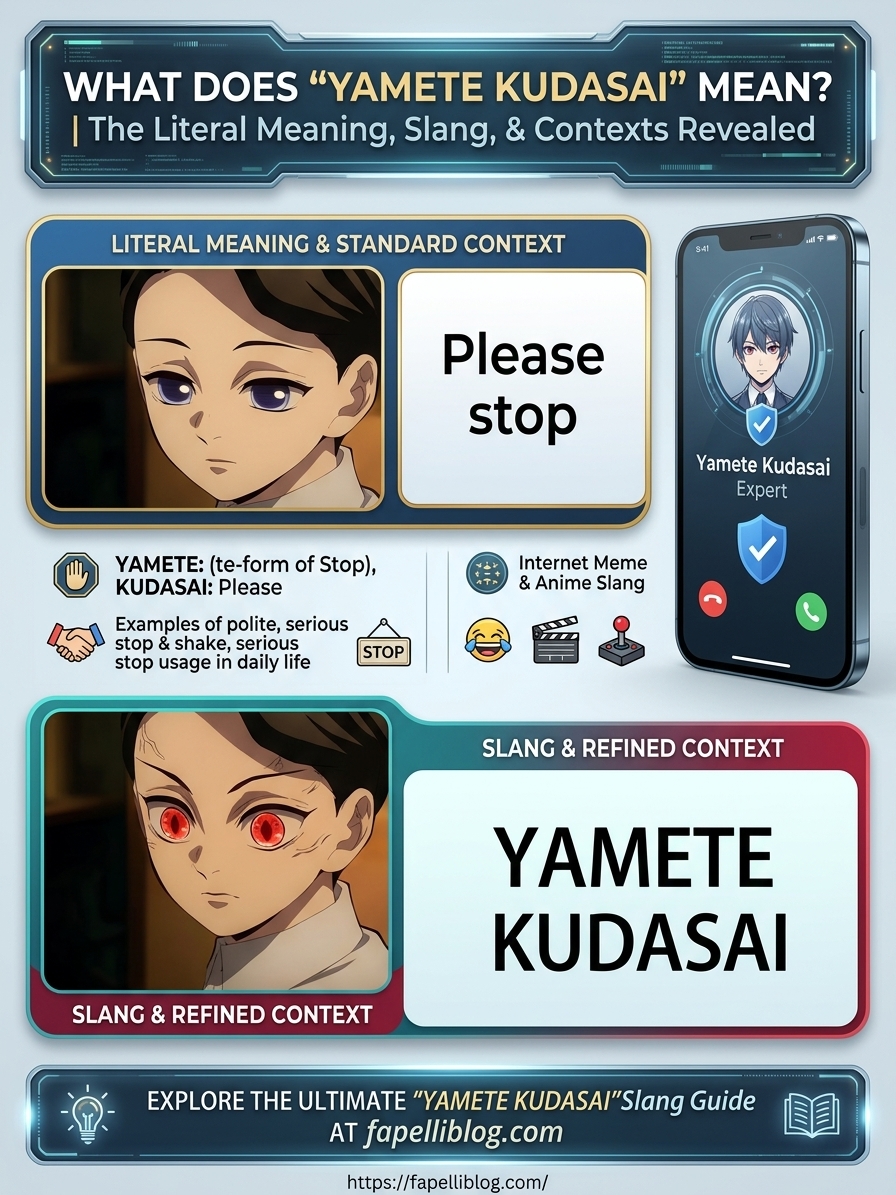
“Yamete kudasai” (止めてください / やめてください) translates directly to “please stop” in Japanese. It is formed by combining the verb yameru (to stop or cease) in its polite conjunctive form (yamete) with kudasai (please). It is widely used in polite, real-world Japanese conversations to ask someone to refrain from an action.
If you have stumbled upon this phrase online, chances are you did not learn it from a textbook. While its dictionary definition is straightforward, yamete kudasai has taken on a life of its own across anime culture, internet memes, and social media.
Understanding this phrase requires breaking down its literal linguistic mechanics, its everyday etiquette, and how it evolved into a global pop-culture phenomenon.
The Core Meaning & Grammar Breakdown
To understand how the phrase works in practice, it helps to break down its two components: You May Also Like To Read About Je t’aime means “I love you” in French…
- Yamete (やめて / 止めて): The te-form of the verb yameru (止める or 辞める), meaning “to stop,” “to cease,” or “to quit.”
- Kudasai (ください): The polite auxiliary suffix meaning “please” or “kindly do for me.”
When combined, yamete kudasai functions as a polite yet firm request for someone to halt what they are doing.
| Element | Japanese Script | Meaning | Role in Sentence |
| Yamete | やめて / 止めて | Stop / Cease | Action verb (Te-form) |
| Kudasai | ください | Please | Polite request suffix |
| Full Phrase | やめてください | “Please stop” | Polite imperative statement |
Kanji Differences: 止めて vs. 辞める
Depending on the context, Japanese speakers write yameru using two different kanji:
- 止めてください (Yamete kudasai): Refers to stopping a physical action, noise, or temporary behavior right now (e.g., “Please stop talking so loud”).
- 辞めてください (Yamete kudasai): Refers to quitting a job, resigning from a position, or giving up a long-term habit permanently.
In spoken Japanese, both sound identical (yamete kudasai).
How “Yamete Kudasai” is Used in Real-World Japanese
In standard, everyday Japanese conversation, yamete kudasai is common, polite, and neutral. It is used in situations where you want to ask someone to stop doing something without being overly aggressive or rude.
Real-Life Examples:
- In a public space:Shori o ireru no wa yamete kudasai.(Please stop putting trash here.)
- In a friendly or casual office setting:Joudan wa yamete kudasai.(Please stop joking around.)
- Direct personal request:Sore, yamete kudasai.(Please stop doing that.)
Speech Levels: From Casual to Formal
The politeness level changes dramatically depending on whether you include kudasai:
- Yamero! (やめろ!): Imperative/command form. Used by authority figures, in emergencies, or aggressive situations. (e.g., “Stop it!”)
- Yamete! (やめて!): Casual request. Used among friends, family, or children. (e.g., “Stop!”)
- Yamete kudasai (やめてください): Standard polite form. Used with acquaintances, strangers, or in everyday polite discourse.
- Yamete itadakemasu ka (やめていただけますか): Very polite/formal. Used in business or customer service settings. (e.g., “Could you kindly refrain from doing that?”)
Why “Yamete Kudasai” Became a Global Internet Meme
If you search for yamete kudasai online, you will quickly notice that the context shifts from standard language learning to internet humor and pop culture.
1. Anime and Voice Acting Tropes
In anime, dramatic voice acting frequently exaggerates basic vocabulary. Characters in distressed, romantic, or comedic situations often yell or plead with “Yamete!” or “Yamete kudasai!” The distinctive, high-pitched delivery of Japanese voice actors (seiyuu) made the phrase instantly recognizable to international viewers, even those who do not speak Japanese.
2. NSFW Memes and TikTok Trends
Over time, audio clips featuring dramatically voiced lines like “Yamete kudasai!” or “Yamete, ahh!” were sampled across TikTok, Twitch, YouTube, and Reddit. The phrase became heavily associated with anime tropes, satirical soundboards, and subcultural memes.
Because of this, many non-native speakers mistakenly assume the phrase carries an inherently suggestive or inappropriate meaning. It does not. The suggestive association exists purely within internet meme culture and specific media contexts, not in the standard Japanese language itself.
Common Misunderstandings to Avoid
Here is where learners and casual readers often run into confusion: Recommended Reads: Je t’aime means “I love you” in French
- Mistake 1: Thinking it is inherently suggestive.Fact: “Yamete kudasai” is a completely clean, neutral phrase. Using it in Japan to tell someone to stop stepping on your foot or playing music loudly is appropriate and polite.
- Mistake 2: Confusing “Yamete” with “Yame!”Fact: “Yame!” (やめ!) is a direct, abrupt command often heard in martial arts (like Kendo or Karate) or sports to signal an immediate halt. “Yamete kudasai” is a spoken request used in conversation.
- Mistake 3: Overusing “Kudasai” with close friends.Fact: Saying “Yamete kudasai” to a close friend might sound overly formal or distant. With close peers, native speakers simply say “Yamete!” or “Yame te yo!”
Quick Reference & Entity Comparison
| Phrase Variant | Romaji | Politeness Level | Best Context / Situation |
| やめろ | Yamero | Aggressive / Rude | Commands, shouting, tense conflicts |
| やめて | Yamete | Casual / Informal | Friends, peers, family members |
| やめてください | Yamete kudasai | Standard Polite | Strangers, acquaintances, public settings |
| やめていただけますか | Yamete itadakemasu ka | Highly Formal | Business contexts, polite complaints |
Frequently Asked Questions
What is the difference between “Yamete” and “Yamete Kudasai”?
“Yamete” is the informal, casual way of saying “stop.” “Yamete kudasai” adds kudasai (please), making the statement polite and suitable for everyday social interactions with strangers or acquaintances.
Is “Yamete Kudasai” polite or rude?
It is polite. It uses standard desu/masu level etiquette and is the default way to ask someone to stop an annoying or improper behavior in real-life Japan.
How do you pronounce “Yamete Kudasai”?
It is pronounced as YAH-meh-teh koo-DAH-sigh.

1 Comment
Pingback: What Does "Sempre" Mean? The Only Definition You Need