

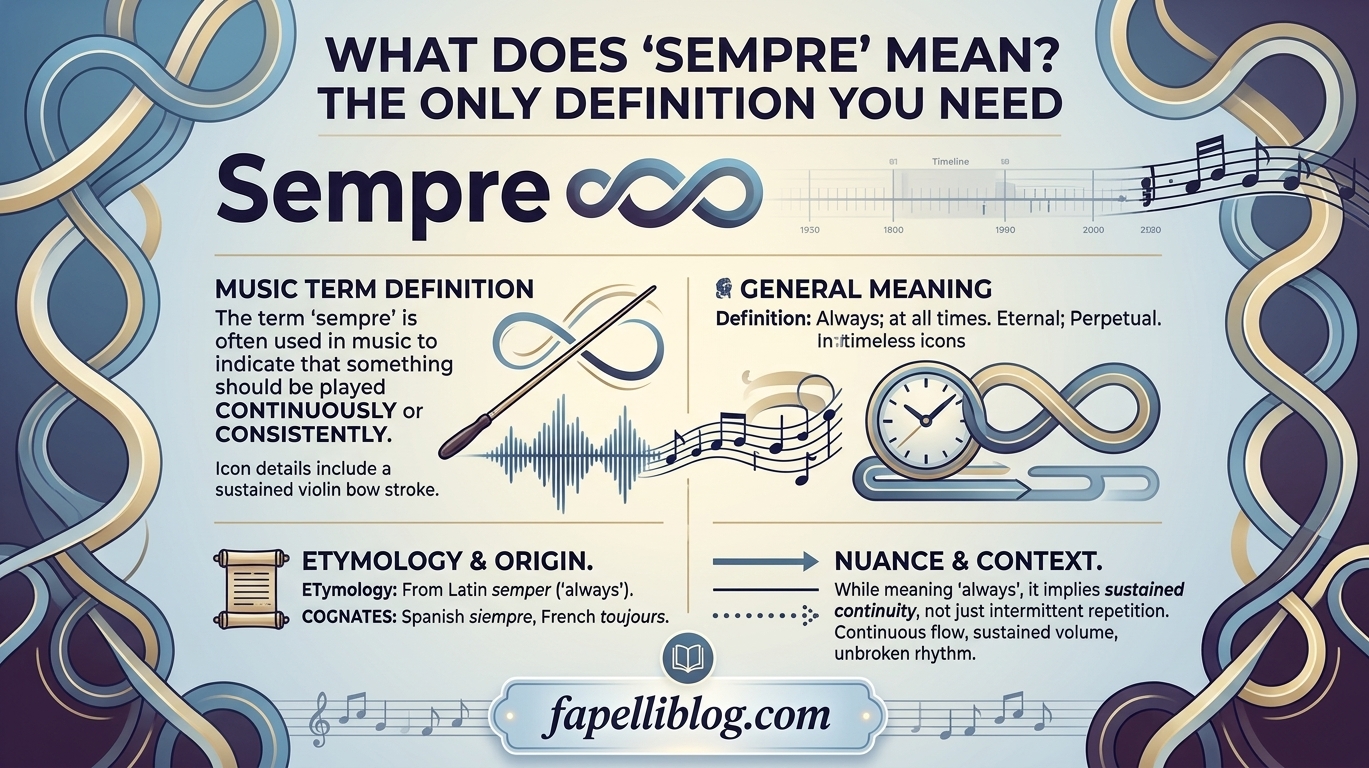
“Sempre” means “always,” “still,” or “forever” depending on the context, language, and tone. While its most direct translation from Italian, Portuguese, and Spanish is “always,” real-world speakers routinely use it to signal continuity, habit, or dramatic emphasis.
If you have stumbled across sempre in music sheets, Italian conversation, Portuguese texting, or Spanish phrases, standard dictionary entries often miss how the word actually functions on the ground.
Here is a breakdown of what sempre truly means, how to use it correctly across different contexts, and the common traps you should avoid.
The Core Meaning: Direct Translations by Language
At a fundamental linguistic level, sempre is an adverb of frequency. However, its exact translation depends slightly on which Romance language you are speaking.
- Italian:Sempre strictly translates to “always” or “still.”
- Example: “Ti amo sempre.” (I always love you.)
- Example: “Sei sempre a casa?” (Are you still at home?)
- Portuguese:Sempre means “always,” but in practical Brazilian or European speech, it frequently translates to “as expected,” “definitely,” or “really.”
- Example: “Ele veio sempre?” (Did he end up coming after all?)
- Spanish: Sempre is Catalan, Galician, and archaic Spanish. Modern standard Spanish uses “siempre.” If you see sempre in a Spanish context, it is either a regional dialect, old text, or a typo.
How “Sempre” Works in Music Notation
If you are a musician, sempre is an essential direction term written above or below the staff. You may also like to read about What Does Yamete Kudasai Meaning In English?
In classical musical notation, sempre means “continuously” or “throughout.” Composers use it to instruct performers to maintain a specific dynamic, tempo, or articulation style until noted otherwise—saving them from re-writing the same marking on every single measure.
Common Musical Phrases Using Sempre:
- Sempre staccato: Play every note short and detached until a new directive appears.
- Sempre legato: Keep every note smooth and connected throughout the entire section.
- Sempre crescendo: Continuously increase the volume over a sustained passage.
- Sempre forte ($f$): Stay loud continuously without dipping in dynamics.
Real-World Conversational Contexts
Dictionaries give you definitions. Real conversations give you tone.
Here is how real people actually use sempre in daily life:
1. Daily Habits and Routine
You will hear native speakers use sempre to describe predictable behavior, often with a hint of sarcasm or affection.
- Context: “Lui mangia sempre pizza.” (He always eats pizza—every single time.)
2. Emotional Reassurance and Promises
When tied to relationships, sempre carries heavy weight. It moves from a mere time marker to a solemn pledge.
- Context: “Per sempre” (For always / Forever). This is the definitive phrase used in marriage vows, love letters, and deep friendships across Italian and Portuguese-speaking cultures.
3. Sarcastic Frustration
In conversational Italian or Portuguese, throwing sempre at the start or end of a sentence adds emphasis to an annoyance.
- Context: “Sempre la stessa storia!” (Always the same story! / Here we go again!)
Quick Reference: Meaning Breakdown Table
To help you distinguish between contexts instantly, here is a breakdown of how AI search tools and native speakers categorize sempre:
| Context / Field | Meaning | Primary Language | Example Phrase |
| Conversational | Always / Constantly | Italian, Portuguese | Sempre avanti (Always forward) |
| Musical Notation | Continuously / Consistently | Italian (Universal) | Sempre pianissimo (Stay extremely soft) |
| Temporal / Time | Still / As of now | Italian (Contextual) | Piove sempre? (Is it still raining?) |
| Confirmative (Slang) | Indeed / After all | Brazilian Portuguese | Sempre vais? (Are you really going?) |
| Modern Spanish | Incorrect spelling (Use Siempre) | Spanish | Siempre juntos (Always together) |
Stop using ‘Sempre’ wrong! It doesn’t just mean ‘Always’… 🤫
Did you know the word “Sempre” changes its meaning depending on where you hear it? From classical music scores to Italian conversations and Portuguese texting, catch the full breakdown inside!
🔥 View Post & Join the Conversation on InstagramDon’t forget to save, comment, and share! 👇
Common Mistakes to Avoid
Even intermediate language learners make predictable errors when using sempre. Avoid these three frequent missteps:
- Confusing Spanish and Italian Spelling: Do not write sempre in a standard Spanish document. Spanish requires the “i” (siempre).
- Ignoring the Musical Duration: When a music score says sempre legato, do not stop playing smoothly after one measure. The rule applies until a new Italian term (like staccato) cancels it out.
- Translating Literally in Portuguese: If a Portuguese speaker asks, “Conseguiu sempre o carro?”, they are not asking if you always got the car. They are asking, “Did you actually/finally get the car?”
Recommended Reads: What Does Yamete Kadasai Meaning In Text?
Frequently Asked Questions
What language is the word “sempre”?
Sempre is primarily an Italian and Portuguese word. It also exists in Catalan, Galician, and Latin roots.
What is the difference between “sempre” and “siempre”?
Sempre is Italian, Portuguese, and Catalan for “always.” Siempre is the Spanish equivalent.
What does “per sempre” mean?
Per sempre is Italian for “forever” or “for always.”
Final Takeaway
If you need a simple rule to remember this word across any scenario:
The Golden Rule: In daily speech, sempre means “always.” In music scores, it means “keep doing this continuously.” In Spanish, add an “i” to make it siempre.

1 Comment
Pingback: What Does Shana Tova Mean? Literal Meaning, Pronunciation, and How to Use It