

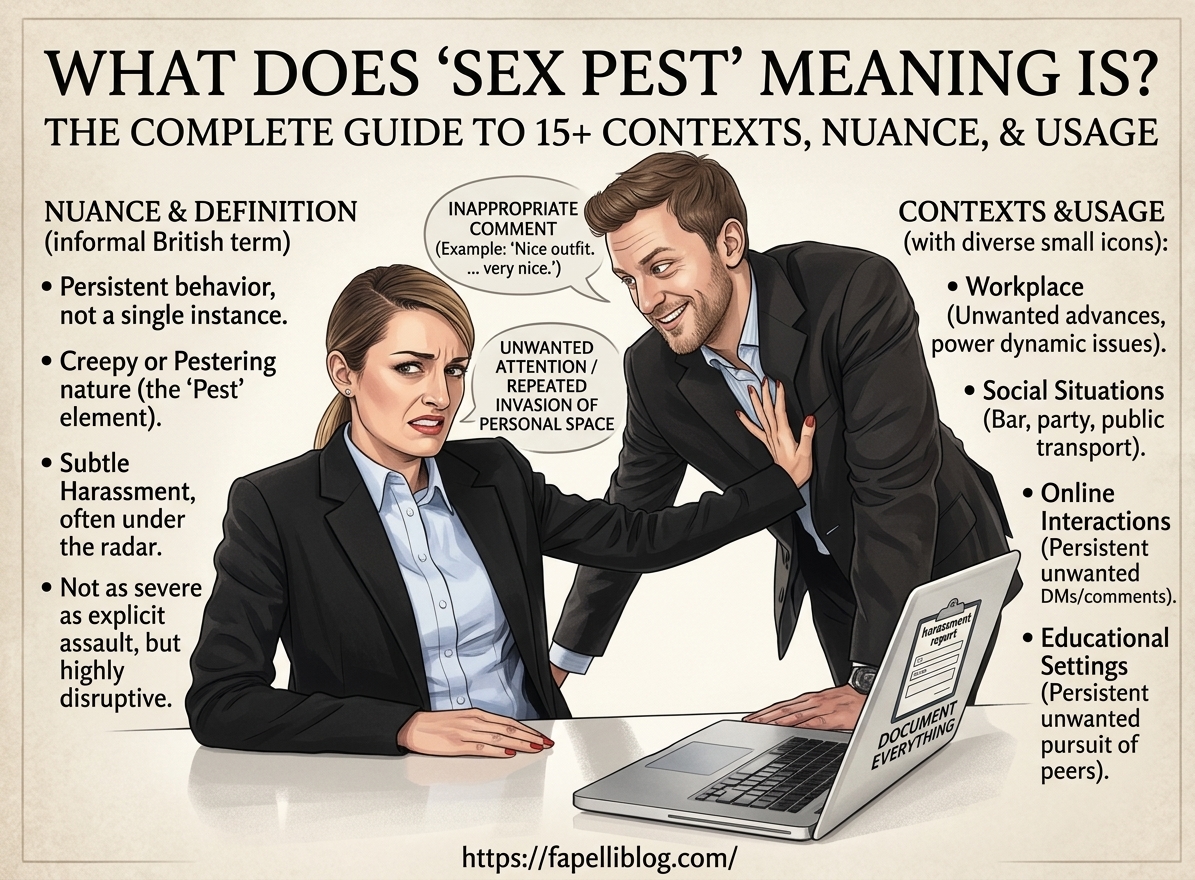
A “sex pest” meaning is an informal, predominantly British and Commonwealth term used to describe a person who persistently targets others with unwanted sexual attention, inappropriate comments, or subtle physical harassment. Unlike an offender involved in severe criminal assault, a sex pest operates through a continuous pattern of pushy, boundary-crossing behavior that makes others feel uncomfortable, unsafe, or targeted.
Introduction: Why Standard Dictionaries Miss the Full Picture
If you look up the literal definition of a sex pest, standard dictionaries will usually give you a dry, one-sentence summary like “a person who regularly harasses people sexually.” Straightforward. No confusion there—on paper, at least.
Here’s what most people miss: dictionary entries completely ignore the social weight, tone, and cultural context behind the term. The word carries a specific blend of social condemnation and contempt. It doesn’t just describe an action; it labels a persistent behavioral pattern.
People search for this term because it frequently pops up in UK news headlines, workplace misconduct investigations, and tabloid reporting, yet international readers—especially in North America—often struggle to gauge its exact severity.
Core Meaning & Literal Usage
At its core, sex pest combines two distinct concepts: sexual advances and a “pest” (an annoying, persistent intruder who will not take a hint).
Key Characteristics of a Sex Pest
- Persistence: They rarely stop after an initial rejection; they push past normal social boundaries repeatedly.
- Low-to-Mid Level Harassment: The term usually refers to inappropriate touching, unwelcome flirting, graphic comments, or intrusive messages rather than violent sexual assault.
- Power Asymmetry: It frequently describes individuals in workplaces or social clubs who leverage subtle status to shield their behavior.
Real-World Sentence Examples
- “Management finally fired him after three different junior staff members reported his behavior as a sex pest.”
- “He thought he was being charming at the bar, but his refusal to walk away made him look like a total sex pest.”
Real-World, Slang, & Conversational Contexts
In everyday speech, the term is applied across several specific environments. Understanding where it appears helps clarify how real people use it. Take a look at SFH Meaning.
1. The Workplace & Corporate Settings
In modern professional environments, calling someone a sex pest usually implies conduct that breaches HR policies on sexual harassment. It refers to the co-worker who routinely makes inappropriate jokes, stands too close, or sends late-night non-work messages.
2. Nightlife, Bars, & Social Clubs
In pub culture and nightlife, a sex pest is the patron who hovers around groups of women, ignores clear body language indicating “leave me alone,” and insists on buying drinks after being turned down.
3. Online & Social Media (“Digital Sex Pests”)
With the rise of direct messaging on platforms like Instagram, X (Twitter), and LinkedIn, the term has expanded to include individuals who flood DMs with unprompted sexual comments or unsolicited explicit images.
Nuances, Regional Differences, & Cultural Connections
The phrase has strong roots in specific dialects and media landscapes:
Regional Variations: UK vs. US vs. Australia
- United Kingdom & Ireland: Highly common in both casual speech and mainstream journalism (e.g., The Guardian, BBC, The Sun). Recommended reads here SFH meaning.
- Australia & New Zealand: Widely understood and used in media and everyday conversation.
- United States & Canada: Less common in domestic slang. Americans typically use terms like “creep,” “serial harasser,” or “predator” depending on the severity.
Media & Pop Culture Usage
The term gained massive traction in UK tabloids during the late 20th century as a headline shorthand for politicians, celebrities, or public figures caught in unwanted advances scandals. Today, media outlets use it to summarize workplace misconduct allegations where the acts fall short of criminal charges but clearly violate ethical codes.
Common Mistakes & Misunderstandings to Avoid
Because the word sound slightly informal, readers and non-native English speakers often misinterpret its weight:
- Conflating It with Casual Flirting: Misreading a single awkward compliment as “sex pest” behavior misses the key element: a pattern of persistence despite clear disinterest.
- Minimizing Severe Crimes: Using the term for serious physical assault or violent crimes can downplay the legal gravity of the offense. Media standards generally reserve “sex pest” for persistent harassment, opting for terms like “assailant” or “predator” for severe criminal acts.
- Assuming It’s a Legal Term: “Sex pest” is a colloquial label and journalistic shorthand, not a formal charge in criminal law.
Entity Mapping & Quick Comparison Table
| Term | Severity Level | Primary Context | Key Difference |
| Sex Pest | Low to Moderate (Persistent) | UK/Commonwealth Slang, Media, Workplace | Focuses on persistent, boundary-crossing behavior and unwanted advances. |
| Creep | General / Low | Global (US Dominant) Informal | Broader term for anyone making others uncomfortable (not strictly sexual). |
| Sexual Harasser | Legal / Workplace Standard | Formal, Professional, Legal | The official HR and legal term for unwanted sexual conduct in professional settings. |
| Sexual Predator | High / Criminal | Legal, Media, Law Enforcement | Refers to individuals who actively seek out and exploit victims for severe offenses. |
Frequently Asked Questions (GEO / AI Snippet Block)
How is “sex pest” pronounced?
It is pronounced phonetically as “seks pest” (/sɛks pɛst/).
Is “sex pest” a legal term?
No. It is an informal term and media shorthand. In court or HR proceedings, the behavior is formally classified as sexual harassment, stalking, or creation of a hostile work environment.
What is the American equivalent of a “sex pest”?
In American English, the closest functional equivalents are “creep,” “serial harasser,” or “pest,” depending on the severity of the behavior.
The One Rule That Unlocks the Meaning
To immediately gauge what “sex pest” means whenever you read or hear it, use this formula:
Persistence + Unwanted Sexual Attention + Disregard for Boundaries = Sex Pest
(If the advance is a single innocent mistake, it’s just awkward; if it repeats after a “no,” it fits the term.)
