

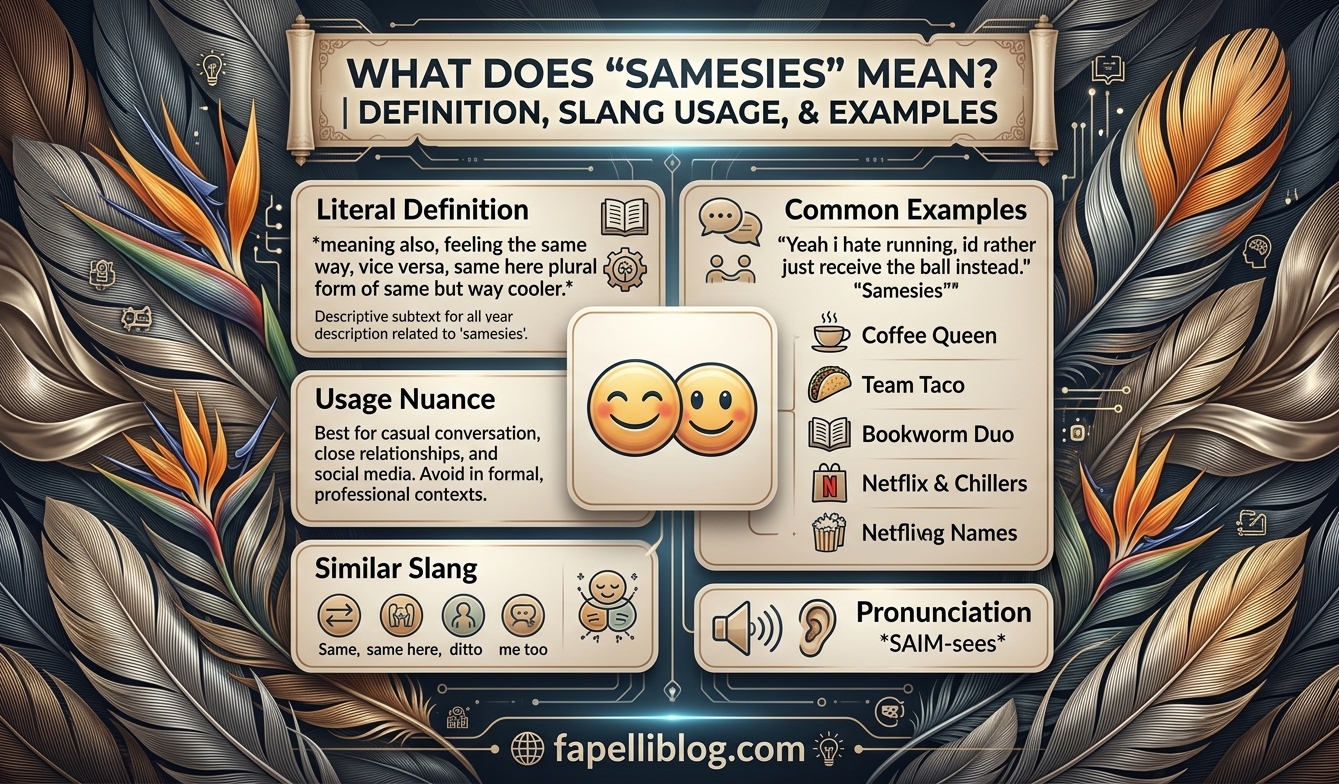
“Samesies” is a lighthearted, informal slang term that means “same here,” “me too,” or “I agree.” People use it in casual conversation, texting, and social media to express agreement or share a matching experience without sounding overly formal.
While a basic dictionary defines it as a simple synonym for “ditto,” that definition misses how the word actually functions online and in daily life.
What Does “Samesies” Mean in Casual Conversation?
At its core, samesies is an playful variation of the word same. Adding the suffix “-sies” softens the response, making your agreement sound friendly, cute, or slightly humorous.
You will rarely hear it in a corporate boardroom or read it in a formal essay. Instead, it thrives in low-stakes environments like group chats, casual coffee runs, and social media comment sections. You May Also Like To Read About What Does Shana Tova Meaning?
Common Everyday Examples
- Friend A: “I am completely exhausted after that workout.”Friend B: “Samesies. My legs feel like jelly.”
- Colleague (via Slack): “Honestly, I just want tacos for lunch today.”You: “Samesies! Count me in.”
- Text Message: “So glad it’s finally Friday!”Response: “Samesies 🙌”
When and How to Use “Samesies” (Tone and Context)
Understanding tone is crucial when using modern slang. Because “samesies” carries a distinctly playful vibe, using it in the wrong setting can feel out of place.
Best Scenarios to Use It
- Texting & Messaging: Perfect for WhatsApp, iMessage, Slack (in casual channels), or Instagram DMs.
- Informal Socializing: Great when hanging out with close friends, family, or peers.
- Lighthearted Social Media Posts: Ideal for quick replies on TikTok, X (formerly Twitter), or Threads.
When to Avoid It
- Formal Professional Emails: Avoid sending it to clients, executives, or in serious work updates.
- Serious or Emotional Conversations: If a friend is expressing genuine distress, responding with “samesies” can seem dismissive.
- Academic or Professional Writing: Stick to traditional terms like “likewise,” “similarly,” or “agreed.”
Cultural Origins and Similar Slang Variations
The practice of adding “-sies” to simple words is a common linguistic trend in English used to create “diminutives”—words modified to convey affection, smallness, or playfulness. Words like backsies (as in “no backsies”), frontsies, and dibsies follow the exact same pattern.
Popularized heavily in pop culture, millennial Internet culture, and early 2000s sitcoms, “samesies” remains a staple of casual modern English alongside several close alternatives.
Quick Comparison of Agreement Terms
| Term | Tone Level | Best Context | Example |
| Samesies | Very Casual / Playful | Texting, close friends, light banter | “I need a coffee.” → “Samesies!” |
| Ditto | Casual / Classic | Everyday chats, neutral agreement | “I loved that movie.” → “Ditto.” |
| Same | Neutral / Short | Modern digital chat, quick replies | “I’m so tired.” → “Same.” |
| Likewise | Semi-Formal / Formal | Professional settings, polite responses | “Nice meeting you.” → “Likewise.” |
| Me Too | Universal | Universal everyday use | “I want pizza.” → “Me too.” |
Common Misunderstandings & Mistakes to Avoid
- Using It in Sarcastic Contexts Incorrectly: While “samesies” is generally positive, tone matters. Saying it with an exaggerated eye-roll can come off as sarcastic or patronizing.
- Confusing It with “No Backsies”: Though both end in “-sies,” “no backsies” refers to a childhood rule preventing someone from taking back a trade or promise. It has no structural link to “samesies.”
- Overusing It in Single Conversations: Because of its distinct sound, repeating “samesies” multiple times in a short conversation can quickly sound repetitive or overly childish.
Recommended Reads: What Does Shana Tova Mean!
Casual Text Messages & Group Chats
- Person A: “I’m way too tired to cook dinner tonight. Ordering takeout.”Person B: “Samesies! Just got a pizza.”
- Person A: “Honestly, I could sleep for 12 hours right now.”Person B: “Samesies 😴”
- Person A: “So relieved that hard test is finally over!”Person B: “Samesies, I feel like a weight was lifted off my shoulders.”
Work Chat (Casual Slack / Teams Channels)
- Colleague A: “Taking a quick coffee break before this afternoon meeting.”Colleague B: “Samesies! Heading to the kitchen now.”
- Colleague A: “I have zero motivation to work on a Friday afternoon.”Colleague B: “Samesies… counting down the minutes till 5 PM.”
Face-to-Face Conversations
- Friend A: “I bought three different sweaters today because I couldn’t decide on a color.”Friend B: “Samesies! I did the exact same thing at Target last week.”
- Friend A: “I’m so obsessed with this new show on Netflix.”Friend B: “Oh, samesies! I binge-watched the whole season yesterday.”
- Friend A: “I always forget where I park my car in this giant garage.”Friend B: “Samesies, I spent ten minutes looking for mine earlier!”
Social Media Comments (Instagram, TikTok, X)
- Post Caption: “Current mood: pretending my inbox doesn’t exist.”Comment: “Samesies 😂”
- Post Caption: “Never drinking iced coffee in the middle of winter… wait, never mind.”Comment: “Samesies, year-round iced coffee team! ❄️☕”
The Golden Rule for Using “Samesies”
The Rule: Use “samesies” when you want to say “me too” or “I agree,” but want to keep the mood light, warm, and playful. If the conversation requires formality or empathy, default to “likewise” or “me too.”
