

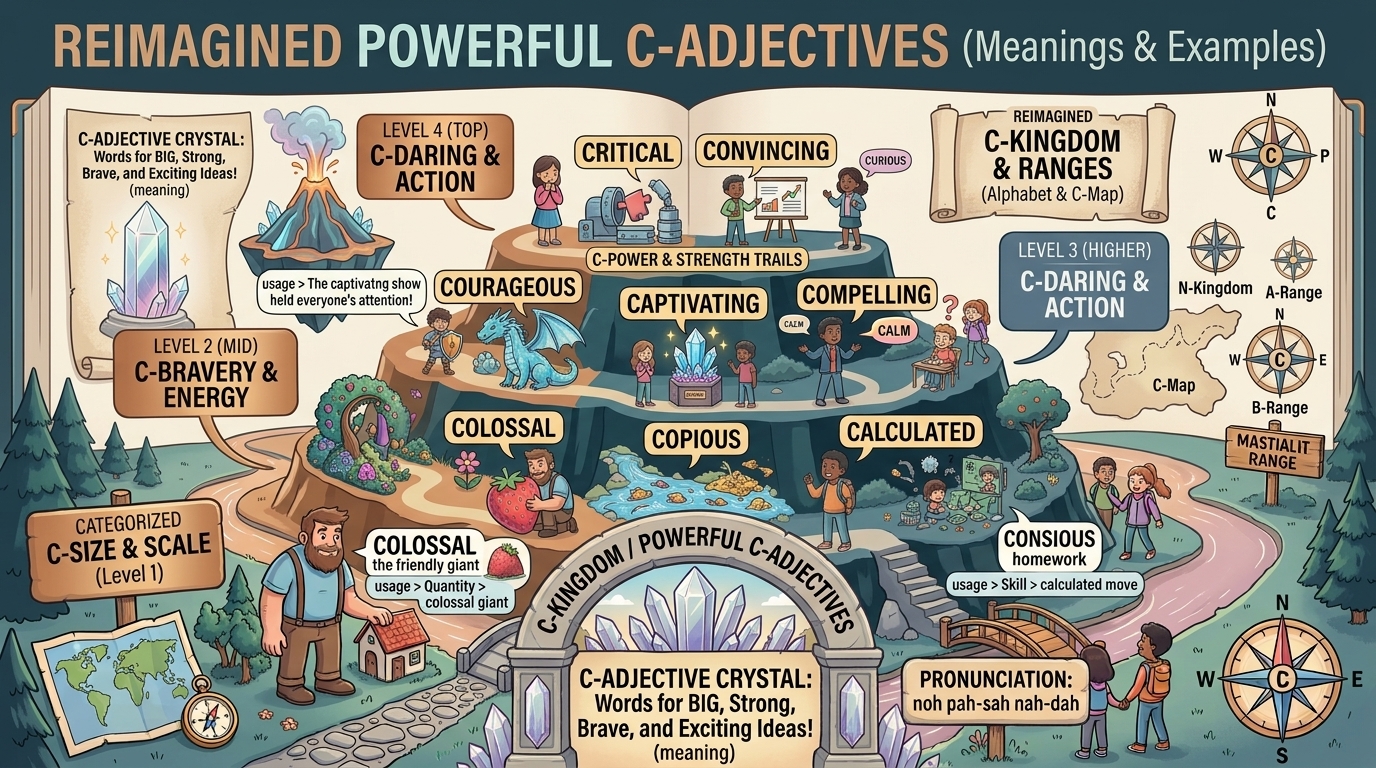
Adjectives that start with C are descriptive words—ranging from “charismatic” and “candid” to “crafty“—used to modify nouns by detailing traits, feelings, appearances, and behaviors. Whether you are polishing a resume, crafting a story, or boosting your vocabulary, selecting the precise C-adjective adds immediate clarity and emotional weight to your writing.
Relying on a standard dictionary list won’t cut it. A raw word bank tells you what a word means on paper, but it won’t show you how tone shifts when you swap “clever” for “cunning” in real life.
Core Usage & Categorized Word Lists
To use adjectives that start with C effectively, you need to match the word’s inherent connotation to your exact intent. The letter C houses some of the most emotionally charged descriptive words in the English language.
Positive & Personality-Focused C-Adjectives
When describing individuals in professional evaluations, character bios, or personal references, these positive traits build immediate rapport.
- Charismatic: Possessing an extraordinary charm that inspires devotion in others.
- Example: Her charismatic speech held the entire audience captive.
- Compassionate: Showing deep sympathy and concern for others.
- Example: The hospital hired compassionate nurses who prioritized patient comfort.
- Candid: Straightforward, honest, and frank.
- Example: He gave a candid interview about his past career failures.
- Conscientious: Wishing to do one’s work or duty thoroughly and well.
- Example: A conscientious editor will catch micro-errors before publishing.
Describing Appearance & Physical Attributes
- Captivating: Formidably attractive or interesting; enchanting.
- Example: The mountain valley offered a captivating view at sunrise.
- Colossal: Extremely large in size or scale.
- Example: The project failed due to a colossal oversight in the budget.
- Cozy: Giving a feeling of comfort, warmth, and relaxation.
- Example: We stayed in a cozy cabin during the snowstorm.
Real-World, Slang & Conversational Contexts
Here is what most people miss: C-adjectives adapt drastically based on conversational setting. How people talk over coffee differs from how writers construct formal prose.
The Modern Slang Shift
In contemporary digital communication and casual conversations, certain C-adjectives have taken on specialized meanings:
- Chill: Originally meaning cold, it now functions as a high-frequency adjective for relaxed or unbothered individuals (“She’s super chill about the deadline”).
- Cheesy: In informal contexts, this describes something painfully corny or exaggerated (“That movie had a cheesy ending”).
- Clutched / Clutch: Borrowed from gaming and sports culture, describing an action or person that delivers critical success under high pressure (“That was a clutch performance in the final minute”).
Professional vs. Casual Tone Matching
Using the wrong C-adjective can inadvertently alter your message’s intent:
Casual / Colloquial: "He is a CRAY-CRAY planner." → Chaotic / Over-the-top (Informal)
Negative / Extreme: "He is a COMPULSIVE planner." → Unable to stop (Unfavorable)
Nuances, Culture & Regional Variations
Word choice often hinges on geographic and cultural context. The subtle difference between British English, American English, and pop-culture usage changes how a listener interprets these descriptors.
British vs. American Nuances
- Cheeky: Widely used in British English to mean playfully impudent or irreverent (“a cheeky pint” or “a cheeky comment”). In American English, it is far less common and can sound overly formal or antiquated.
- Cranky: Heavily favored in American English for someone who is irritable. British speakers often lean toward grouchy or grumpy.
Pop Culture & Literary References
Certain C-adjectives carry distinct cultural associations:
- Kafkaesque vs. Catch-22 (Catch-22-esque): Pop culture frequently turns to descriptors like Cinematic to describe grand visual moments or Comic to highlight absurd scenarios in media and storytelling.
Common Mistakes to Avoid with C-Adjectives
Language learners and seasoned writers alike often trip over subtle connotation traps when choosing words starting with C.
- Confusing Clever with Cunning
- Clever implies brightness, quick intellect, and positive problem-solving skills.
- Cunning carries a deceitful, craftier edge. Calling your boss “cunning” instead of “clever” might read as a backhanded compliment.
- Overusing Generic Descriptors
- Relying continuously on broad words like cool or cute weakens your writing. Swap cool for compelling, credible, or captivating depending on the true context.
- Mixing Up Adjectives and Nouns
- Words like Chaos (noun) versus Chaotic (adjective), or Courage (noun) versus Courageous (adjective). Ensure the word properly modifies the target noun.
Quick Reference & Entity Mapping Table
| Target C-Adjective | Primary Context | Best Synonym | Tone / Connotation |
| Candid | Professional / Personal | Honest | Positive / Direct |
| Cautious | Decision Making | Guarded | Neutral / Prudent |
| Charismatic | Leadership / Personality | Charming | Highly Positive |
| Cheeky | Casual / Regional (UK) | Playful | Informal / Lighthearted |
| Clumsy | Physical / Behavior | Awkward | Slightly Negative |
| Cunning | Strategy / Motives | Crafty | Negative / Suspicious |
| Cozy | Environment / Ambiance | Warm | Positive / Comforting |
Frequently Asked Questions
What are some positive adjectives that start with C to describe a person?
Top positive C-adjectives for describing individuals include compassionate, charismatic, considerate, candid, courteous, creative, and conscientious.
What are good C-adjectives for a resume?
Effective resume descriptors include capable, collaborative, consistent, constructive, competent, and resourceful (or creative). Use these to highlight key workplace behaviors and skills.
What is the difference between childish and childlike?
While both originate from the same root, childish is negative and describes emotional immaturity. Childlike is positive, describing innocence, trust, or wonder.
Positive Adjectives That Start With C
Positive adjectives starting with the letter C bring warmth, energy, and strength to everyday vocabulary. Using words like charismatic, compassionate, and considerate allows you to highlight genuine empathy and inspiring personality traits in others. When evaluating professional achievements or personal work ethic, terms such as conscientious, creative, and capable clearly signal reliability, intelligence, and high standards. Even when describing an environment or experience, options like cozy, captivating, and cheerful immediately set an uplifting tone. Mastering these descriptors gives you precise, powerful tools to uplift people, build rapport, and highlight the bright side of any situation.
The One Rule for Mastering C-Adjectives
Whenever you are selecting an adjective starting with C, apply this simple standard:
Check the connotation before you confirm the word: verify if your chosen C-adjective signals intellect (clever), deceit (cunning), or warmth (compassionate) to ensure your exact tone comes through.
