

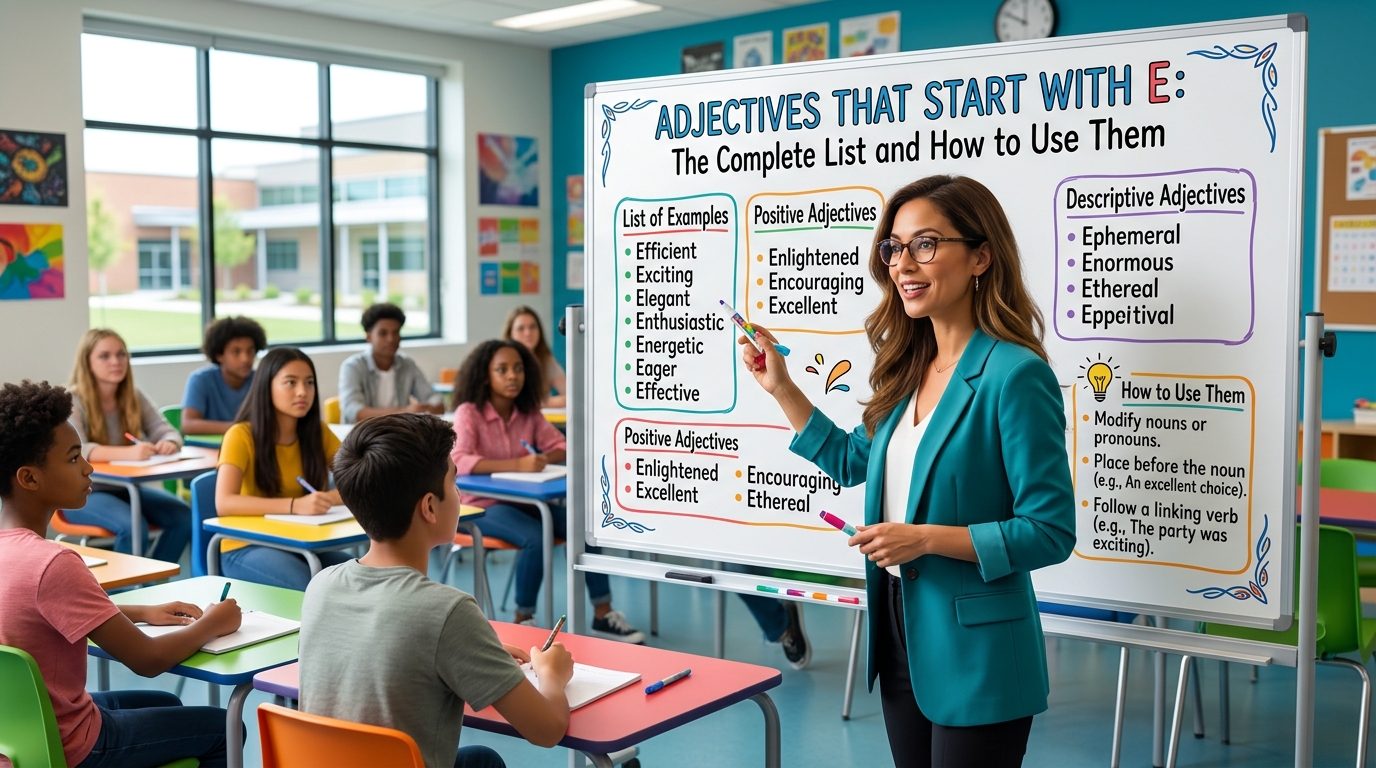
Adjectives that start with E describe qualities, states, or characteristics ranging from enthusiastic emotions to elegant designs. This curated guide breaks down the most useful E-adjectives by tone, context, and practical usage so you can instantly sharpen your writing and vocabulary.
Standard dictionaries give you static definitions, but they miss how words function in real conversations. Choosing the right adjective is not just about expanding your word bank; it is about matching tone, intent, and subtle emotional nuance.
Core Meaning & Literal Usage
Adjectives beginning with the letter “E” cover a broad spectrum of human experience, physical appearances, and abstract concepts. Using them correctly depends on understanding their precise definitions and grammar contexts.
Here are core categories of common E-adjectives paired with direct sentence examples:
Positive & Personality Adjectives
- Empathetic (/ɛmˈpæθ.ə.tɪk/): Able to understand and share the feelings of others.
- Example: “Her empathetic nature made her a trusted mentor to the entire team.”
- Energetic (/ˌɛn.ərˈdʒɛt.ɪk/): Showing or involving great activity or vitality.
- Example: “The puppy gave an energetic greeting the moment we opened the front door.”
- Exuberant (/ɪɡˈzjuː.bər.ənt/): Filled with lively, uninhibited energy and excitement.
- Example: “The crowd was exuberant after the home team scored the winning goal.”
Descriptive & Visual Adjectives
- Elegant (/ˈɛl.ɪ.ɡənt/): Graceful and stylish in appearance or manner.
- Example: “She wore an elegant silk gown to the awards gala.”
- Ethereal (/iˈθɪə.ri.əl/): Extremely delicate and light in a way that seems too perfect for this world.
- Example: “The morning mist gave the mountain valley an ethereal glow.”
- Eccentric (/ɪkˈsɛn.trɪk/): Unconventional and slightly strange in a charming way.
- Example: “The collector filled his home with eccentric art pieces from around the globe.”
Real-World, Conversational, and Professional Contexts
Here is how real people actually deploy E-adjectives across different everyday scenarios:
Workplace & Resume Descriptions
When describing professional achievements, choose adjectives that highlight efficiency and impact:
- Efficient: “He developed an efficient workflow that cut production time in half.”
- Exemplary: “She received an award for her exemplary leadership during the project.”
- Effective: “We need an effective marketing strategy to reach younger demographics.”
Creative Writing & Character Building
In storytelling, descriptive E-adjectives build vivid imagery:
- Eerie: “An eerie silence fell over the abandoned house.”
- Enigmatic: “The protagonist met an enigmatic stranger at the train station.”
- Elusive: “The detective spent years chasing the elusive art thief.”
Cultural, Pop-Culture, and Regional Nuances
Words carry cultural weight. The way an adjective like epic or electric gets used in popular culture often shifts its meaning away from strict dictionary definitions.
- Epic: Originally referring to long heroic poems (like Homer’s Odyssey), modern internet culture uses epic to mean anything extraordinarily impressive or large in scale (e.g., “epic fail,” “epic party”).
- Electric: Beyond literal electrical current, pop culture uses electric to describe high-voltage energy in music or sports crowds (e.g., “The stadium atmosphere was electric“).
- Eccentric vs. Crazy: In conversational English, calling someone eccentric implies fondness for their quirky personality, whereas calling them “crazy” carries a harsher, negative connotation.
Mistakes & Misunderstandings to Avoid
Learners and native writers alike often stumble over closely related E-adjectives.
1. Elicit vs. Illicit (Adjective vs. Verb)
- Elicit is a verb meaning to draw out a response (e.g., “to elicit a reaction”).
- Illicit is the adjective starting with I that means illegal or forbidden.
2. Economic vs. Economical
- Economic relates to the economy or business operations (e.g., “economic growth”).
- Economical means budget-friendly or avoiding waste (e.g., “an economical compact car”).
3. Empathy vs. Sympathy (Empathetic vs. Sympathetic)
- Empathetic means feeling with someone by sharing their pain.
- Sympathetic means feeling for someone with sorrow or pity.
Quick Summary & Comparison Table
Use this entity table to quickly match the right E-adjective to your target tone and context:
| Adjective | Primary Meaning | Best Context | Tone / Nuance |
| Effortless | Done with ease or natural skill | Fashion, Sports, Writing | Admiration, Smoothness |
| Elaborate | Detailed and complicated | Architecture, Plans, Stories | Intricate, Complex |
| Emphatic | Expressed with firm emphasis | Speeches, Arguments | Strong, Direct |
| Enchanting | Delightful and charming | Nature, Fairy Tales, Romance | Warm, Whimsical |
| Erratic | Unpredictable or inconsistent | Weather, Behavior, Markets | Cautionary, Negative |
| Evocative | Bringing strong images or memories to mind | Art, Music, Literature | Nostalgic, Deep |
Frequently Asked Questions
What are some powerful adjectives that start with E for a resume?
Top resume adjectives include exemplary, efficient, effective, enterprising, enterprising, and experienced.
What are good positive E-adjectives to describe a friend?
Great options include empathetic, encouraging, exuberant, enthusiastic, and extraordinary.
What is the difference between “exceptional” and “extraordinary”?
While both mean far above average, exceptional often refers to high performance or talent within a standard system, while extraordinary implies something rare, unusual, or remarkable in nature.
The One Rule That Unlocks All E-Adjectives
Whenever you are choosing an adjective that starts with E, remember this quick formula:
Precision > Ornamentation.
Do not add an E-adjective just to sound sophisticated. Pick the single word that captures the exact tone, intensity, and context you need, and let the specific meaning do the heavy lifting for your sentence.
Positive Adjectives That Start With E
Positive adjectives beginning with the letter “E” are ideal for highlighting warmth, high energy, and outstanding quality in everyday conversations and writing. Words like enthusiastic, empathetic, and exuberant perfectly describe vibrant personal traits, capturing someone’s ability to bring joyful energy or heartfelt understanding into a room. When praising achievements or character, terms such as exemplary, extraordinary, and empowering add a strong sense of admiration and capability. Meanwhile, words like elegant and enchanting bring a touch of grace and charm when describing visual beauty or memorable experiences. Using these uplifting E-adjectives allows you to express genuine appreciation and construct far more engaging, impactful compliments.
