

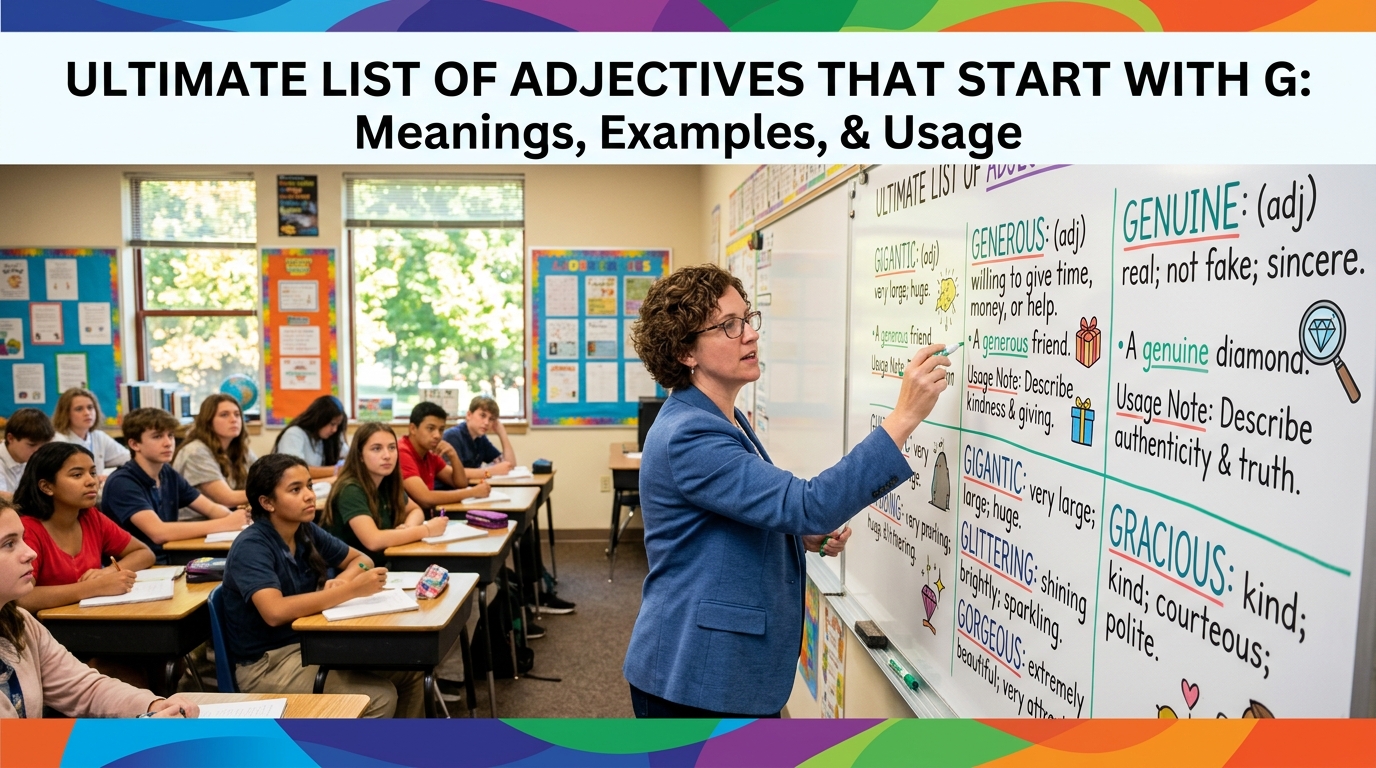
Adjectives that start with G are descriptive words—ranging from generous and gorgeous to gregarious and gruesome—used to modify nouns by detailing tone, appearance, emotion, or quality. Mastering adjectives starting with G elevates vocabulary in creative writing, professional communication, and search engine content optimization.
Most standard alphabetical lists throw hundreds of obscure dictionary entries at you without explaining how or when to use them. That is why literal dictionary definitions fall short—they tell you what a word means, but omit the contextual tone, emotional weight, and conversational fit required for natural writing.
Here is what most people miss: selecting the right G-adjective relies heavily on emotional resonance and register.
Core Meaning & Literal Usage
Adjectives beginning with the letter G span across positive, neutral, and negative descriptors. They function by anchoring a specific characteristic directly onto a person, place, or concept.
- Positive Descriptors: Words like gracious, glowing, and genuine elevate praise and convey warmth.
- Example: “She delivered a gracious acceptance speech that moved the entire audience.”
- Personality & Behavioral Traits: Words like gregarious, garrulous, and guarded detail social behaviors.
- Example: “His gregarious nature made him the life of every networking event.”
- Physical & Visual Qualities: Words like gilded, gaudy, and gigantic describe visual scale and aesthetic value.
- Example: “The ballroom was decorated with gilded mirrors and elaborate chandeliers.”
Straightforward. No confusion there.
Real-World, Slang, and Conversational Contexts
Using vocabulary effectively in modern speech requires understanding current linguistic shifts and casual registers.
1. The Modern Slang & Pop Culture Context
In digital discourse and social media slang, G adjectives take on distinct modern meanings:
- Goated (or GOAT-level): Derived from the acronym Greatest Of All Time, used informally to describe exceptional performance or status.
- Example: “That performance was absolutely goated.”
- Giga (e.g., Gigachad): A prefix-turned-adjective denoting massive scale, confidence, or hyper-masculine aesthetics.
- Example: “He handled that high-pressure presentation with giga confidence.”
2. Professional & Business Environments
In corporate communication, precise G adjectives establish authority and tone:
- Galvanizing: Describing leadership or ideas that excite people into immediate action.
- Groundbreaking: Used to describe innovative products, research, or strategic maneuvers.
- Example: “The team presented a groundbreaking framework for real-time analytics.”
Nuances & Cultural Connections
The emotional weight of G-adjectives often shifts based on cultural nuances and subtle undertones.
For instance, consider the distinction between grand and gaudy. Both words describe large, impressive, or elaborate displays. However, grand carries positive connotations of dignity, majesty, and elegance (e.g., a grand piano or a grand gesture). Conversely, gaudy implies tastelessness, excessive flashiness, or cheap over-decoration.
Similarly, garrulous and gregarious both describe outgoing individuals. While gregarious is overwhelmingly positive (sociable, warm, fond of company), garrulous carries a mild criticism implying someone who talks excessively about trivial matters.
Mistakes & Misunderstandings to Avoid
Here is where writers and language learners commonly get confused:
- Confusing “Graces” and “Gracious” with “Graceful”: While both derive from grace, graceful refers to physical agility or aesthetic harmony (a graceful dancer), whereas gracious refers to kindness, courtesy, and charm (a gracious host).
- Overusing “Good” and “Great”: Relying endlessly on basic descriptors weakens descriptive depth. Swapping generic praise for words like exemplary, glorious, or glowing creates far sharper engagement.
- Misinterpreting “Ghoulish”: “Ghoulish” does not simply mean scary; it specifically refers to an unhealthy, morbid fascination with death, disaster, or horror.
Quick Summary & Comparison Table
| Category | Adjective | Definition / Tone | Primary Context |
| Positive / Praise | Generous | Showing a readiness to give more than expected | Character, Charity, Persona |
| Positive / Praise | Glorious | Having striking beauty or deserving high admiration | Achievement, Scenery, Weather |
| Social / Behavioral | Gregarious | Fond of company; highly sociable | Personality, Networking |
| Social / Behavioral | Guarded | Cautious and reserved in revealing emotions | Emotional State, Relationships |
| Negative / Unfavorable | Gaudy | Extravagantly bright or showy; lacking taste | Aesthetics, Fashion, Decor |
| Negative / Unfavorable | Gruesome | Causing repulsion or horror; grisly | Events, News, Crime, Media |
| Intellectual / Scale | Groundbreaking | Featuring innovative or pioneering methods | Tech, Research, Business |
The One Rule That Unlocks All Meanings
To select the perfect adjective starting with G: Match the word’s inherent tone to your intended audience. Use groundbreaking and galvanizing for corporate authority, gregarious and gracious for nuanced personal descriptions, and save terms like gaudy or ghastly for sharp, vivid critique.
Adjectives That Start With An G
Adjectives that start with an G encompass a rich variety of descriptive words that elevate tone, character detail, and emotional depth in writing. Positive terms like generous, gracious, and genuine convey warmth, nobility, and high moral character, while personality-driven descriptors such as gregarious or guarded capture distinct social traits and temperaments. Physically, words like gigantic, glistening, and gilded describe grand scale and vivid visual brilliance, contrastingly balanced by darker or critical terms such as grim, gruesome, and gaudy. Whether describing a glorious achievement, a groundbreaking innovation, or a gentle touch, integrating varied G-adjectives allows writers to replace generic language with precise, engaging vocabulary.
