


In “Know” or “no”, ‘Know’ is a verb that refers to having information, awareness, or understanding in your mind, while “no” is a negative response, a decision, or an indicator of zero quantity. Although both words sound identical (homophones pronounced as /noʊ/), they perform completely opposite functions in English grammar and daily conversation.
Mixing up “know” and “no” is one of the most common spelling blunders in fast-paced texting, email drafting, and ESL learning. Standard spellcheckers often fail to catch this error because both words are spelled correctly.
Here is the ultimate guide to understanding the distinct mechanics of know or no, how they operate across daily speech, pop culture, and texting, and simple memory tricks to keep them straight every single time.
1. Core Meaning & Literal Usage (With Clear Examples)
To master these two homophones, you need to look at their basic grammatical jobs. They belong to completely different word classes.
The Verb: Know
Know (verb) originates from Old English cnāwan. It always involves the brain—processing facts, recognizing faces, or possessing a specific skill.
- Factual Knowledge: “I know the answer to that question.”
- Familiarity with People/Places: “Do you know Sarah from accounting?”
- Skill or Capability: “She knows how to code in Python.”
The Negative: No
No (determiner, adverb, interjection, or noun) comes from Old English nā. It is used to reject something, show refusal, or state the complete absence of an item.
- Direct Refusal: “No, I cannot attend the meeting today.”
- Absence of Quantity: “There is no coffee left in the pot.”
- Prohibition Signs: “No parking allowed on this street.”
2. Real-World, Slang, and Conversational Contexts
People rarely struggle with these words in spoken dialogue because context carries the load. In written communication—texts, Slack messages, social posts—fast typing creates frequent slip-ups.
Common Conversational Phrases With “Know”
- “In the know”: Having insider access or secret information (“Talk to Alex; he’s in the know about upcoming hires.”).
- “You know?”: A conversational filler used to seek agreement or check for understanding (“It’s just too cold outside, you know?”).
- “Know-it-all”: A somewhat derogatory slang term for someone who acts like they understand everything (“Don’t be such a know-it-all.”).
Common Conversational Phrases With “No”
- “No way”: An expression of disbelief or firm refusal (“No way am I eating that!”).
- “No worries”: A casual way of saying “you’re welcome” or “it’s fine” (“Thanks for the help!” — “No worries.”).
- “Big fat no”: A emphatic, unyielding rejection (“I asked for a raise, but it was a big fat no.”).
3. Pop-Culture Connections & Regional Nuances
Because “know” and “no” sound identical in standard English accents (General American, Received Pronunciation), song titles, movies, and wordplay frequently play on this exact confusion.
Pop Culture References
- Music: Song titles like “I Know You Want Me” (Pitbull) vs. “No Scrubs” (TLC) show the direct split between desire/awareness (know) and outright rejection (no).
- The “I Don’t Know” Trope: Iconic comedy routines—like Abbott and Costello’s classic “Who’s on First?”—rely heavily on the listener confusing names, answers, and verbal affirmations/negations.
Dialects and Phonetic Shifts
While standard English pronounces both as /noʊ/, certain regional accents subtly alter them:
- Scottish & Northern English: “No” can often sound like “nae” or “na”, distinct from the pronunciation of “know” (“I dinna ken“ replaces “I don’t know”).
- Text Speak & Internet Slang: “Know” is often abbreviated as kno or integrated into IDK (I Don’t Know). “No” remains no or gets stretched out (nooooo) for dramatic emphasis.
4. Mistakes & Misunderstandings to Avoid
Why do educated adults still write “I have know idea” or “Do you no where it is?”?
Here are the three primary failure points:
1. Phonetic Autopilot (Typing Fast)
When typing at high speeds, your brain outputs the sound /noʊ/ before your fingers select the correct spelling. Because both are ultra-common words, your muscle memory picks whichever one you type most frequently.
2. The Hidden “K” Confusion
The silent “K” in know trip up non-native English speakers. Remember that words related to mental processing often carry silent letters inherited from historical Germanic roots (like knowledge, knee, knight).
3. Double Negative Confusion
Using “no” alongside another negative creates a double negative that flips your meaning entirely:
- Incorrect: “I don’t know no answer.”
- Correct: “I don’t know the answer” OR “I know no answer.”
5. Quick Summary & Comparison Table
Here is how “know” and “no” compare side-by-side across grammatical function, context, and usage:
| Attribute | Know | No |
| Part of Speech | Verb | Determiner / Adverb / Exclamation / Noun |
| Primary Meaning | To possess information, skill, or awareness | A negative answer, rejection, or zero quantity |
| Phonetic IPA | /noʊ/ | /noʊ/ |
| Silent Letter | Yes (Silent “K”) | No |
| Antonym (Opposite) | Ignore / Be ignorant of | Yes |
| Texting Acronym | IDK (I Don’t Know) | N/A |
| Example Sentence | “I know where the office is located.” | “There is no milk left in the fridge.” |
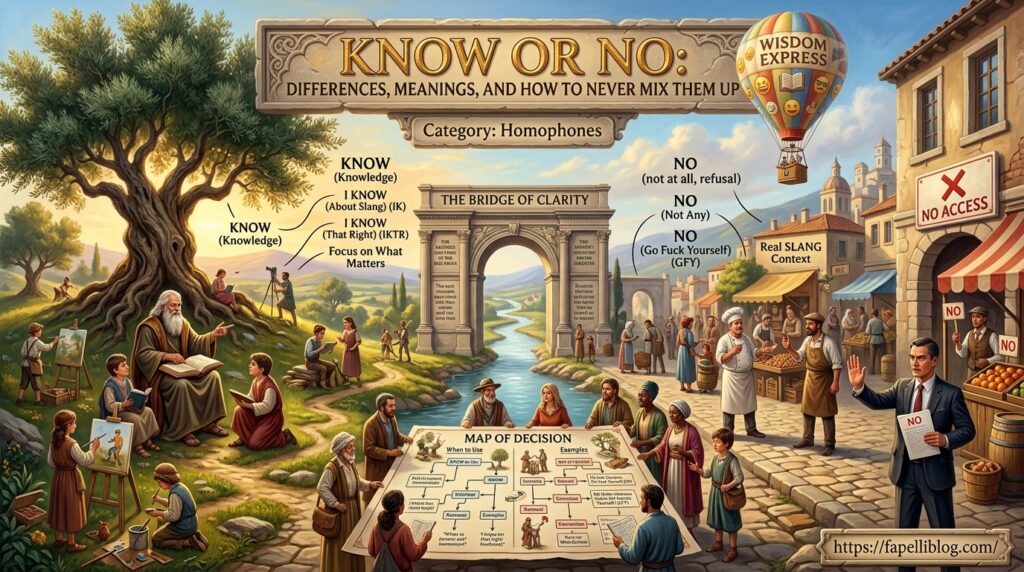
Frequently Asked Questions About Know or No
Is “know” always spelled with a K?
Yes. When referring to mental understanding, awareness, or recognizing someone, it always starts with a silent K. “Now” (without a K or an O at the end) refers to time (e.g., right now).
Why do “know” and “no” sound the same?
They are homophones—words that share the exact same pronunciation but have different origins, spellings, and meanings. “Know” comes from the Old English verb cnāwan, where the “K” was originally spoken, but over centuries, English speakers dropped the initial /k/ sound.
How can I quickly proofread for “know vs. no” errors?
Read your text out loud or swap the word with a synonym. If you can replace the word with “understand”, write know. If you can replace the word with “zero” or “refusal”, write no.
The One Rule to Master “Know” vs. “No”
Whenever you hesitate between know or no, use this simple visual memory formula:
If it takes KNOWLEDGE, use the word with a K → K-N-O-W.
If it means ZERO or NEGATIVE, use the short word → N-O.
