

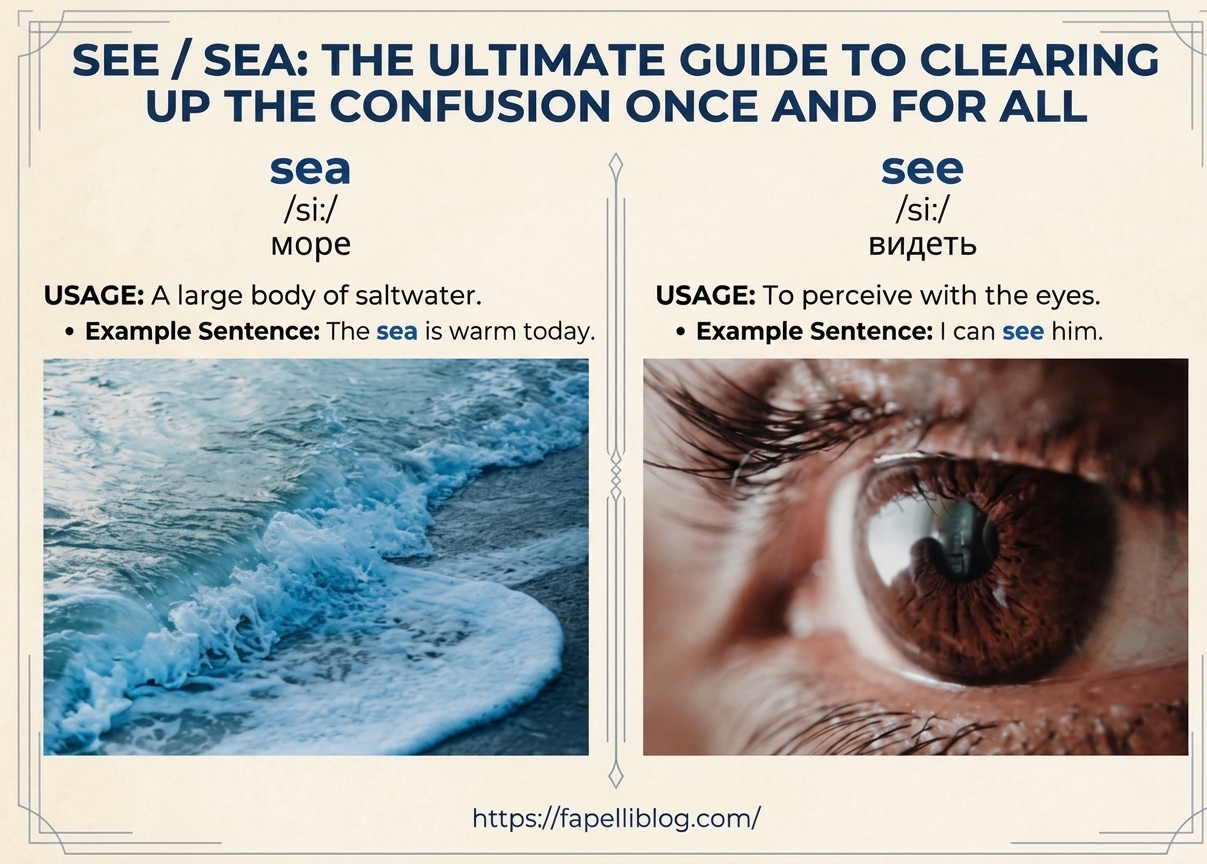
“See” is a verb that refers to perceiving something with your eyes, while “sea” is a noun that describes a vast body of salt water. Although both words sound identical because they are homophones, their grammatical roles, etymologies, and everyday applications are completely distinct.
Mixing up these two words is one of the most common written typos in the English language. Standard dictionary definitions often give you the quick rule, but they fail to show how deep these two short words run in everyday idioms, literary expressions, professional terminology, and cultural slang.
This comprehensive guide breaks down the technical differences, etymology, real-world usage scenarios, common mistakes, and idiomatic expressions associated with “see” and “sea” so you never confuse them again.
Core Meaning, Etymology, and Technical Breakdown
To master the difference between “see” and “sea,” you need to understand their linguistic origins and grammatical classes. They share the exact same pronunciation—/siː/ in the International Phonetic Alphabet (IPA)—but their evolutionary paths in the English language are vastly different. You may Also Like to Read About Right / Write: Master These Tricky Homophones Once and For All
Core Meaning & Etymology
| Word | Part of Speech | Primary Definition | Etymology / Origin |
|---|---|---|---|
| SEE | Verb Noun | To perceive with eyes | Old English ‘sēon’ (Proto-Germanic) |
| SEA | Noun Adjective | Body of salt water | Old English ‘sǣ’ (Proto-Germanic) |
The Verb “See”: Visual Perception and Mental Understanding
The word see functions primarily as an irregular verb. Its main forms are:
- Base form: See
- Past tense: Saw
- Past participle: Seen
- Present participle / Gerund: Seeing
Etymologically, “see” traces back to the Old English verb sēon, which means to perceive, look, behold, or comprehend. It relates to the Proto-Germanic root *sehwana3.
Beyond physical sight, “see” carries cognitive weight. When you say “I see what you mean,” you aren’t using your eyes. You are using your mind to grasp an idea.
Note on Noun Usage: “See” can also function as a rare noun referring to the jurisdiction or throne of a bishop, such as the Holy See in Vatican City. This comes from the Latin sedes, meaning seat.
The Noun “Sea”: Geography, Water, and Vastness
The word sea functions almost exclusively as a noun. It refers to a continuous body of salt water that covers most of the Earth’s surface, or a specific region of that water enclosed partly by land (like the Caribbean Sea or the Mediterranean Sea).
Etymologically, “sea” comes from the Old English noun sǣ, which meant sheet of water, lake, or ocean. This stems from the Proto-Germanic *saiwiz.
In a figurative sense, a “sea” can describe an overwhelming expanse or a massive quantity of something, such as a “sea of faces” in a crowded stadium.
Practical Usage and Everyday Scenarios
Understanding definitions is a great starting point, but seeing these words in action reveals how context shapes meaning. Let’s look at four distinct real-world situations.
Scenario 1: A Coastal Vacation Planning Email
“We are planning to visit the coast this summer. I can’t wait to see the sea from our hotel balcony!”
- Analysis: The first usage (see) is an action requiring eyes. The second usage (sea) is the physical body of salt water.
Scenario 2: Professional Troubleshooting and Problem-Solving
“Let me see if we can isolate the server glitch before the client arrives.”
- Analysis: Here, see means to investigate, ascertain, or determine. Using “sea” in this context would make the sentence completely unintelligible.
Scenario 3: Describing Large Crowds or Data Sets
“The speaker stepped onto the stage and looked out at a sea of eager attendees.”
- Analysis: This uses sea as a metaphor for vastness and immense volume.
Scenario 4: A Maritime Navigation Log
“The vessel encountered rough seas while navigating through the strait.”
- Analysis: Here, seas (plural) refers directly to ocean waves and turbulent marine conditions.
Real-World Contexts: Professional, Social, and Digital Settings
In modern communication, context dictates how these words appear in everyday speech and writing.
See vs. Sea Across Real-World Scenarios
| Context | How “SEE” is Applied | How “SEA” is Applied |
|---|---|---|
| Corporate Email |
“Let’s see if we can reschedule.”
Action / Evaluation
|
“We have a sea of data to process.”
Metaphor for vast volume
|
| Everyday Social Chat |
“Long time no see!”
Visual greeting
|
“I miss being down by the sea.”
Coastal location / Water
|
| Academic / Environmental |
“See Figure 2.1 for visual details.”
Reference / Direction
|
“Sea level rise impacts coasts.”
Marine science / Geography
|
Professional Settings
In business environments, see is used constantly for coordination and verification:
- “Please see the attached file for details.”
- “I’ll see to it that the report is finished on time.”
Conversely, sea appears in industry-specific contexts like marine logistics, environmental science, and shipping line management:
- “Freight charges vary based on sea route stability.”
Digital and Social Settings
On messaging apps and social media platforms, short phrases dominate:
- “Catch you later, let’s see how it goes!”
- “Vacation mode on! Heading straight to the sea.”
Idioms, Phrasal Verbs, and Cultural Nuances
Both words appear in rich, historic English idioms that do not translate literally. Memorizing these expressions will elevate your writing and reading comprehension.
Essential Idioms Using “See”
- See eye to eye: To agree fully with someone.
- Example: “They rarely see eye to eye on marketing strategies.”
- See red: To become extremely angry.
- Example: “When he realized he had been lied to, he began to see red.”
- Wait and see: To withhold judgment until more information arrives.
- Example: “We need to wait and see how the market reacts.”
- See the light: To finally understand or accept something after a period of doubt.
- Example: “After reading the audit, the board finally saw the light.”
Essential Idioms Using “Sea”
- At sea / All at sea: Confused, lost, or uncertain about what to do.
- Example: “Without clear instructions, the new intern was completely at sea.”
- Sea change: A profound, radical transformation in character or situation.
- Example: “The company underwent a total sea change after the merger.”
- There are plenty of fish in the sea: There are many other potential partners or opportunities available.
- Example: “Don’t dwell on that lost account; there are plenty of fish in the sea.”
- Sea legs: The ability to keep your balance on a boat, or adapt to a new, unfamiliar situation.
- Example: “It took a few weeks on the job before she finally found her sea legs.”
Step-by-Step Guide: How to Always Pick the Right Word
If you catch yourself second-guessing whether to use “see” or “sea” while writing, follow this simple 3-step decision flow:
How to Choose: See vs. Sea
Step 1: Check for the Physical Vision Test
Ask yourself: Does this involve eyeballs, looking, or visually observing something?
- If yes, the word is see.
- Memory trick: See has two e‘s. Think of those two e‘s as two eyes looking back at you.
Step 2: Check for the Water or Volume Test
Ask yourself: Does this involve salt water, oceans, or a massive, overwhelming pile of items?
- If yes, the word is sea.
- Memory trick: Sea ends with an a. Think of aqua or aquatic environments.
Step 3: Try a Synonym Substitution
Replace the target word with “look at” or “ocean” to see which one maintains logical meaning.
- “I want to [look at / ocean] the new building.” -> “Look at” works, so write see.
- “The ship sailed into the [look at / ocean].” -> “Ocean” works, so write sea.
Common Mistakes, Misunderstandings, and Auto-Correct Traps
Homophone mistakes happen to everyone, but understanding why they happen prevents repeat errors.
The Auto-Correct and Dictation Trap
Voice-to-text engines and modern smartphone keyboards frequently swap homophones based on algorithms that misread surrounding context. If you dictate “I want to see the ocean,” software might mistakenly render “I want to sea the ocean.”
Pro Tip: Always proofread homophones manually. Spellcheckers rarely flag homophone errors because both “see” and “sea” are valid English words spelled correctly.
Confusing “Sea” with “Ocean”
While both refer to salt water, they are not geographically identical:
- An ocean is a massive, boundless body of salt water (e.g., the Pacific Ocean).
- A sea is smaller, usually located where land and ocean meet, and partially enclosed by land (e.g., the Red Sea).
The “Holy See” Confusion
Capitalized as the Holy See, this term refers to the episcopal jurisdiction of the Pope in Rome. Readers frequently assume this is a misspelling of “Holy Sea.” It is not. It derives from the Latin sedes (seat) and refers to the papal throne.
Exhaustive Entity Comparison Table
For quick reference, this table maps out the key grammatical, phonetic, and semantic differences between both terms.
See vs. Sea: Key Differences
| Feature | SEE | SEA |
|---|---|---|
| Primary Part of Speech | Verb | Noun |
| Phonetic Spelling | /siː/ | /siː/ |
| Memory Visual | Contains two ‘e’s (looks like eyes) | Contains ‘a’ (stands for aqua/water) |
| Past Tense Form | Saw | N/A (Nouns do not have tense) |
| Plural / Form | Sees (3rd person singular verb) | Seas (Plural noun) |
| Direct Synonyms | Perceive, view, notice, grasp | Ocean, main, deep, expanse |
| Antonyms | Miss, ignore, blind, overlook | Land, earth, desert |
| Common Collocations | See a doctor, see you later, see red | Sea level, sea breeze, sea monster |
Recommended Reads: Sun Or Son : Usage Rules….
Frequently Asked Questions (FAQ)
What is the simple rule to remember “see” versus “sea”?
“See” uses your eyes, while “sea” is full of water. Use the double e in “see” to remind yourself of two eyes.
Is “sea” ever used as a verb?
No. In modern English, “sea” functions exclusively as a noun or an adjective modifying another noun (such as sea breeze or sea turtle). “See” is the only word in this pair that functions as an action verb.
Why do “see” and “sea” sound exactly the same?
They are homophones. Over centuries of linguistic evolution in Old and Middle English, the distinct vowel sounds of sēon and sǣ merged into the single modern vowel sound /siː/.
What does the phrase “at sea” mean in slang or figurative speech?
When used figuratively, being “at sea” means feeling lost, confused, or incapable of understanding a situation. For example: “I felt completely at sea during the advanced physics lecture.”
