

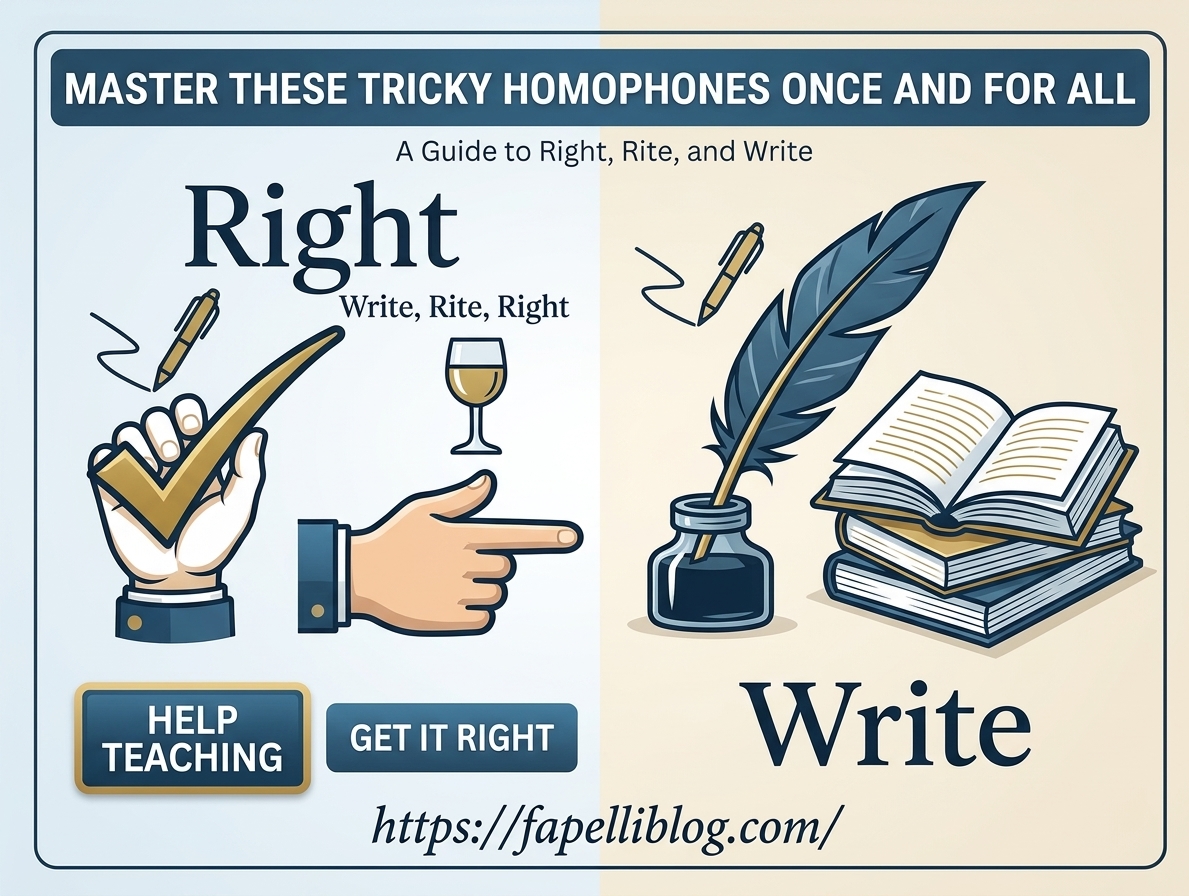
“Right” is a multi-use word indicating correctness, direction, or entitlement, while “write” is a verb specifically meaning to form letters or words on a surface. The fastest way to keep them straight is to remember that write involves a writer and a pen, while right covers everything else from directions to moral correctness.
Introduction: Why Mixing Up Right and Write Happens
Homophones are a writer’s worst nightmare. When two words sound identical, your brain relies on context rather than sound to spell them. But when you are typing quickly on a smartphone keyboard or rushing through a professional email, typos slip through the cracks.
Standard dictionary definitions tell you what each word means in isolation. They rarely explain why your brain confuses them during rapid-fire typing. Right and write share the same exact phonetic pronunciation, yet they serve completely different grammatical functions.
In this comprehensive guide, we are going to break down every single layer of these two words. You will learn their core meanings, etymological roots, real-world conversational contexts, common pitfalls, and foolproof memory hacks. By the end, you will never second-guess whether you are supposed to type right or write again.
Core Meaning, Etymology, & Technical Breakdown
To truly master a pair of confusing words, you need to understand what they are doing grammatically and where they came from. Let’s look at them individually. You May Also like To Read About Sun Or Son Simple Difference Examples
The Anatomy of “Right”
Right is a linguistic powerhouse. It can function as an adjective, an adverb, a noun, or even a verb.
- As an Adjective: Meaning correct, accurate, or morally good (“That is the right answer”). It also refers to the opposite of left (“Turn down the right street”).
- As an Adverb: Meaning immediately or precisely (“He walked right into the room”).
- As a Noun: Meaning a moral or legal entitlement (“Freedom of speech is a basic human right“).
Etymologically, right traces back to Old English riht, meaning straight, direct, or fair. It shares roots with Latin rectus (straight or correct). This connection explains why right ties into concepts of geometry, direction, and moral rectitude.
The Anatomy of “Write”
Write is much more specialized. It is almost exclusively a verb focused on the physical or digital act of creating text.
- As a Verb: Meaning to form characters on a surface, compose literary works, or code software (“I need to write a blog post today”).
The word write originates from Old English wrītan, which originally meant to score, scratch, or engrave runes into wood or stone. Ancient Germanic peoples physically carved symbols, which is why our modern spelling still retains that silent ‘w’ at the beginning.
Practical Usage & Everyday Scenarios
Let’s look at how these words show up in your daily life. You encounter them across professional emails, casual text messages, academic papers, and social media platforms.
Scenario 1: Workplace Communication and Feedback
Imagine reviewing a colleague’s project proposal.
- Correct Usage: “You are entirely right about the budget allocation, and I will write up the final revision by tonight.”
- Why it matters: Using the wrong word here changes your professional credibility. Saying “You are entirely write” instantly flags you as careless.
Scenario 2: Giving Navigation Directions
Picture yourself directing a friend to a local coffee shop over the phone.
- Correct Usage: “Take a right turn at the traffic light, and then write down the gate code I am texting you.”
- Why it matters: One word directs physical movement, while the other handles information retention.
Scenario 3: Creative Expression and Content Creation
Think about your daily workflow if you produce digital content.
- Correct Usage: “To write high-ranking articles, you need to make sure your keyword placement is right.”
- Why it matters: Combining both words correctly in a single sentence demonstrates complete mastery of English mechanics.
Real-World Conversational Contexts
How do real people use these terms in modern digital communication?
The Texting Shortcuts and Slang Factor
In fast-paced chat apps like WhatsApp, Slack, or iMessage, shortcuts rule the day. People rarely misspell right as write because right often gets shortened to “rt” or “rite” in slang (though “rite” is a different word entirely meaning a ritual).
However, autocorrect frequently wreaks havoc. If you swipe quickly on a touchscreen, your keyboard might swap write for right because they share similar finger patterns on a QWERTY layout.
Professional vs. Casual Tone
In formal business correspondence, precision is non-negotiable. Contractual agreements talk about legal rights, whereas software development contracts discuss code written by engineers. Mixing up these terms in legal or technical documentation can lead to ambiguity, miscommunication, and costly errors.
Step-by-Step Guide: How to Choose the Right Word Every Time
When you pause mid-sentence wondering which spelling to use, run through this mental checklist:
Step 1: Check for the Silent “W”
Does your word involve a pen, a keyboard, a document, an email, or putting thoughts into words?
- If yes, it requires creation. Add the silent W at the beginning: W-R-I-T-E.
Step 2: Check for Direction, Correction, or Entitlement
Does your word mean “correct,” “the opposite of left,” or a “legal freedom”?
- If yes, it requires none of that physical writing action. Spell it: R-I-G-H-T.
Step 3: Use Substitution Tests
- The “Pen” Test for Write: Can you replace the word with pen, type, or draft? If yes, use write. (Example: “I need to pen an email.”)
- The “Correct” Test for Right: Can you replace the word with correct or accurate? If yes, use right. (Example: “Your answer is correct.”)
Common Mistakes, Pitfalls, and Misunderstandings to Avoid
Pitfall 1: Relying Solely on Pronunciation
Because homophones sound identical, sounding out the sentence in your head will not help you catch the spelling error. You must rely purely on grammatical context.
Pitfall 2: The Compound Confusion (Writing vs. Righting)
Watch out for verb tense variations and derived forms:
- Writing: The continuous form of write (“She is writing a book”). Note that the ‘e’ drops when adding ‘-ing’.
- Righting: A less common term meaning to restore something to a normal upright position (“Righting a capsized boat”).
Q&A Micro-Block: Spotting the Error
Q: Why does write have a silent ‘w’ if we don’t pronounce it?
A: Because of its historical roots in Old English (wrītan), where people literally scratched or carved runes into hard surfaces. The spelling survived even though the pronunciation evolved. Recommended Reads: Sun Or Son Usage Rules Examples
Quick Summary & Comparison Table
| Feature | Right | Write |
| Primary Part of Speech | Adjective, Adverb, Noun | Verb |
| Core Definition | Correct, direction (opp. of left), or entitlement | To form words, compose text, or create content |
| Key Action | Assessing accuracy or navigating space | Inscribing characters onto a surface |
| Test Replacement | Correct, accurate, or left/direction | Type, pen, or compose |
| Example Sentence | “You guessed the right answer.” | “I love to write stories.” |
Frequently Asked Questions (FAQ)
Q: Are right and write true homophones?
A: Yes. In standard English dialects, right and write are pronounced with the exact same phonetic sound (/raɪt/).
Q: Can “right” ever be used as a verb?
A: Yes, but in a very specific context. You can “right a wrong,” which means to correct a mistake, fix an injustice, or restore something to its proper state.
Q: Why do people mix up right and write more than other homophones?
A: Because both words are extremely common in everyday vocabulary, and their physical typing patterns on keyboards are nearly identical, making them prime targets for autocomplete errors.
Final Takeaway
If you are making marks, use the pen. Whenever your sentence involves putting thoughts down on paper or screen, spell it write. For every other scenario—direction, correctness, or entitlements—default to right.
