

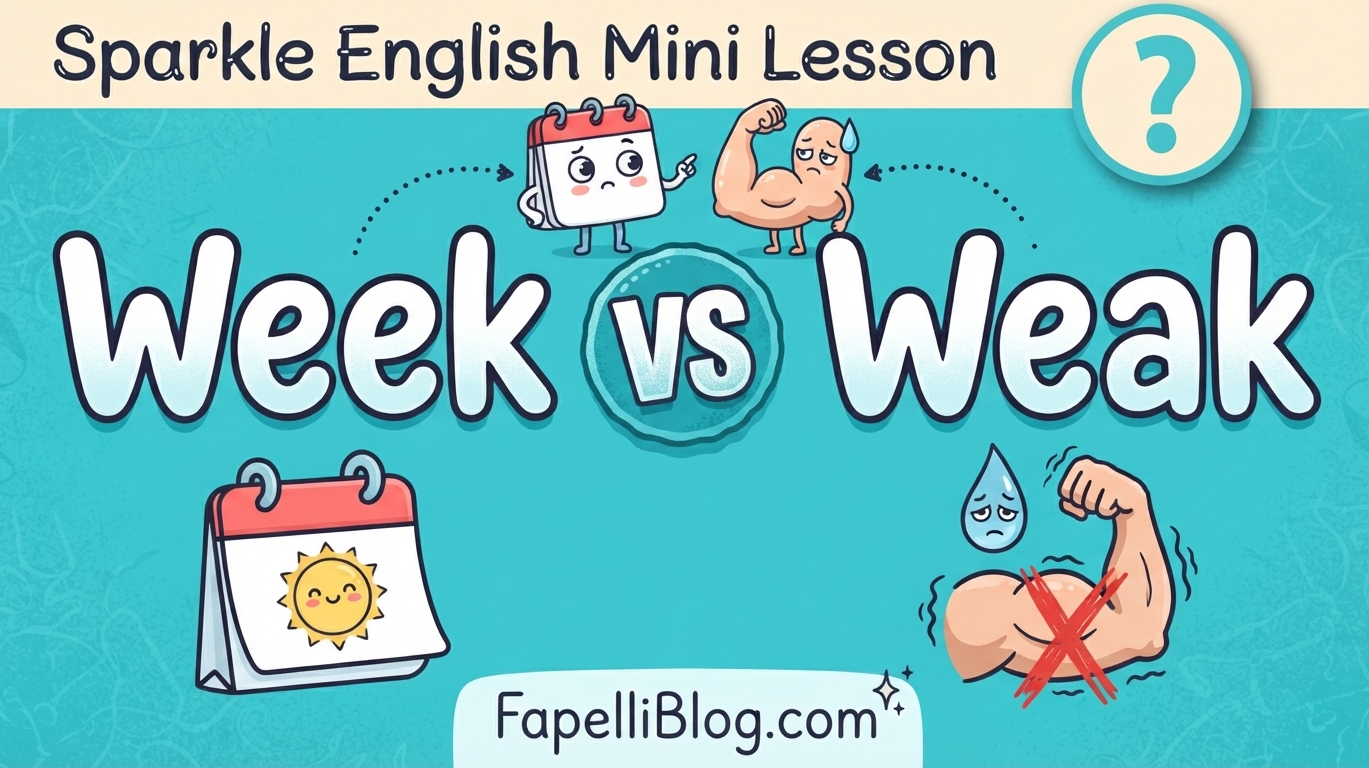
In English grammar, weak Or week are classic examples of homophones—words that share the exact same pronunciation (/wiːk/) but differ completely in spelling, origin, and meaning. While the word weak functions as an adjective describing a lack of physical strength, power, or stability, week is a time-related noun referring to a continuous seven-day period. Because both terms sound identical in spoken conversation, writers often mix them up when typing quickly; however, understanding the contextual distinction between weak vs week is essential for maintaining clear, error-free communication in everyday writing.
“Weak” describes a lack of strength, power, or durability, while “week” refers to a seven-day period. Although both words are homophones and sound identical—pronounced as /wiːk/—their spelling and functions in a sentence are completely distinct.
Why People Get Confused (And Why Literal Definitions Fall Short)
It seems straightforward enough on paper. One is an adjective, and the other is a noun. Yet, “weak” and “week” remain two of the most commonly misspelled words in written English, popping up in everyday text messages, professional emails, and casual blogs alike.
Why does this happen? The primary culprit is phonetic overlap. In modern English, the double vowel patterns “ea” and “ee” frequently produce the exact same long vowel sound. Your brain processes the sound first, and when you are typing at full speed, muscle memory picks whichever spelling comes to mind first.
Understanding the literal definition gets you halfway there, but mastering how these words function across idioms, pop culture, and daily speech is what keeps you from making an embarrassing typo. You may Also Like To Read About Other Homophones Like No Or Know ….
Core Meanings & Literal Usage
Let’s break down each word by its grammatical function and exact meaning.
1. Weak (Adjective)
“Weak” describes something or someone lacking physical strength, intensity, authority, or substance. It is the direct opposite of strong, intense, or firm.
- Physical strength: “After recovering from the flu, my legs felt remarkably weak.”
- Intensity or flavor: “This coffee is too weak; it tastes like plain warm water.”
- Arguments or structure: “The prosecution presented a weak case that failed to convince the jury.”
- Grammar context: In linguistics, a “weak verb” forms its past tense by adding -ed, -d, or -t (e.g., walk to walked).
2. Week (Noun)
“Week” refers strictly to a time measurement consisting of seven consecutive days. It usually runs from Monday through Sunday (or Sunday through Saturday depending on regional calendars).
- Calendar usage: “We are taking a vacation next week.”
- Duration: “The project will take at least three weeks to complete.”
- Work schedule: “It has been a long, exhausting work week.”
Real-World Contexts & Everyday Usage
Here is how both words operate when spoken naturally in daily life.
Quick Comparison & Entity Map
Key differences between “Weak” and “Week” at a glance
| Attribute | Weak | Week |
|---|---|---|
| Part of Speech | Adjective | Noun |
| Primary Meaning | Lacking strength, power, or stability | A continuous period of seven days |
| Opposite Word | Strong / Mighty | N/A (Time unit) |
| Phonetic (IPA) | /wiːk/ | /wiːk/ |
| Common Collocations | Weak argument, weak coffee, weak link | Weekday, weekend, biweekly, workweek |
| Quick Mnemonic |
Weak = Easy to break
|
Week = Seven days (2 e‘s)
|
Idioms, Slang, and Pop Culture Connections
Beyond standard dictionary definitions, these terms frequently appear in modern idioms, music, and pop culture phrases.
Phrases Using “Weak”
- “Weak at the knees”: Feeling overwhelmed by emotion, love, or sudden fear.
- Example: “Standing on the edge of the cliff made him feel weak at the knees.”
- “The weak link”: The least dependable member of a group or process.
- Example: “A chain is only as strong as its weakest link.”
- “Weak sauce”: Slang used to describe something unimpressive, underwhelming, or disappointing.
- Example: “Canceling the event at the last minute is total weak sauce.”
Phrases Using “Week”
- “7 Days a Week”: Continuous effort without days off. Featured prominently in popular music, including songs like 7 Weekends or modern pop tracks emphasizing daily dedication.
- “Workweek vs. Weekend”: Cultural framing separating labor (typically 5 days) from rest (2 days).
- “Biweekly / Semi-weekly”: Often confused financial or scheduling terms. Biweekly usually means every two weeks, whereas semi-weekly means twice a week.
Common Mistakes & How to Avoid Them
The most frequent error occurs during rapid writing or typing, particularly in fixed phrases.
Here are three common trip-ups:
- “Have a great week!” vs. “Have a great weak!”
- Correct: “Have a great week!” (Wishing someone a good seven days ahead).
- Incorrect: “Have a great weak!” (Literally wishing someone a good lack of strength).
- “Weak days” vs. “Weekdays”
- Correct: “I prefer traveling on weekdays when traffic is light.”
- Incorrect: “I prefer traveling on weak days…”
- Mixing up “Week-long” and “Weak-long”
- Correct: “They went on a week-long road trip.”
Recommended Reads: Sun or Son: Simple Difference, Usage Rules, and Proper Examples…
Frequently Asked Questions (Q&A)
How do you pronounce “weak” and “week”?
Both words are pronounced identically as /wiːk/ (rhyming with peek, leak, and seek). There is no difference in sound, pitch, or emphasis.
What is the simple rule to remember the difference between weak and week?
Look at the vowels inside the words:
- WEEk has two “e”s, just like a calendar week has multiple days (Every Evening).
- WEAK contains an “a”, which stands for Almost broke or Ailment.
Is “weak” an adjective or an adverb?
“Weak” is an adjective. To turn it into an adverb, you add -ly to make weakly (e.g., “He smiled weakly”).
The One Rule That Unlocks All Meanings
Whenever you are unsure which spelling to use, apply this single mental check:
If you can replace the word with “seven days,” use WEEK (with two E’s). If you can replace the word with “not strong,” use WEAK (with an A).
