

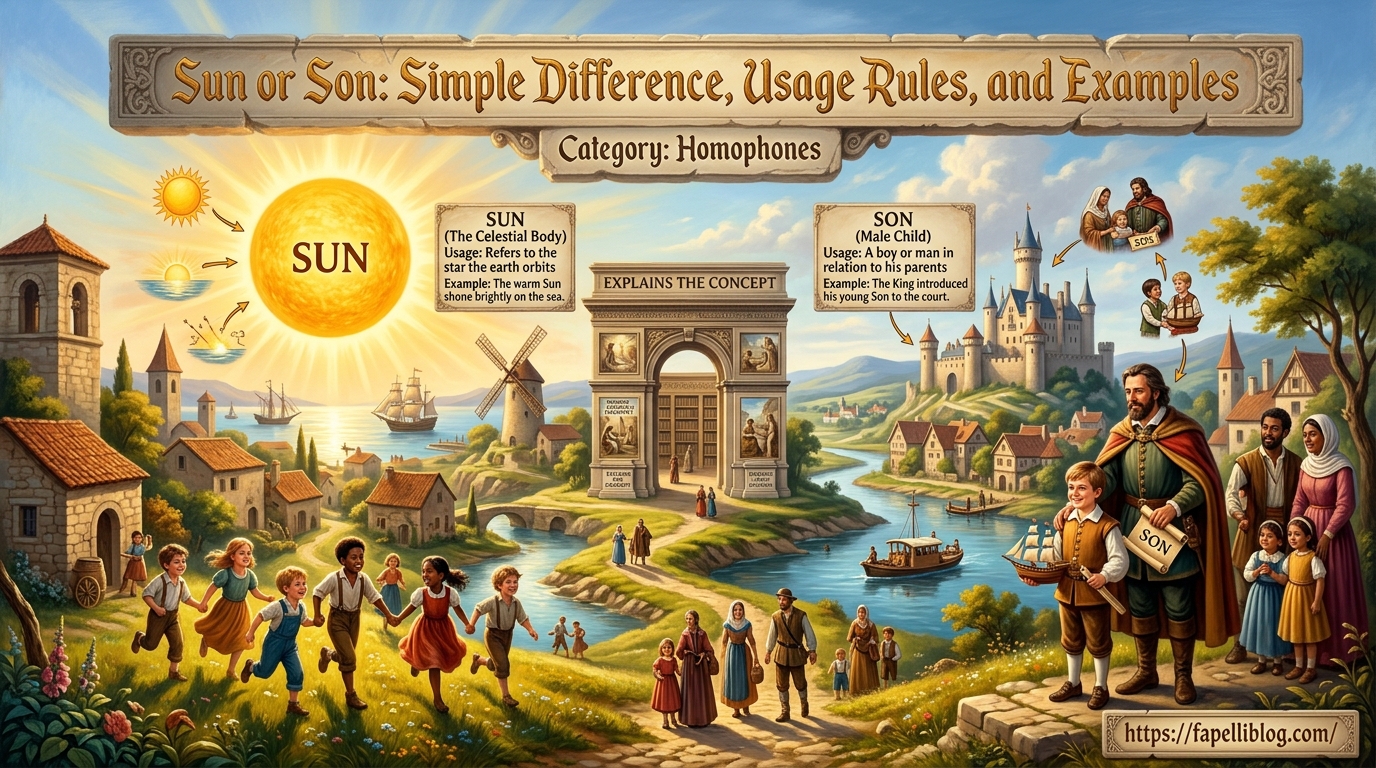
Sun or son are homophones refers to the star at the center of our solar system that provides light and heat, while son refers to a male child or offspring. Although both words are homophones pronounced identically as /sʌn/, “sun” is an astronomical noun or verb related to sunlight, whereas “son” is a familial relationship term.
Mixing up these two words is one of the most common spelling blunders in written English. Dictionaries give you strict definitions, but they often leave out the quick mental shortcuts, idiomatic slang, and everyday contexts that help you choose the right spelling instantly without second-guessing yourself.
Sun vs. Son: Quick Overview & Entity Mapping
Straightforward. No confusion there. Here is how both terms break down side-by-side across grammar, meaning, and application:
| Attribute | Sun | Son |
| Part of Speech | Noun, Verb | Noun |
| Core Definition | The star that illuminates Earth; sunlight/warmth | A male child or male descendant |
| Phonetic Spelling | /sʌn/ | /sʌn/ |
| Primary Category | Astronomy, Weather, Nature | Family, Kinship, Relationships |
| Common Modifiers | Bright, Morning, Setting, Rays, Eclipse | Eldest, Youngest, Adopted, Favorite |
| Slang / Informal Use | “Sunning” (basking), “Catching rays” | “Son” (addressing a younger male or peer) |
1. Core Meaning & Literal Usage
Understanding when to spell it with a U versus an O comes down to the subject matter: space and weather vs. family trees.
“Sun” (With a U) — Astronomy, Light, and Motion
The word sun stems from the Old English sunne. It primarily functions as a noun referring to the central star of our solar system or the light and warmth emitted by it. It can also act as a verb meaning to expose oneself to warmth or sunlight.
Sentence Examples:
- “The sun rises in the east and sets in the west.”
- “We sat on the porch to enjoy the afternoon sun.”
- “Lizards often sun themselves on warm rocks to regulate body temperature.”
“Son” (With an O) — Family, Offspring, and Lineage
The word son derives from the Old English sunu. It is strictly a noun denoting a male offspring in relation to his parents or a male descendant within a family tree.
Sentence Examples:
- “Their eldest son just graduated from law school.”
- “He treats his stepson like his own biological son.”
- “She called her son to ask what time he would be home for dinner.”
2. Real-World, Slang, and Conversational Contexts
Here’s what most people miss: both words carry informal usages that crop up constantly in casual conversation and social media.
“Son” as Casual Address & Urban Slang
In urban slang and informal spoken English—particularly across New York and East Coast Hip-Hop culture—“son” is used as a familiar term of address for a close friend or peer, similar to bro, dude, or man.
- “Yo son, you see that play last night?”
- “Hold up, son, that doesn’t make any sense.”
In sports or competitive gaming culture, saying someone got “sonned” means they were thoroughly outplayed, dominated, or treated like a subordinate by an opponent.
“Sun” in Daily Vernacular
As an informal verb, “sunning” means relaxing in direct sunlight.
- “She is sunning by the pool all afternoon.”
3. Nuances, Cultural, and Pop-Culture Connections
The homophonic pair sun/son is a favorite tool for poets, songwriters, and authors who rely on double entendres and wordplay.
Religious & Mythological Parallels
In Christian theology, literary works frequently play on the acoustic identity of the “Sun” (the physical light) and the “Son” (the Son of God / Jesus Christ). Shakespeare famously opened Richard III with a clever play on words: “Now is the winter of our discontent / Made glorious summer by this sun of York,” referring simultaneously to the heraldic sun emblem of King Edward IV and his status as a son of the Duke of York.
Pop Culture & Music
- Music: The classic song “Here Comes the Sun” by The Beatles celebrates the natural star, whereas terms like “Son of a Preacher Man” or “Carry On Wayward Son” center on family lineage.
- Geographic Titles: Nicknames like “Land of the Rising Sun“ (Japan) or “The Sunshine State” (Florida) exclusively use the “U” spelling.
4. Mistakes and Misunderstandings to Avoid
That’s not a glitch—your brain simply processes the sound /sʌn/ before analyzing the spelling. Here are the most frequent slip-ups and how to avoid them:
- Typing “Sonflower” instead of “Sunflower”: The bright yellow bloom follows the star. It always takes the “U”—Sunflower.
- Confusing “Son-in-law” with “Sun-in-law”: Family relationships via marriage always use the “O”—Son-in-law.
- Misspelling “Sundae”: The ice cream treat is spelled Sundae, which is a variation of Sunday (named after the sun), but it never uses an “O”.
- Auto-Correct Overwrites: Speech-to-text software regularly swapped “son” and “sun” depending on vocal emphasis. Always proofread dictation around family or weather descriptions.
5. Frequently Asked Questions (Q&A Block)
Why are “sun” and “son” pronounced the exact same way?
Both words are homophones. Over centuries of Linguistic shift from Middle English to Modern English, the vowels $/u/$ and $/o/$ in these specific Germanic roots merged into the short central vowel sound /ʌ/ (as in cup or bus).
Is “sun” ever capitalized?
You capitalize Sun when referring to Earth’s specific star in astronomical or scientific contexts (e.g., “The Earth orbits the Sun”). In general literature or casual writing, it remains lowercase (“The sun is shining”).
What is the female equivalent of “son”?
The female counterpart to a son is a daughter. The counterpart to the sun in celestial mythology is often the moon.
The One Rule That Unlocks All Meanings
When deciding between sun and son, use this simple substitution formula to pick the right spelling instantly:
If you can replace the word with “star” or “daylight”, use S-U-N. If you can replace it with “boy” or “child”, use S-O-N. Identify the context first, and you will never mix them up again.

1 Comment
Pingback: Weak or Week: The Quick Difference (And How Never to Mix Them Up)